






Bitcoin and Ethereum dominate global cryptocurrency conversations, although they serve very different objectives. Understanding the distinctions is critical for both novice and experienced investors. This article Bitcoin vs Ethereum delves into their roles, technology, and prospects, providing clarity in a market sometimes muddied by hype.
Bitcoin vs Ethereum: The Origins That Shaped Two Giants
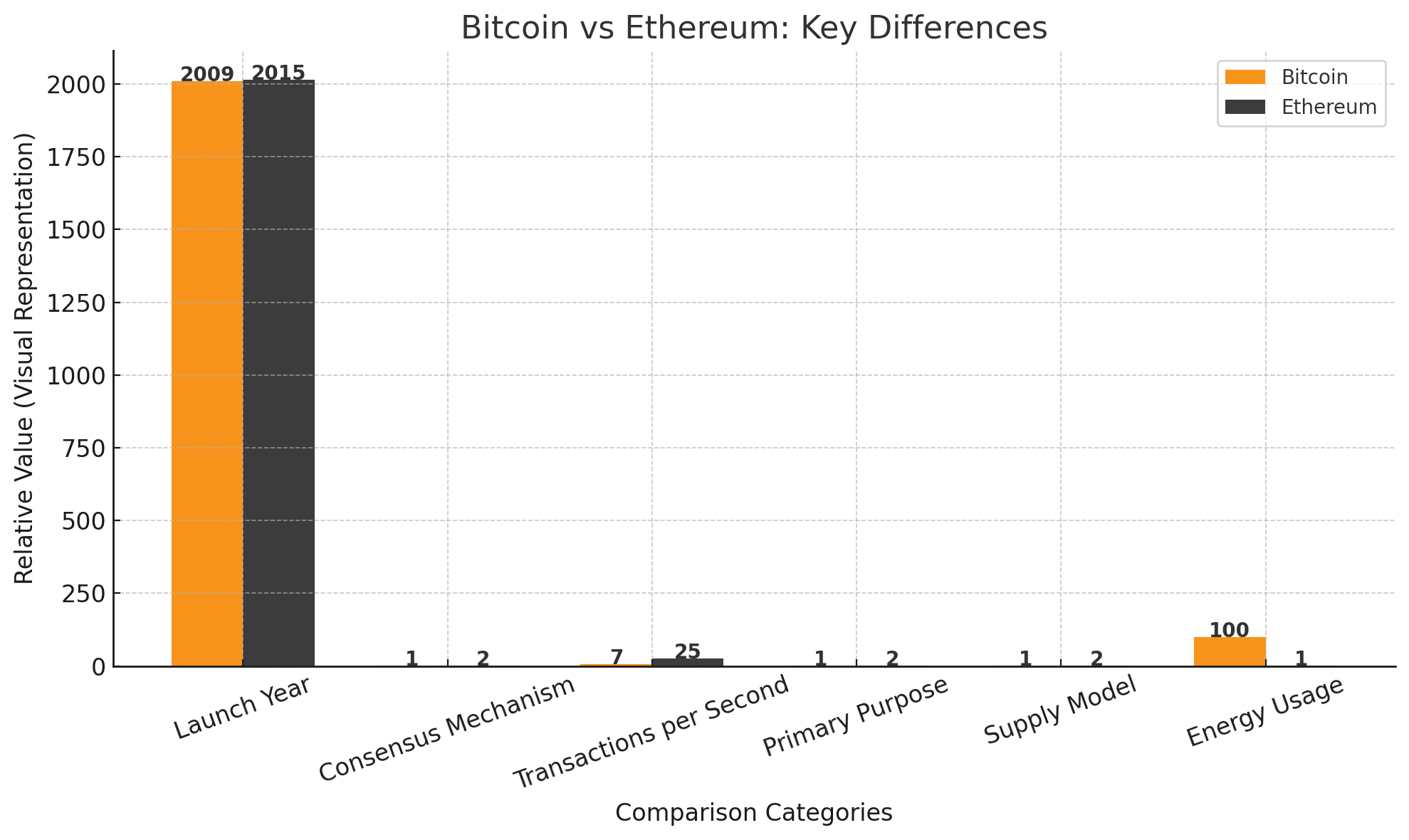
Bitcoin was founded in 2009 by an unidentified developer using the alias Satoshi Nakamoto. Its purpose was simple yet revolutionary: to build a decentralized, peer-to-peer value transfer system that did not rely on banks or governments. Bitcoin’s fixed quantity of 21 million coins gives it a hedge against inflation, and it is sometimes referred to as “digital gold.”
Ethereum, developed in 2015 by programmer Vitalik Buterin and a team of developers, broadened blockchain’s use beyond payments. It introduced smart contracts, which are self-executing agreements programmed directly into the blockchain. This breakthrough enables decentralized applications (dApps) to operate without downtime or third-party influence, distinguishing Ethereum as a programmable blockchain.
Technology: Proof of Work vs. Proof of Stake
Bitcoin uses the Proof-of-Work (PoW) consensus technique. Miners tackle complicated mathematical challenges to secure the network and validate transactions. While this technology is incredibly safe, it requires a large amount of energy, which has created a global discussion about its environmental effect.
Ethereum initially utilized PoW but switched to Proof-of-Stake (PoS) in September 2022 through “The Merge.” Under PoS, validators safeguard the network by staking ETH, lowering energy consumption by more than 99%. According to Ethereum Foundation statistics, this adjustment enhanced scalability prospects, allowing for speedier updates and potential adoption.
Purpose: Store of Value Versus Decentralized Platform
Bitcoin’s principal use case remains as a store of wealth and means of trade. It provides security, predictability, and resistance to censorship. Institutional investors, including publicly listed firms and hedge funds, are increasingly storing Bitcoin in their treasuries as a long-term asset.
However, Ethereum serves as the foundation for decentralized finance (DeFi), NFTs, and gaming ecosystems. Its blockchain supports dozens of initiatives, including loan systems and digital art exchanges. DappRadar data shows that Ethereum remains the leader in total value locked (TVL) across DeFi platforms, despite competition from other networks.
Transactional Speed and Scalability
Bitcoin handles around 7 transactions per second (TPS), with average block timings of 10 minutes. While this improves network reliability, it reduces throughput. Layer 2 alternatives, like as the Lightning Network, seek to alleviate these limits by enabling immediate, low-cost transactions.
Ethereum processes around 15-30 TPS in its present state. However, its scalability plan includes sharding, a way of dividing the network into smaller chains that might increase TPS into the thousands. Layer 2 rollups such as Optimism and Arbitrum have already improved speed while protecting Ethereum’s security.
Economic Models and Supplies
Bitcoin’s supply is limited, with halving occurring every four years, cutting block rewards by 50%. This scarcity model has traditionally spurred long-term price appreciation, with previous cycles resulting in large rallies following each halving.
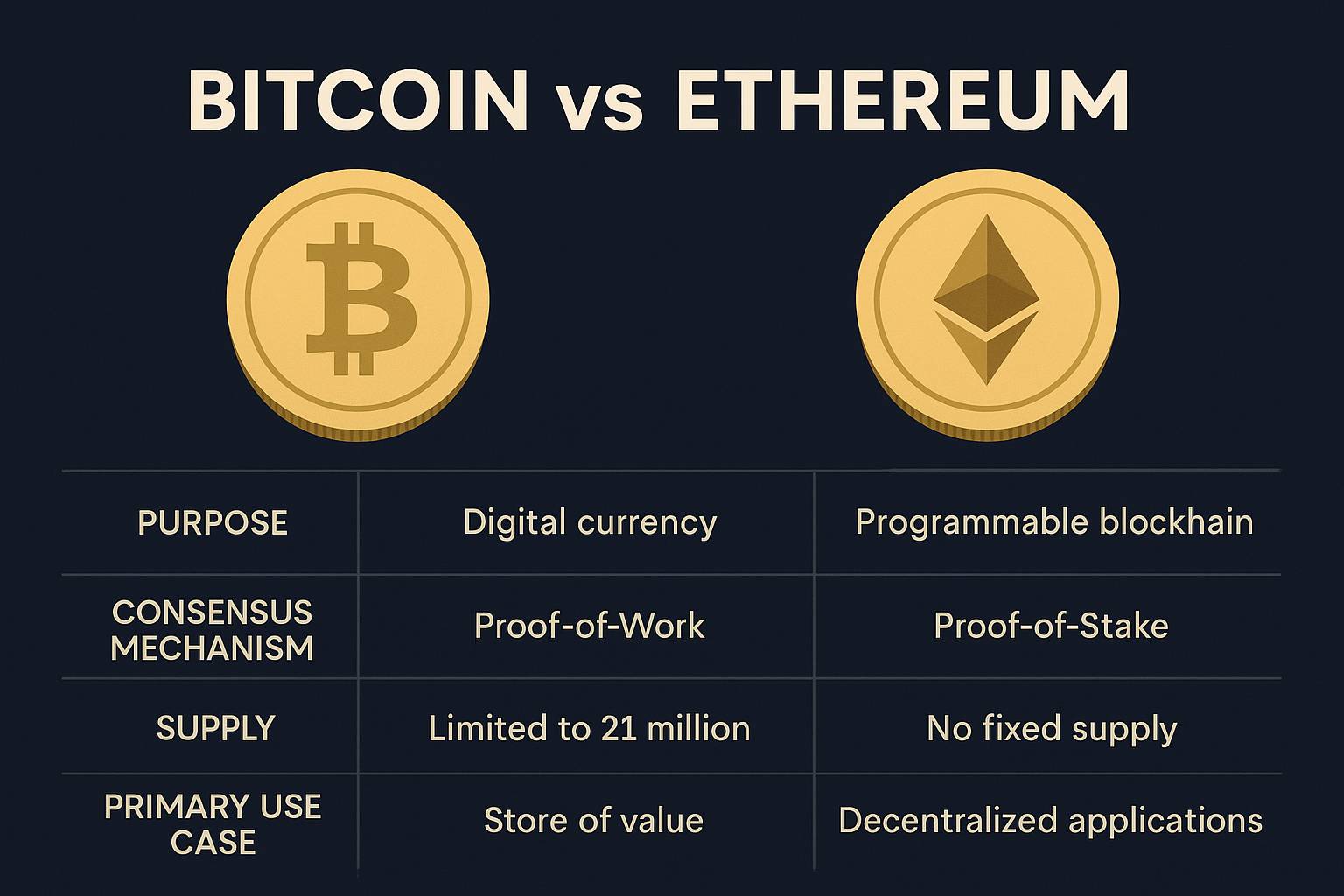
Ethereum has no fixed supply, but with the implementation of EIP-1559 in 2021, a portion of each transaction fee has been burnt, gradually lowering $ETH’s circulating amount. During instances of strong network utilization, Ethereum can become deflationary, increasing scarcity without a fixed limit.
Regulatory and Market Risks
Bitcoin vs Ethereum, both assets are under regulatory review. Governments are developing regulations for cryptocurrency taxes, anti-money laundering enforcement, and consumer protection. Analysts warn that adverse rules may affect liquidity and adoption. Investors must also account for volatility, as both Bitcoin and Ethereum have suffered price changes of more than 50% in recent months.
Long-term investment potential
Bitcoin appeals to individuals looking for stability, scarcity, and protection against fiat money dangers. Many investors consider it a “buy and hold” asset, anticipating long-term growth. Ethereum, while more volatile, provides exposure to a larger innovation ecosystem, ranging from banking to gaming, making it appealing to investors who believe in blockchain’s expanding value.
Analysts’ social media discussions indicate a growing interest in Ethereum’s burgeoning ecosystem, although Bitcoin remains the dominant asset in institutional portfolios. The decision is frequently influenced by an investor’s risk tolerance and trust in either monetary stability or the revolutionary potential of blockchain.
Conclusion
In the Bitcoin vs Ethereum argument, there is no clear “winner.” Bitcoin stands out as a safe, scarce, and universally recognized store of wealth. Ethereum flourishes as a hotbed of innovation, paving the way for the future of the decentralized internet. For many, a balanced portfolio that includes both assets offers the best of both worlds.
Disclaimer: This article is for informational purposes only and does not constitute financial advice. Readers should conduct independent research before making investment decisions.
Glossary of Key Terms
Blockchain: A decentralized digital ledger storing transaction data in linked blocks.
Smart Contract: A self-executing digital agreement coded on a blockchain.
Proof-of-Work (PoW): A consensus method requiring computational work to validate transactions.
Proof-of-Stake (PoS): A consensus method where validators secure the network by staking tokens.
DeFi (Decentralized Finance): Financial services built on blockchain without traditional intermediaries.
NFT (Non-Fungible Token): A unique digital asset representing ownership of items or content.
Halving: An event that reduces Bitcoin’s mining rewards by half, impacting supply.
Frequently Asked Questions
1. Which is better for long-term investment, Bitcoin vs Ethereum?
Both have potential, but Bitcoin offers scarcity and stability, while Ethereum offers innovation and growth.
2. Can Ethereum overtake Bitcoin in market value?
It’s possible if Ethereum’s ecosystem adoption outpaces Bitcoin’s demand as a store of value.
3. Is Bitcoin more secure than Ethereum?
Both are secure, but Bitcoin’s simpler structure and longer history offer proven resilience.
4. Will Ethereum’s shift to PoS impact its price?
The shift reduced energy use and may boost adoption, but market prices depend on broader demand.
5. Are both assets equally volatile?
Ethereum tends to be more volatile due to its broader use cases and market speculation.
Sources/References