





Last updated on: 16th July, 2026.
This article was first published on The Bit Journal.
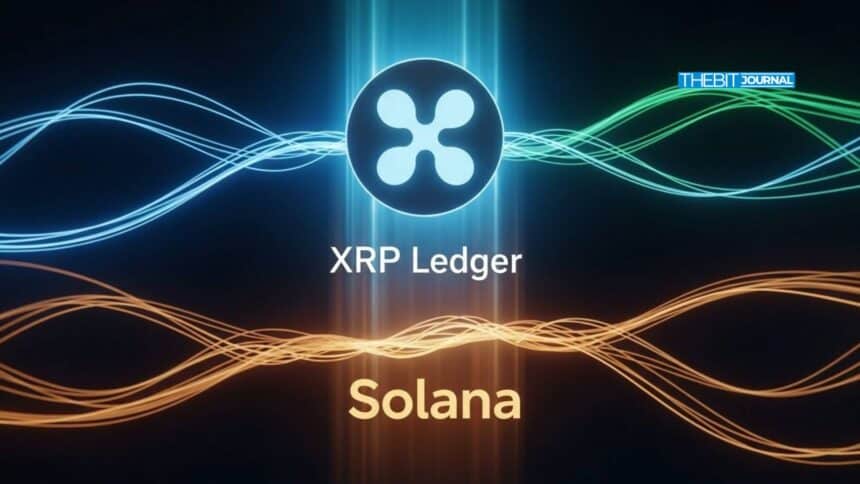
XRP Ledger (XRPL) has surpassed Solana on an important parameter in terms of tokenized assets. According to RWA.xyz data, the combined RWA tokenization value of XRPL on-chain is now sitting at just over $1.756 billion without counting stablecoins; a slightly higher figure than Solana’s $1.682 billion.

This hasn’t been driven solely by retail trading gush or decentralized exchange hype, but rather by more organized, tokenized blocks that point towards developing institutional use cases.
Concentrated Growth on XRPL
XRPL represented asset value over the past 30 days increased by about 276.75%, much faster than Solana, Ethereum, and Polygon. Over the same time, Solana’s distributed real-world asset value rose approximately 43.34%, compared with gains of 16.58% for Ethereum and 22.48% for Polygon.
Just weeks earlier, XRPL ranked behind several established tokenization networks including Ethereum and Polygon in represented asset value. By the end of January 2026, the ledger had already climbed into the top four globally before overtaking Solana less than two weeks later.
Institutional tokenization projects tend to move slowly. Fund launches, custody approvals and regulatory reviews often take months before assets appear on-chain. XRPL’s rise therefore likely shows decisions and integrations that had been developing quietly throughout 2025.
The difference lies in how these assets are held. On XRPL, the majority of tokenized value comes in represented assets, holdings stored on-chain but not able to be transferred freely off the chain by participants other than a predefined set.
This model is based on the traditional financial records where asset ownership and movement are heavily governed, and certainly not open-ended or permissionless.
That pattern is part of why XRPL can display high tokenized value yet maintain low on-chain activity for crypto traders. Solana’s RWAs, on the other hand, are mostly in distributed assets, that is, tokens that can easily move between addresses; and have more visibility in secondary markets.
XRPL’s Institutional Sequence
One of the attractions for institutions is XRPL’s architecture, which enables control over access and compliance features. On XRPL, solutions like Permissioned Domains provide issuers with the ability to gate participation through credentialed systems and fits how regulated entities are comfortable operating.
Other features such as MPTokensV1 also assist with the token issuance that traditional markets require including metadata and restrictions.
This is in stark contrast to the open-access models favored by several decentralized finance (DeFi) networks on other chains. Instead of onboarding thousands of small holders, XRPL’s current RWA tokenization has featured a few large high-value issuances in controlled conditions.
According to RWA.xyz, XRPL currently has just 23 real-world asset holders and the 30-day transfer volume is about $129.23 million, an increase of 15%. With approximately $1.756 billion represented across just 23 holders, the average exposure per holder works out to more than $76 million.
| Metric | XRPL | Solana |
| Tokenized RWA Value | $1.756B | $1.682B |
| Holders | 23 | 285,336 |
| Average Value Per Holder | $76.3M | $5,893 |
| 30-Day Transfer Volume | $129M | $2.21B |
The calculation reveals two entirely different models of adoption. XRPL currently resembles a private market settlement dominated by large institutions and issuers. Solana resembles a public market distribution network with more participation and higher asset velocity.
Academic research published in 2026 has warned against relying exclusively on headline tokenization values because concentration and liquidity risks can remain hidden beneath large asset balances.
This is the type of structure institutions often use when they first bring assets on-chain; that is, they record and reconcile value with tight controls and then extend distribution once operations and compliance systems prove reliable.
Solana’s RWA Tokenization Position Still Strong
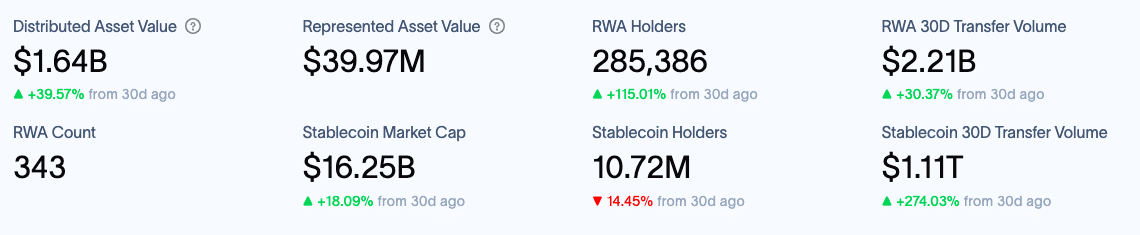
Solana is still front running when it comes to tokenized real-world assets, and its approach is very different from XRPL’s. Recent figures indicate that Solana’s RWA distributed asset value totals approximately $1.64 billion, while there are approximately 285,336 holders and its 30-day transfer volume is about $2.21 billion.
These numbers demonstrate a larger distribution of assets, and exponentially more on the move.
Solana’s ecosystem was also reported to have surpassed $1 billion in total value locked (TVL), motivated by institutional issuances such as tokenized U.S. Treasuries and other traditional finance instruments. This has been consistently growing during the past year and there has been a lot of interest from issuers and holders.
In another way of describing the situation, Solana is experiencing deep, high-throughput participation, and XRPL’s surge shows large concentrated holdings rather than mass token movement.
Notable Institutional Activity on XRPL
A notable event occurred on Feb. 11, 2026, when Aviva Investors, a major regulated asset manager, announced a partnership with Ripple to tokenize traditional fund structures on XRPL.
Aviva Investors is not a crypto-native asset manager experimenting with blockchain infrastructure. The firm manages approximately £261 billion in assets while parent company Aviva oversees more than £450 billion in group assets globally, placing it among Europe’s largest financial institutions.
The partnership is a sign that more traditional finance firms may be willing to experiment with tokenization of regulated products on a public ledger, complete with baked in compliance tooling.
This follows the $280 million diamond tokenization project in the United Arab Emirates, which was implemented through a partnership between Ctrl Alt, a Ripple-backed custody tech provider, and Billiton Diamond.
Those issuances go straight to the represented value on XRPL adding to the total that is now higher than Solana’s volume.
Ripple’s Vice President of Trading and Markets, Nigel Khakoo echoed the sentiments from issuers when he stated:
“With [XRPL] built-in compliance tools, near-instant settlement, and native liquidity, the [blockchain] provides the secure and scalable infrastructure required to support the next generation of institutional assets.”
Beyond the Headline: What Happens Now
The immediate takeaway from the new RWA data shows that XRPL has pulled ahead of Solana slightly when it comes to in raw tokenized value.
Solana still has a higher degree of participation and activity, while XRPL’s represented value is heavily concentrated to a small number of large issuances.
In the meantime, a good question for RWA and XRPL generally is whether they can actually generate active markets from these value ledgers.
This would need volume growth, more interest and trading environments beyond locked holdings. Permissioned marketplaces and institutional trading layers like permissioned DEXs on XRPL would have to mature as venues where these tokenized assets actually trade, not just exist as recorded value.
If that does indeed happen, XRPL’s rise could lead to the birth of a hybrid institutional path for on-chain finance, launching with strict controls and then slowly progressing into more conventional trading constructs.
If it doesn’t, the “flip” in tokenization value may come to seem like a small and fleeting change of focus rather than a genuine shift.
If nothing else, it becomes clear that RWA tokenization at least for such high-value instruments as funds, commodities or bonds, is no longer just a mere experiment.
The fact that XRPL and Solana are neck and neck on this metric emphasizes the tremendous increase in institutional appetite towards blockchain asset infrastructure seen over the last several months.
Three Possible Futures For RWA Tokenization
| Scenario | Likely Winner | Why |
| Institutions continue favouring closed ecosystems | XRPL | Compliance and transfer restrictions become advantages |
| Regulators permit broader secondary trading | Solana | Existing liquidity and holder base become valuable |
| Hybrid models emerge | Both | Issuance occurs on permissioned rails while trading moves to open markets |
Conclusion
This February, XRPL’s move over Solana in value of RWA tokenization assets is an important marker for the changing blockchain sector.
Fueled by large represented holdings and supported by real partnerships with mainstream finance giants, XRPL’s standing shows a different type of adoption than chains that stake their pitch on retail or active trading use cases.
Solana still excels in distributed asset participation, but XRPL’s growth is an example that there are multiple avenues for tokenization to creep into crypto.
Glossary
Represented assets: Tokens held on-chain that are not freely transferable outside of a limited set of participants, common in institutional or compliance-focused tokenization.
Distributed assets: Tokens that are transferable between addresses and that can be traded in both retail and secondary markets.
RWA (Real-World Assets): Traditional financial assets like funds, bonds, commodities and private credit, that are represented on a blockchain.
Tokenization: A digital representation of real-world financial assets on a blockchain.
Permissioned Domains: An XRPL-specific option for issuers to limit participation to known parties.
Frequently Asked Questions About XRPL RWA Tokenization
What does XRPL surpassing Solana in RWA tokenization value mean?
That would mean that the total value of tokenized real-world assets on the XRP Ledger not to count stablecoins, now exceeds those on Solana’s network, according to RWA.xyz data.
Are these assets widely traded?
Not necessarily. On XRPL, the majority of value is in represented assets which are held in controlled structures, not freely traded peer-to-peer. By contrast, Solana has much more decentralized activity and transfer volume.
Who’s using XRPL for tokenization?
Recent institutional partners have been Aviva Investors and projects such as a $280 million diamond tokenized using Ripple-backed Custody technology.
Does this mean that XRPL is better than Solana?
Not better, but it’s a different pattern of adoption. Compared to Solana investing in an array of distributed assets, XRPL is the strong choice for controlled, compliance-based tokenization.
References