
This article was first published on The Bit Journal.
Polkadot has just rolled out one of its most important upgrades yet, the highly anticipated smart contracts hub. The upgrade includes native support for smart contracts and improved Dapp performance, with the objective being to drive Polkadot nearer to widespread Web3 functionality.
However ,even with such development progress, the native DOT token has barely budged in price, suggesting that market sentiment is yet to catch up with technical achievements.
Polkadot Smart Contracts Hub Now Live
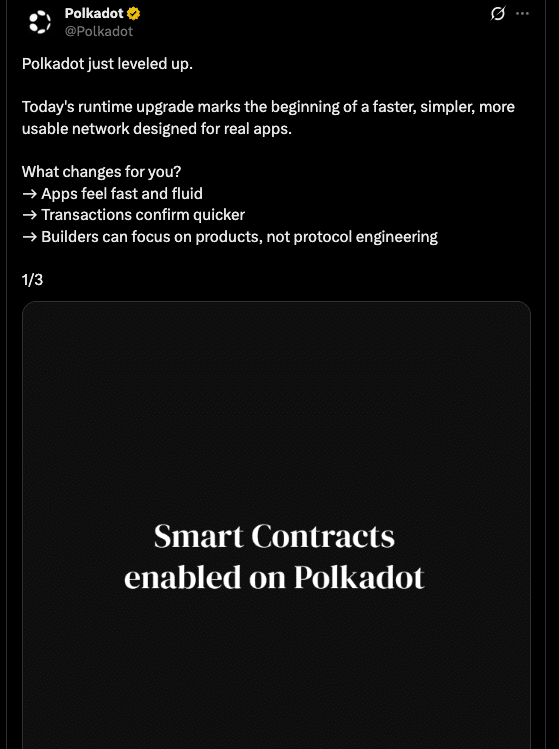
Polkadot’s development team rolled out a major upgrade that activates native smart contract capabilities on the main network.
Previously, smart contracts could only be deployed on another parachain or test system, which led to additional complexity. What this means is, instead of having to navigate through multiple developer portals and platforms, developers can work natively on the Polkadot Hub by deploying Ethereum-compatible as well as native PVM contracts.
The update also offers faster application functionality and transaction confirmation, which brings the Web3 user experience closer to that of Web2 platforms.
The Polkadot project said this will allow developers to concentrate more on creating useful products rather than wrestling with low-level protocol specifics. This, according to the network, “moves Polkadot up” for use cases in real world and wider adoption.
Tokenomics Change: Fixed Supply And Reduced Inflation
Along with the smart contracts rollout, Polkadot’s governance community has moved Polkadot’s tokenomics towards a more predictable model.
The Polkadot DAO approved Referendum 1710 in late 2025, establishing a hard cap of 2.1 billion DOT tokens. This is different from the network’s former inflationary plan which would have created around 120 million new DOT annually, with no maximum supply.
The new system will decrease the issuance rate by 15% every two years from March 2026, similar to scarcity models used within other large networks.
Under the revised schedule, DOT supply is expected to come to about 1.91 billion by 2040, well below of the 3.4 billion under the old model. This supply limit is intended to decrease inflation over the long term, and provide clearer expectations for holders and markets.
Trader Reaction: Price Action Continues To Be Bland
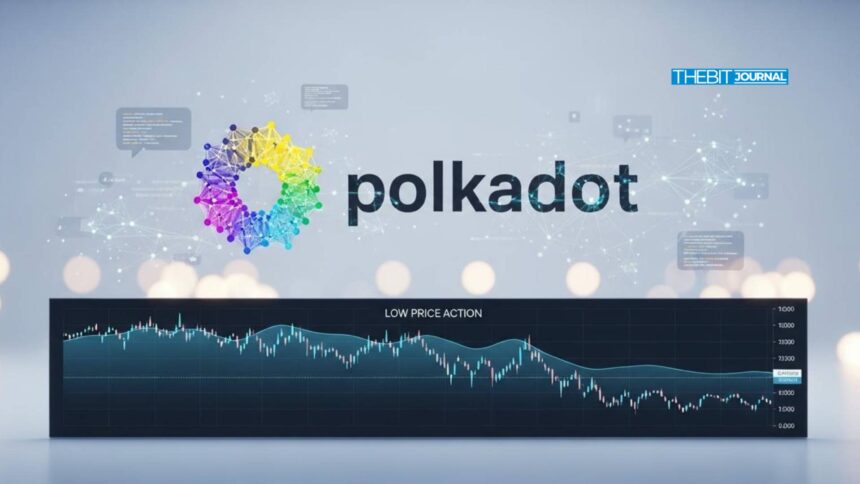
Despite the network being upgraded and having its tokenomics reworked, the DOT market price has not moved much.
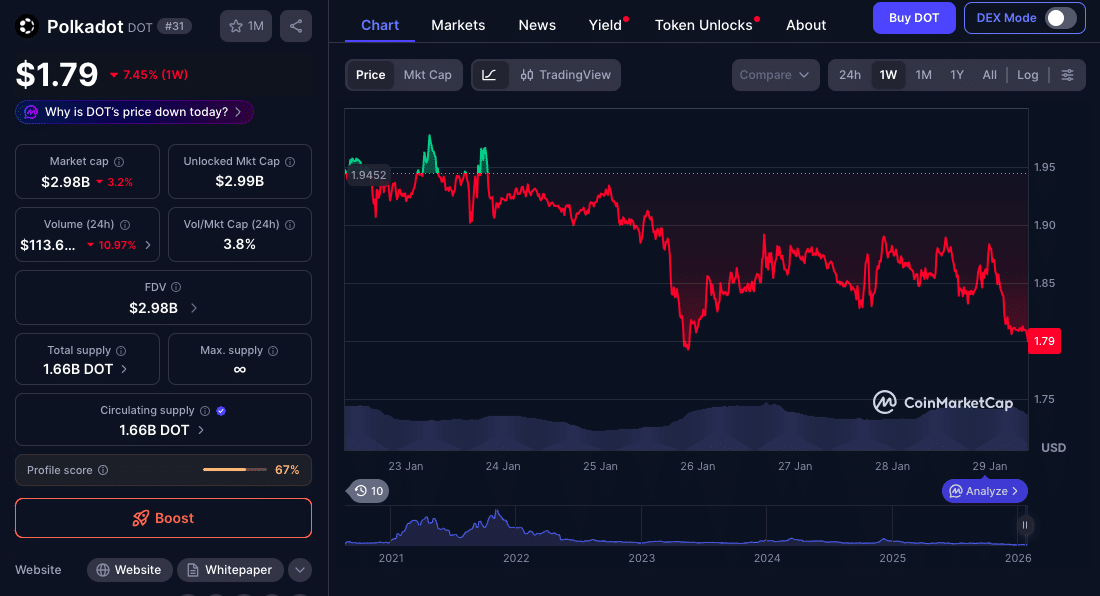
At the time of writing, DOT is ranging at $1.79 level, down by 7.45% in the last 7 days. Price action has been choppy and a sustained move higher never really happened even after small spikes toward local resistance levels.
Market signals show this lack of conviction. The 14-day RSI is hovering just below the midrange of 50.0, indicating there isn’t much buying or selling pressure in the stock right now.
Cash-flow metrics like the Chaikin Money Flow (CMF) are dipping modestly but without enough sell-side presence to invite aggressive bullishness.
Overall open interest in derivatives markets has remained flat rather than rising, meaning traders are holding their positions and not leveraging up anew.
Funding rates have remained slightly negative, and when funding is in negative territory, it means shorts are marginally benefiting from longs, giving more credence to a cautious trading position.
Ecosystem Implications and Developer Momentum
Price action has been less than impressive, however, the Polkadot ecosystem is really starting to heat up. Allowing native smart contracts enables developers to launch a variety of decentralized applications without relying on third-party parachains or workarounds.
That brings Polkadot closer to par with other smart contract platforms, which have much more mature developer tooling and dApp ecosystems.
Support for Ethereum Virtual Machine (EVM) tooling means those acquainted with well-loved frameworks like Hardhat and Foundry can build on Polkadot with limited resistance.
Assets and contracts can now interface more seamlessly with the network’s common security layer, enabling greater composability across the Web3 stack.
The upgrade also includes enhancements to transaction finality and block performance that are expected to improve user experience on decentralized applications. The aim is to make Polkadot’s interface feel “faster, simpler and more usable” for real apps but while also being decentralized.
Conclusion
Polkadot smart contracts hub rollout introduces faster development, lower friction for developers, and clearer monetary policy by having a hard-capped supply of 2.1 billion DOT.
In spite of these advancements, the post-market reaction has been lackluster, with DOT’s price action remaining flat as traders look out for clearer, longer-standing signs of adoption.
Though the upgrade provides a stronger base for dApps and overall ecosystem expansion, it has not yet resulted in obvious price conviction among market participants.
As developers begin to ship real products and liquidity deepens, Polkadot’s foundational changes may eventually be seen in market confidence.
Glossary
Smart Contracts Hub: refers to Polkadot’s native framework for running decentralized applications directly on the main network, enabling both Solidity (EVM) and native contract execution environments.
Runtime Upgrade: A software upgrade at the protocol level, which brings a new set of features without impacting consensus/network, such as the introduction of smart contract support.
Tokenomics: refers to the way a cryptocurrency is created, supply and liquidity parameters are managed, and how those influence demand and price.
Open Interest: in derivatives is an indication of how much money is behind a certain contract.
Frequently Asked Questions About Polkadot Smart Contracts
What does the Polkadot smart contracts hub mean for developers?
It means developers will now be able to develop decentralized apps on Polkadot that don’t depend on external parachains, making the development process more straightforward and quicker.
Why has the DOT price not moved following the upgrade?
Market actors are looking for continued momentum and hands-on adoptions before deploying capital.
What does a cap of 2.1 billion DOT mean?
It transitions Polkadot’s economy to a more predictable and scarcity-oriented model, which may lower long term inflation rate and align stakeholders toward similar interests and ecosystem growth.
Does smart contract support change Polkadot’s competitive position?
Yes. Polkadot’s native support for smart contracts helps it to be more attractive to dApps and the developers that build them, making it increasingly competitive with other smart contract platforms.
How does this impact the hear experience?
Due to performance improvements, users can expect faster confirmations and smoother interactions with decentralized apps created on Polkadot.
References
AMBCrypto
MEXC
Reddit
Coinmarketcal