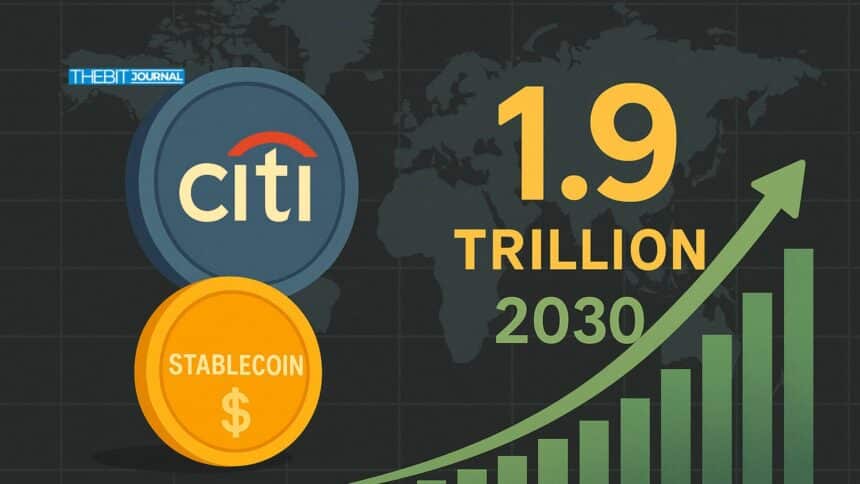

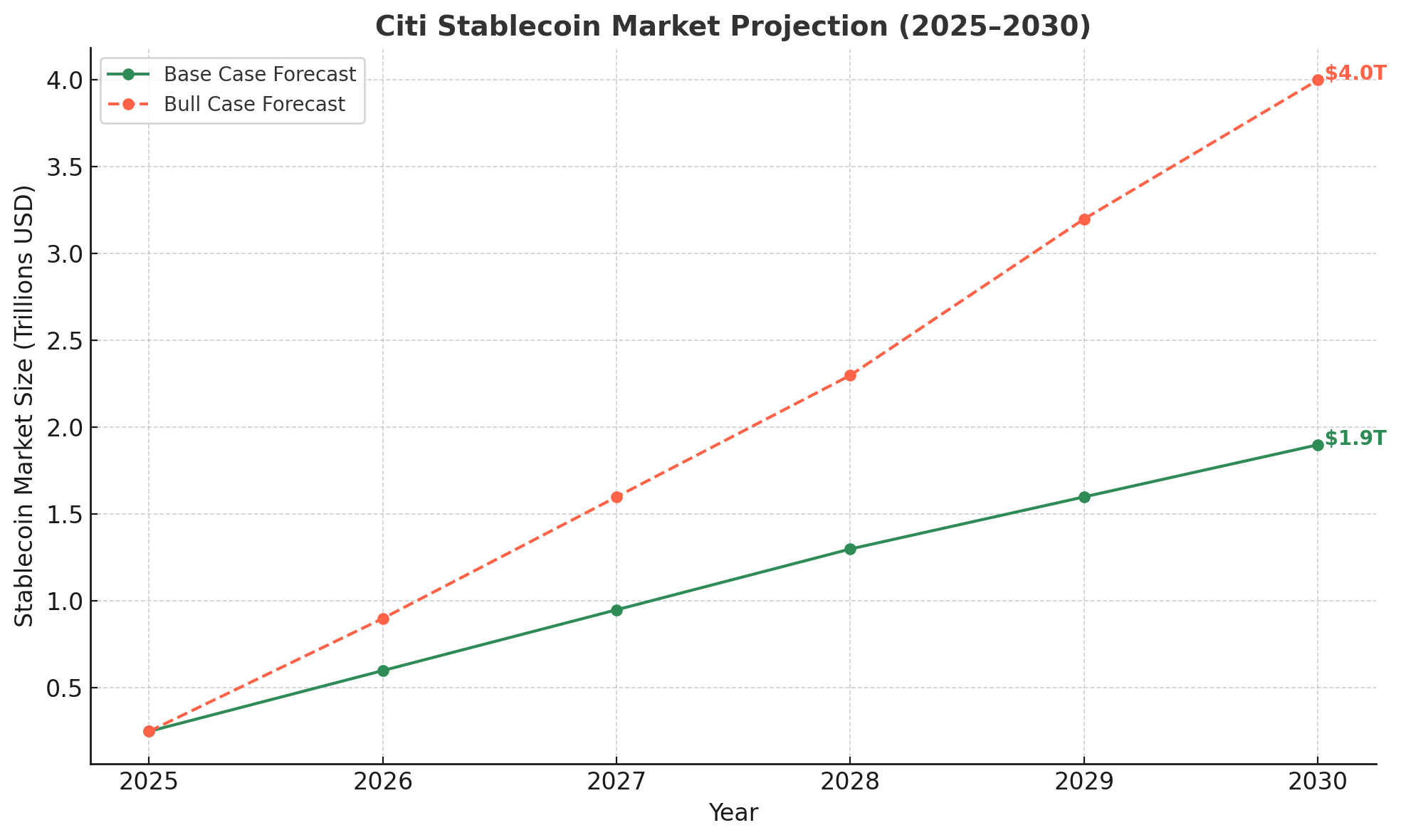
When a major bank talks crypto, markets listen. This week, the Citi stablecoin outlook shook the digital finance world after the institution revised its forecast to $1.9 trillion in circulation by 2030.
In a bullish case, it went even further, predicting issuance could touch $4 trillion. That figure is more than the combined GDP of several mid-sized nations, and it raises questions about how fast tokenized finance will evolve.
The report wasn’t just about big numbers. Citi argued that stablecoins could facilitate up to $200 trillion in annual transactions by the end of the decade if they achieve velocity on par with fiat.
For now, however, the reality is more cautious. Adoption across institutions still sits at what one executive called “a half-point on a scale of ten,” underlining the gap between vision and practice.
Growth Drivers Behind the Citi Stablecoin Outlook
Citi analysts pointed to regulatory momentum as a key tailwind. Laws like the GENIUS Act in the U.S. and the European MiCA framework have laid foundations for clearer oversight. This structure, according to the bank, gives stablecoin issuers the guardrails needed to build scale.
Stephen Cunningham, head of digital assets strategy, noted, “Issuance has already grown more than 40% this year alone, and we’re only scratching the surface of what demand could look like”.
That rapid growth, paired with rising use cases in payments and DeFi, adds weight to the new Citi stablecoin target.
The Institutional Gap and Reality Check
Despite bold numbers, the path isn’t simple. Institutional adoption remains in its infancy. A senior Visa executive recently admitted that stablecoin maturity among big players is “closer to zero than one.”
That candid assessment shows just how early the market is, even as capital continues to flow in.
The Citi stablecoin forecast also highlighted competition from deposit tokens, or “bank tokens,” which some regulators may favor due to trust and compliance factors. If these gain traction faster than independent stablecoins, they could split liquidity and slow down growth.
Wider Market Reactions
The $1.9 trillion call sparked debate across trading desks and social platforms. One analyst wrote on X, “Citi’s base case looks ambitious, but the $4T bull case borders on fantasy unless institutions jump in with both feet”.
Others argue that forecasts like these are a sign of confidence, not hype, showing that mainstream finance now treats stablecoins as a lasting pillar of the digital economy.
Contrast that with earlier warnings from rival banks, which trimmed their own stablecoin outlooks by nearly half, citing uncertainty in regulation and adoption. The differing views reflect just how polarized predictions are in a market where real-world usage is still building.
What This Means for Traders and Builders
For traders, the Citi stablecoin forecast is both exciting and sobering. Exciting because it signals massive potential growth, with liquidity and transaction velocity unlike anything seen in crypto today. Sobering because it reminds the market that speculation is no substitute for adoption.
Builders in the ecosystem will likely seize on the forecast to attract capital. But investors should temper expectations with reality: the leap from $250 billion in issuance today to trillions tomorrow requires not just optimism, but scalable infrastructure, regulatory alignment, and user trust.
Conclusion
The Citi stablecoin projection has injected fresh energy into the digital asset debate. Whether $1.9 trillion is achievable or not, the forecast forces a closer look at where the market is headed.
Adoption hurdles remain, but momentum is undeniable. If stablecoins become the rails for everyday payments, cross-border transactions, and decentralized finance, then Citi’s numbers may not sound so far-fetched after all.
For now, the takeaway is clear: stablecoins have moved from the fringes to the center of financial discussions. And if forecasts are even halfway correct, they are here to stay.
Frequently asked questions about Citi stablecoin
Q1: What is Citi’s stablecoin forecast for 2030?
Citi predicts $1.9 trillion in stablecoins by 2030, with a bullish scenario of $4 trillion.
Q2: Why does Citi believe stablecoins will grow so much?
Regulatory clarity, growing adoption in payments, and use in DeFi are key drivers of growth.
Q3: What challenges face stablecoin adoption?
Institutional hesitation, regulatory competition with deposit tokens, and trust in reserves remain major hurdles.
Q4: How does this affect crypto traders?
It signals more liquidity and potential mainstream adoption, but also warns that growth depends on real utility, not hype.
Glossary
Stablecoin: A digital asset pegged to a stable reserve like USD or treasuries.
Tokenization: Converting real-world assets into blockchain-based digital tokens.
DeFi: Decentralized finance platforms offering financial services without intermediaries.
Deposit Token: Bank-issued digital currency backed by deposits.
Liquidity: Ease of trading an asset without moving its price.
Regulatory Clarity: Legal frameworks that define how assets can be issued and traded.