

Most headlines about artificial intelligence and cryptography focus on what AI might do one day. This time, it has already done something that security researchers have spent years trying to achieve.
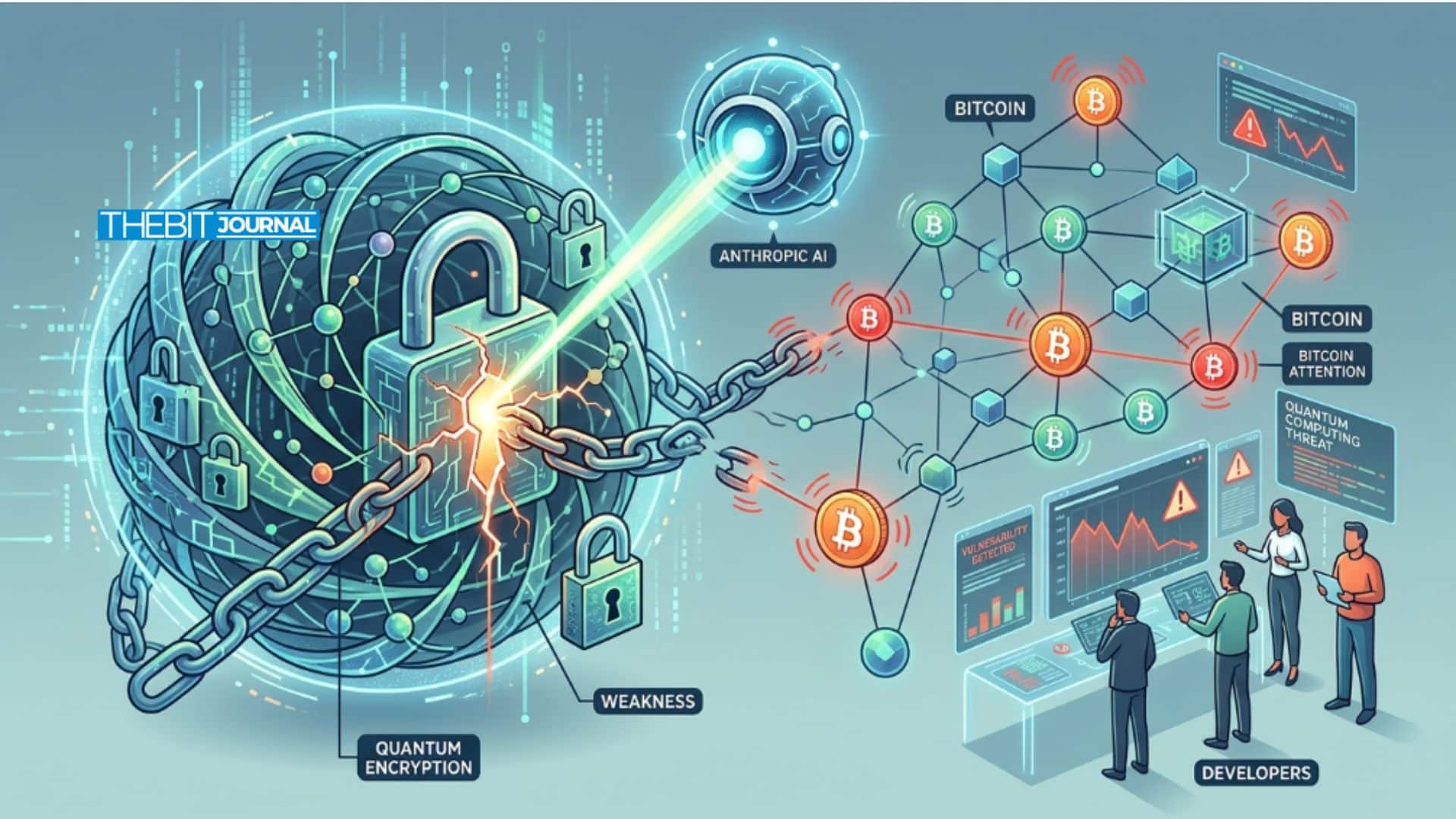
Anthropic says its Claude Mythos Preview model discovered a new mathematical weakness in HAWK, a post-quantum digital signature scheme that had already survived two years of expert review.
The research took about 60 hours and around $100,000 in computing costs. While the quantum encryption flaw discovery does not affect Bitcoin, Ethereum, or the encryption protecting today’s internet, it reveals how AI is becoming a powerful new tool for testing the security of tomorrow’s digital infrastructure.
AI is helping researchers find weaknesses before these algorithms are widely deployed. That is exactly what the post-quantum review process is designed to do, and it could make future cryptographic standards more secure.
The Discovery Was About Tomorrow’s Encryption, Not Today’s
To understand why this quantum encryption flaw discovery matters, it helps to know what HAWK actually is.
Every time someone sends cryptocurrency, signs into online banking, or opens a secure website, cryptography proves that the request really came from the correct person. Those mathematical systems are known as digital signatures.
The signatures used today work well against ordinary computers. The concern is that sufficiently powerful quantum computers could eventually solve the mathematical problems that protect many of today’s encryption methods.
That is why researchers have spent years developing new “post-quantum” algorithms that are designed to resist future quantum attacks.
HAWK is one of the digital signature schemes currently being evaluated through the U.S. National Institute of Standards and Technology’s post-quantum cryptography process. It has never been deployed in real-world financial systems or blockchain networks.
Anthropic’s AI found a faster way to attack HAWK’s smallest challenge parameter, reducing the estimated work needed from roughly 2⁶⁴ operations to 2³⁸.
That is a major improvement in cryptanalysis, but it does not mean the algorithm was broken in production because it was never protecting real users in the first place. Larger security parameters also remain impractical to attack.

Why Bitcoin Users Shouldn’t Panic
It is easy to assume that any headline mentioning AI, quantum computing, and cryptography automatically threatens Bitcoin. That is not the case here.
Bitcoin secures transactions using Elliptic Curve Digital Signature Algorithm (ECDSA), not HAWK. Ethereum also relies on different cryptographic methods. The weakness Anthropic discovered does not affect either blockchain’s existing security model.
Instead, the research is relevant because Bitcoin developers are already discussing how the network should eventually migrate to quantum-resistant cryptography if large-scale quantum computers become practical.
One proposal, BIP-360, recommends supporting several standardized post-quantum signature algorithms instead of depending on a single replacement. That approach looks even more sensible after Anthropic’s findings. If one proposed algorithm later proves weaker than expected, developers still have other vetted alternatives available.
In other words, the research reinforces Bitcoin’s cautious approach instead of exposing a weakness in the network itself.
AI Is Changing How Cryptography Is Tested
Perhaps the most important lesson from this quantum encryption flaw discovery has little to do with Bitcoin.
For decades, new encryption systems were tested almost entirely by teams of mathematicians and security researchers. Reviews could take years because every possible weakness had to be explored manually.
AI is beginning to change that process.
According to Anthropic, Claude Mythos initially refused one of the cryptographic challenges because it believed the problem was too difficult.
After additional prompting and several days of computation, the model generated more than a billion output tokens before identifying a new mathematical shortcut. Human researchers then spent weeks verifying the result before it was disclosed to the HAWK team and NIST.
That workflow may become more common. Instead of replacing cryptographers, AI can rapidly explore mathematical possibilities, while human experts confirm whether those discoveries are correct.
For organizations such as NIST, this could ultimately strengthen the review process. Future cryptographic standards may have to withstand not only years of human analysis but also capable AI systems designed to uncover hidden weaknesses before the algorithms reach production.
The Crypto Industry Is Already Preparing for the Quantum Era
Bitcoin is not the only blockchain planning for a future where quantum computers become powerful enough to threaten today’s cryptography.
Developers across the industry have been researching quantum-resistant upgrades, while some privacy-focused networks have already begun introducing features designed to make future migrations easier.
Governments and technology companies are moving toward post-quantum standards as they prepare for long-term security risks. Google’s previously announced roadmap to transition parts of its infrastructure to quantum-safe cryptography is another sign that the issue is no longer confined to academic research.
For Bitcoin, the latest research supports a cautious approach not a rushed one. Instead of adopting every promising cryptographic proposal, developers have favored algorithms that have undergone extensive public scrutiny.
Conclusion
Attention will likely remain on three areas over the coming years.
The first is how quickly AI improves at cryptanalysis. Anthropic itself noted that language models have advanced from struggling with basic cryptographic tasks to discovering weaknesses that escaped years of expert review.
The second is NIST’s continued evaluation of post-quantum algorithms. Every newly approved standard will probably face increasingly sophisticated AI-assisted testing before widespread adoption.
The third is Bitcoin’s own quantum roadmap. Discussions around proposals such as BIP-360 and BIP-361 are expected to continue as developers weigh how and when the network should eventually migrate to quantum-resistant signatures.
While practical quantum attacks remain a future concern rather than an immediate one, planning years in advance is widely seen as the safest approach.
Glossary
Bitcoin Quantum Security: The long-term effort to protect Bitcoin from future quantum computers by adopting quantum-resistant cryptography.
Digital Signature: A mathematical method used to prove that a transaction or message came from its rightful owner.
Post-Quantum Cryptography: Encryption designed to remain secure even if powerful quantum computers become available.
HAWK: A candidate post-quantum digital signature algorithm that is still under evaluation and is not used by Bitcoin or today’s internet.
NIST: The U.S. National Institute of Standards and Technology, which oversees the standardisation of many cryptographic technologies.
ECDSA: The digital signature algorithm currently used by Bitcoin to authorise transactions.
Frequently Asked Questions About Quantum Encryption Flaw
Did Anthropic’s AI break Bitcoin’s encryption?
No. The research targeted HAWK, a post-quantum signature scheme that Bitcoin does not use. Bitcoin transactions remain protected by ECDSA, and there is no evidence that the network’s current cryptography has been compromised.
What is HAWK?
HAWK is a proposed post-quantum digital signature scheme being evaluated as part of NIST’s effort to identify encryption methods that could resist future quantum computers.
Why is this quantum encryption flaw research important if nothing was hacked?
The findings show that AI can help researchers identify weaknesses in future cryptographic systems before they are adopted. That could make future internet and blockchain security stronger by exposing flaws early.
Should Bitcoin investors be worried about quantum computers today?
Not immediately. Practical quantum computers capable of breaking Bitcoin’s cryptography do not yet exist.
References