







This article was first published on The Bit Journal.
For the very first time since 2018, Tether USDT market cap briefly overtook Ethereum. However, before the dust had even settled, Ethereum had reclaimed its spot as the second-biggest cryptocurrency. Still, that brief moment of glory exposed that stablecoins are growing while risk assets are struggling.
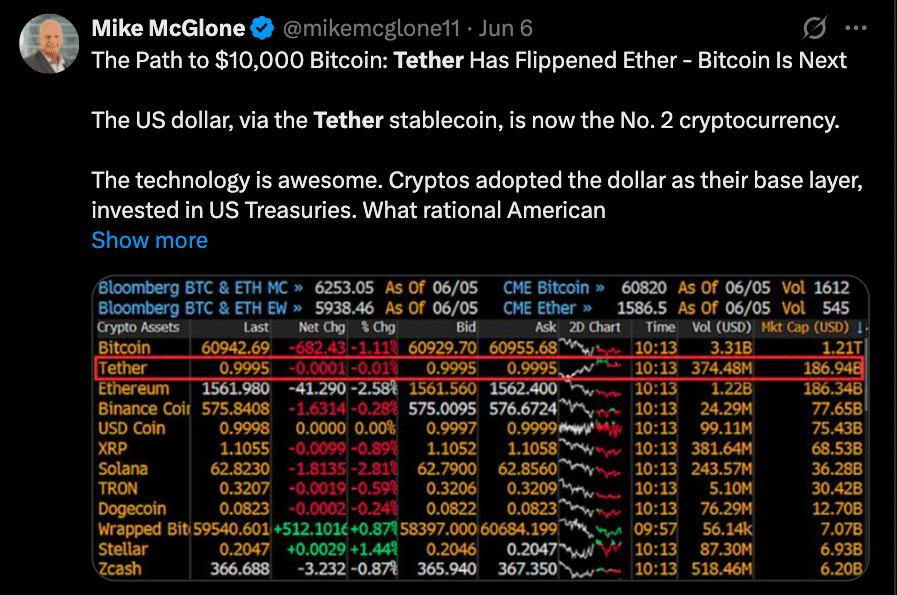
At the height of the USDT/Ethereum crossover; market trackers showed USDT valued at $187 billion, while Ethereum stood at $186 billion.
Even though Ethereum eventually recovered enough to regain second place, the forces behind the flip have not disappeared.
How Tether USDT Market Cap Surpassed Ethereum
The temporary ranking change was not caused by a sudden increase in Ethereum supply. Instead, Ethereum’s market cap started to fall as its price went down, while Tether USDT market cap kept climbing through new issuance.
According to Tether’s Q4 2025 attestation, USDT reached a record market cap of $187.3 billion after adding $12.4 billion in just one quarter. The growth came despite challenging market conditions that saw declines across digital assets.
Over the course of a year; USDT expanded from $144.2 billion to around $184 billion, a growth of about 28%. During the same period, Ethereum’s valuation went in the opposite direction as investors backed away from riskier crypto assets.
Market conditions really sped things up. In the three weeks running up to the crossover, more than $7 billion left the stablecoin sector while roughly $400 billion got wiped from the crypto market. Ethereum’s DeFi ecosystem got hit too, with TVL (Total Value Locked) falling to around $36 billion.
Stablecoins Are Becoming Go-To Safe Haven
The rise of the Tether USDT market cap revealed that investors are choosing to hold stablecoins while they wait for the market to sort itself out. That has let stablecoin supply stay high even when Bitcoin, Ethereum and all the other altcoins are struggling.
USDT now makes up about 59% of the stablecoin market. Combined with USDC, the two of them account for approximately 82% of the sector.
Tether’s user growth report also said they added 35.2 million users in the fourth quarter of 2025, bringing their estimated user base to over 534 million worldwide.
Mike McGlone Thinks There’s an Even Bigger Flippening to Come
One of the most interesting reactions to the crossover came from Bloomberg Intelligence’s Senior Commodity Strategist, Mike McGlone.
McGlone has been saying for years that stablecoins are one of the most promising trends in digital assets. Back in October 2020, when USDT’s market cap was a mere $16 billion (compared to Ethereum’s $43 billion), he said Tether was on a path to eventually matching Ethereum. And now, he’s more optimistic than ever.
McGlone is of the view that the “flippening” could continue to unfold beyond Ethereum and potentially even extend to include Bitcoin. He has been arguing that in an extreme scenario where Bitcoin starts tanking toward $10,000 and the USDT keeps growing, Tether could in the end steal the title of biggest cryptocurrency by market value.
But all of this remains a speculative outlook.
Can Ethereum Keep Its Lead?
Ethereum is currently still the second-largest cryptocurrency by market capitalization; though the margin is now so thin compared to what it used to be.
For Ethereum to start widening the gap again, it would need a sustained price growth backed up by renewed investor interest. The Ethereum network is still advancing its technology roadmap; including work around zero-knowledge proof scaling solutions designed to improve efficiency and reduce costs.
But even then, those developments may still take a while to start making their presence felt in the market.
Meanwhile, every time USDT gets issued, the Tether USDT market cap gets a direct boost; because the stablecoin always manages to keep its dollar peg. Unlike Ethereum, its valuation does not depend on price appreciation.
Conclusion
The brief moment when Tether USDT market cap surpassed Ethereum has shown a market increasingly focused on liquidity preservation instead of speculation.
With USDT now standing at $187.3 billion and still growing controlling a massive 59% of the stablecoin sector, it is getting harder to ignore the fact that stablecoins are becoming one of the strong forces in crypto.
For Ethereum to create meaningful distance again will depend on investor confidence as well as technological progress.
Glossary
Tether (USDT): A stablecoin pegged to the dollar and issued by Tether.
Market Capitalization: The value of all the coins that are out in circulation for a particular cryptocurrency.
Stablecoin: A type of cryptocurrency that is designed to keep its value steady usually by being tied to the value of a real-life currency like the dollar.
DeFi TVL: The total amount of money that is currently locked up in DeFi applications.
Flippening: When the market capitalization of one cryptocurrency overtakes that of another.
Frequently Asked Questions About Tether USDT Market Cap
Did Tether USDT market cap really overtake Ethereum?
Yes. There was a few hours in when USDT’s market capitalization briefly outstripped Ethereum’s before ETH reclaimed its place as second biggest.
What was the market cap of USDT during the crossover?
At the time, USDT was sitting on around $187 billion while Ethereum was trading at around $186 billion.
Why is Tether growing so fast?
It is being driven by how much demand there is for stablecoins at the moment. This is mainly because investors are keen to get their hands on liquidity, capital preservation, payments; and settlement solutions.
Could USDT eventually overtake Bitcoin?
Some analysts, including Mike McGlone; have said that it is possible but only under certain extreme market conditions and even then, it is still a speculative scenario.
References