
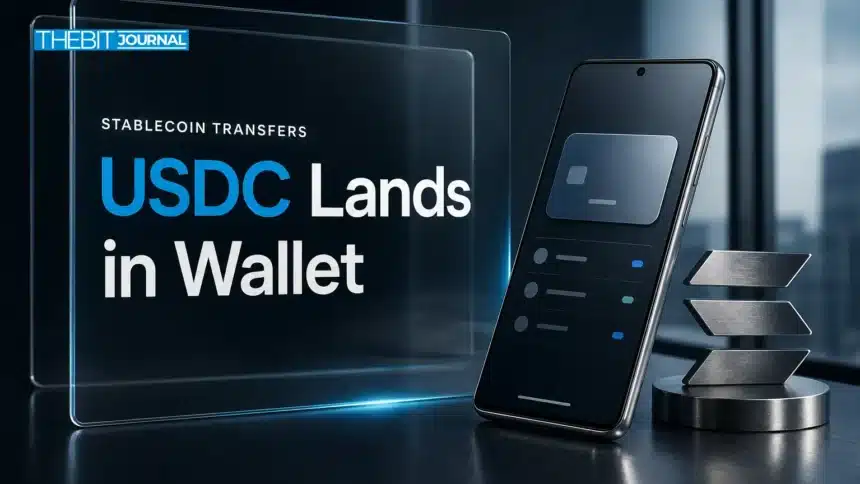

Samsung Wallet USDC is now available to eligible U.S. Galaxy users, allowing them to buy, hold, send and receive the stablecoin on Solana through the phone wallet. The November 5 launch does not require a separate crypto app or self-managed private keys. Samsung says the account holds a digital asset, not a bank deposit.
Why Samsung Wallet USDC matters
Samsung has added stablecoin access to Wallet for eligible Galaxy users. The service combines USDC transfers with Samsung’s wallet interface, while its fees, eligibility rules and account protections differ from those of a bank deposit.
What we know about Samsung Wallet USDC
Samsung Wallet’s Stablecoin Account went live on November 5, according to The Block and Decrypt. Decrypt reported that eligible U.S. users can transact in USDC on Solana directly in Wallet without managing a separate crypto app or private keys.
Samsung announced the feature on October 7 and said it would be available across 82 million compatible U.S. Galaxy devices. That figure refers to compatible devices, not confirmed account holders or active users. Eligibility requires U.S. residence, age 18 or older, identity verification and a compatible device running Android 13 or later, according to Samsung’s announcement. Samsung’s support FAQ says the service is currently unavailable to New York residents.
Samsung named Bastion as the provider of the stablecoin payment framework and Coinbase as Bastion’s sub-custodian. The USDC is held through Coinbase Prime Vault. Samsung also named Solana and Sui as blockchain-support partners. The launch coverage describes USDC on Solana as the live offering; the earlier announcement identified both networks as partners.
Samsung says users can send USDC to compatible external wallets without a Samsung transfer fee. Decrypt reported that credit-card top-ups, including through Samsung Pay, carry a 4% fee, and that withdrawals to bank accounts or debit cards also incur a fee. The outlet also reported an offer under which qualifying new users making a first top-up of at least $50 can receive $25 in USDC.
Samsung says international-transfer fees vary by destination and amount. Eligible bank-account payouts are available in more than 60 countries. Online and in-store stablecoin payments, as well as expansion to additional markets, are possible future plans subject to local regulatory requirements. Samsung has not described these as live features of this launch.
What is still unclear
Samsung Wallet USDC limits and practical availability
The supplied launch information sets out eligibility and some fees but does not provide figures for how many people have opened accounts or used the service. Samsung’s estimate of 82 million compatible devices is not a measure of adoption.
Samsung’s support FAQ says the account holds a digital asset, not a bank deposit. It also says USDC balances and rewards are not covered by FDIC, NCUA or SIPC protections. Those statements distinguish the account from a bank deposit with those protections. New York residents cannot currently use the service, according to the FAQ.
How markets and analysts reacted
The supplied market data does not isolate a price move caused by Samsung’s announcement. At 16:13 UTC on November 5, CoinGecko data put Solana at $90.48, down 6.95% over 24 hours. Bitcoin was $76,000, down 5.77%, and ether was $2,254.47, down 7.78%. These figures describe the listed assets at that time, not a measured market response to Samsung Wallet USDC.
| Asset | Price | 24-hour change |
|---|---|---|
| Solana (SOL) | $90.48 | -6.95% |
| Bitcoin (BTC) | $76,000 | -5.77% |
| Ether (ETH) | $2,254.47 | -7.78% |
Decrypt reported that Solana Foundation president Lily Liu welcomed the launch as a way to bring stablecoins to mainstream users. Her reaction, as reported by the outlet, was that stablecoins had demonstrated the technology but lacked a path to mainstream reach. In Samsung’s October announcement, executive Woncheol Chai said the aim was to make sending money abroad as convenient as using the wallet already on a user’s phone, without requiring another app or private-key management.
The Crypto Fear & Greed Index was 50, classified as Neutral on November 5, according to Alternative.me. The index provides broad sentiment context; it does not establish adoption of Samsung’s account.
What Samsung Wallet USDC means for investors
The launch adds a stablecoin transfer feature to Samsung Wallet for eligible U.S. Galaxy users. Samsung said the feature would be available across 82 million compatible devices, but that number does not show how many people will use it. The launch alone does not establish whether the service will gain regular users.
Samsung’s announcement identifies Bastion as the payment framework provider and Coinbase as Bastion’s sub-custodian, with USDC held through Coinbase Prime Vault. Users access the account through Samsung Wallet, while these named providers are part of its payment and custody arrangements. The available material does not establish how widely the service will be used or whether Samsung’s potential future plans will proceed.
Samsung has said future plans may include online and in-store stablecoin payments and expansion to additional markets, subject to local regulatory requirements. For now, the confirmed launch is the USDC account for eligible users, with the terms and geographic exclusions described by Samsung.

Bottom line
Samsung Wallet USDC brings Solana-based stablecoin transfers into a mobile app for qualifying U.S. Galaxy users. Bastion and Coinbase are involved in the payment framework and custody arrangements. Fees, eligibility limits and the absence of FDIC, NCUA and SIPC protections for balances and rewards remain important details of the service.
Sources
- Samsung Wallet to Bring Stablecoin Access to Eligible Galaxy Users in the US (news.samsung.com)
- Samsung Wallet launches USDC accounts on Solana for US Galaxy users (The Block)
- Stablecoins Go Mainstream as Samsung Wallet Adds USDC on Solana (Decrypt)
This article is for informational purposes only and does not constitute financial or investment advice. Cryptocurrencies are highly volatile; always do your own research before investing.