






According to the latest SEC statement, the SEC staking guidance now makes it clear that some types of staking are not considered securities. This change opens the way for spot Ethereum (ETH) and Solana (SOL) ETFs to add staking and earn rewards. The decision gives investors a chance to benefit from staking without breaking any rules.
What Does the SEC Staking Guidance Say?
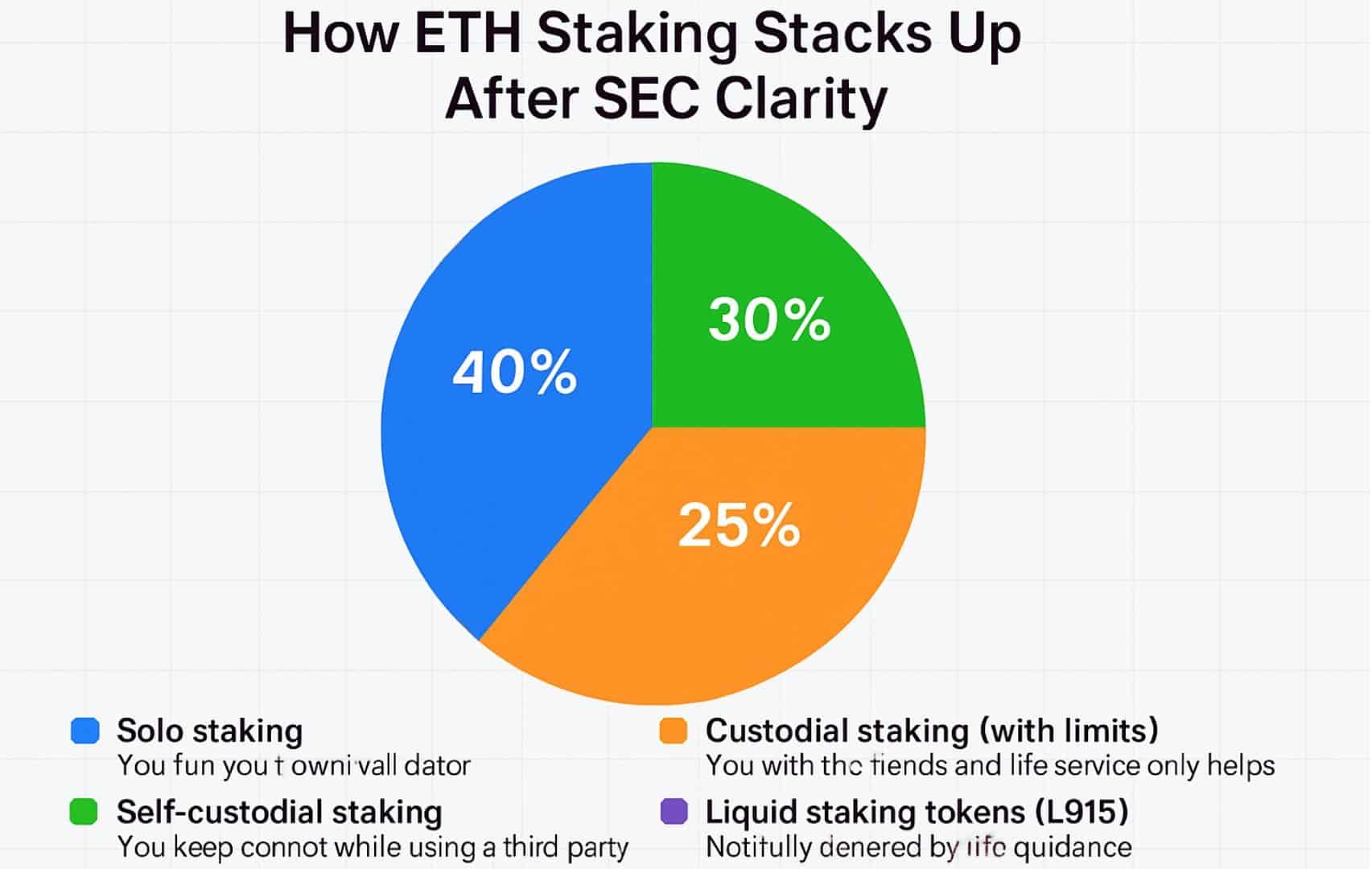
The SEC shared its view on staking on May 29, 2025. It said that solo staking, self-custodial staking, and some custodial staking do not fall under securities law. These are called “protocol staking activities.” They follow network rules and do not depend on a company or team to make money for others.
That means people who stake their tokens in these ways are helping the network, not investing in a business. So, these actions do not pass the Howey Test, which decides if something is a security.

How It Affects Spot ETH and SOL ETFs
Before this update, many ETF providers avoided staking. They didn’t want to risk breaking SEC rules. But now, the SEC staking guidance gives them more confidence.
Nate Geraci, president of The ETF Store, said, “This clears the last major hurdle for staking in spot ETH ETFs.” This means ETF companies like BlackRock and VanEck can now design funds that offer both price exposure and staking rewards.
BlackRock recently filed a plan to add staking to its iShares Ethereum Trust. They want to earn extra returns from Ethereum staking, which can bring about 3% yearly.
Which Staking Types Are Allowed?
| Staking Method | Status | Notes |
|---|---|---|
| Solo staking | Allowed | You run your own validator |
| Self-custodial staking | Allowed | You keep control while using a third party |
| Custodial staking (with limits) | Allowed | You own the funds and the service only helps |
| Liquid staking tokens (LSTs) | Unclear | Not fully covered by the guidance |
What the Crypto Market Is Doing
After the SEC staking guidance, ETF providers started updating their applications. Some are preparing to include staking in their funds before the end of 2025.
REX Financial launched a Solana ETF that uses staking rewards. Other funds may follow.
Ethereum staking is also growing. Over 34 million ETH are now staked, with average returns between 3% and 4%.
Some platforms, like Uphold, had paused staking for U.S. users earlier this year. With this new guidance, they may start offering it again.
What Experts Are Saying
Law firm Lowenstein Sandler LLP said this guidance proves that staking is a network task, not an investment. They believe this gives more clarity to users and companies.
Not everyone agrees. SEC Commissioner Caroline Crenshaw disagreed with the update. She said it only works for ideal cases and doesn’t match real-world staking services. She worries some companies will use this to avoid the law.
What About Taxes on Staking in ETFs?
While the SEC staking guidance gives regulatory clarity, tax treatment is still a missing piece. The IRS has not yet confirmed how staking rewards inside ETFs will be taxed. Fund managers and legal experts are waiting to learn whether rewards will count as regular income or if they’ll receive deferred treatment. Until the IRS gives clear rules, ETF issuers may hold off on launching full staking strategies, even with SEC approval in hand.
Conclusion
Based on the latest research, SEC staking guidance makes it clear that staking is not always a security. This gives ETFs a safe way to include staking rewards. As the crypto market grows, this rule can help more people earn passive income without breaking regulations. ETF providers now have a more straightforward path to bring staking to mainstream investors.
For more expert reviews and crypto insights, visit our dedicated platform for the latest news and predictions.
Summary
The SEC staking guidance confirms that solo, self-custodial, and specific custodial staking methods do not qualify as securities. This update clears a path for spot ETH and SOL ETFs to include staking rewards legally. While liquid staking remains under review, the guidance boosts confidence for issuers and investors. It marks a step forward in blending regulatory clarity with crypto innovation, allowing staking to support long-term yield in compliant investment products.
FAQs
What is the SEC staking guidance?
It explains that solo, self-custodial, and some custodial staking methods do not fall under securities law.
Are liquid staking tokens allowed?
Not fully. The SEC says their guidance only covers simple staking. Liquid staking still needs more review.
Can ETFs now stake ETH or SOL?
Yes. Fund providers can now stake their claim if they follow the rules and wait for tax updates from the IRS.
What happens next?
ETF companies are working on updates. If tax rules allow, staking-based ETFs could launch later this year.
Glossary
Staking: Locking tokens to help run a blockchain and earn rewards
Solo staking: Running your staking node
Custodial staking: A service provider stakes your tokens
Liquid staking tokens (LSTs): Tokens you get when staking, which can be traded
Howey Test: A legal test to decide if something is a security
Sources / References
Commissioner Crenshaw Dissent Statement