





This week, Solana pulled off a headline grab: Solana overtakes Ethereum in daily decentralized exchange (DEX) trading volume. That is no small feat. It is the kind of shift that makes traders, developers, and even skeptics sit up.
Solana has just edged past Ethereum in 24-hour decentralized exchange trading volume. The shift is not just headline noise, it may signal a deeper change in how liquidity flows across chains. Behind the move lie surging stablecoin inflows, expanding real economic usage, and a narrative of infrastructure advantage.
Call it what one might: Solana overtakes Ethereum in DEX volume not as a fluke, but as a statement.
Surging Liquidity and DEX Supremacy
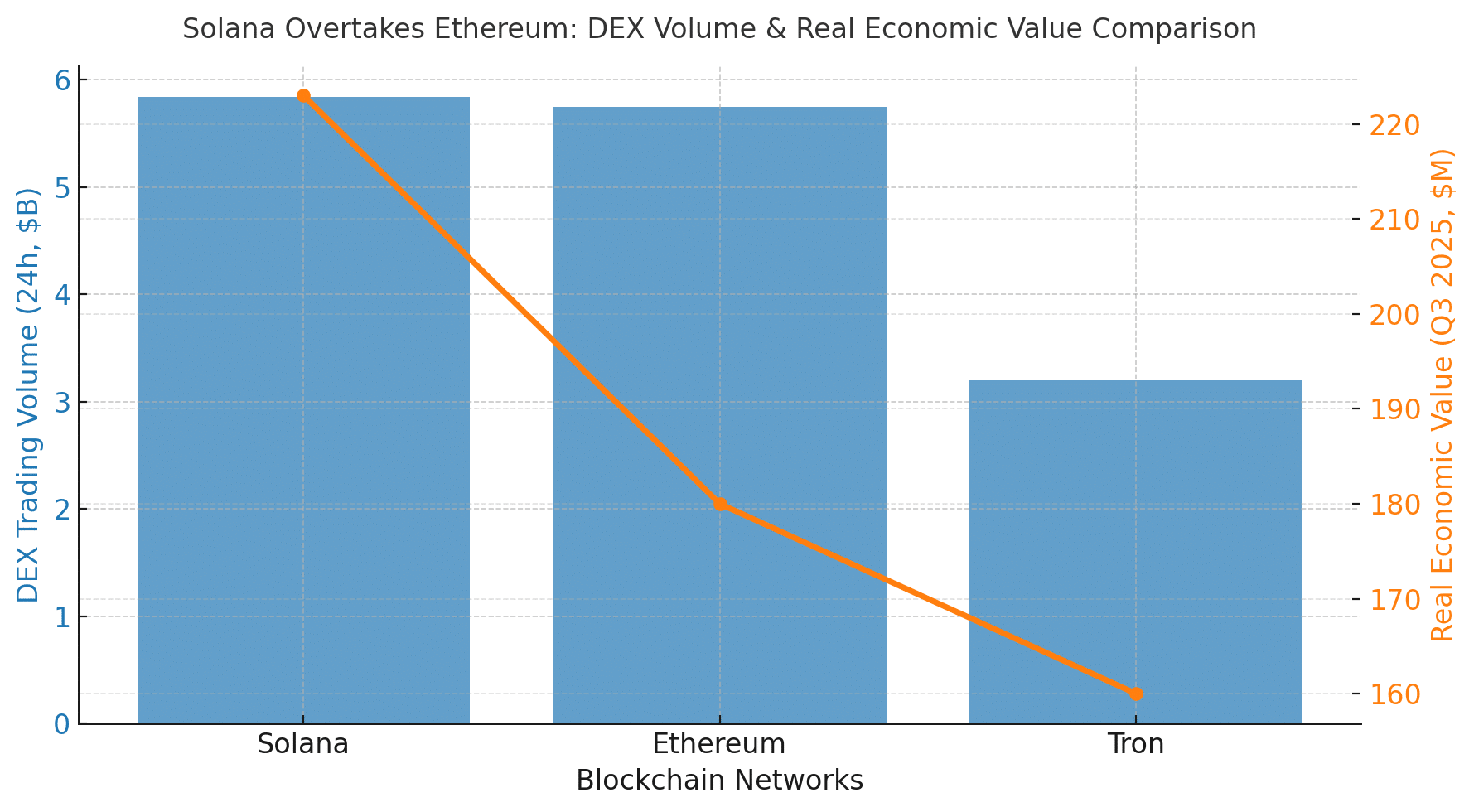
Recently, Solana’s DEX volume reached $5.84 billion, narrowly topping Ethereum’s $5.75 billion. Over the past month, Solana has processed nearly $137 billion in DEX trades. That level of activity reflects something deeper than mere momentum. (Data from DefiLlama aggregations).
Part of the story is stablecoin inflows. On Solana, stablecoin supply has hit record highs, about $17.5 billion circulating, funneled into liquidity pools across Jupiter, Raydium, Phoenix, and others. These assets bring depth to the order books, reduce slippage, and make the network more attractive for swap-heavy traders.
Solana overtakes Ethereum in DEX volume precisely at the moment when that liquidity becomes meaningful. While Ethereum still dominates in institutional slots and high-value settlements, Solana is carving its niche in fast, cheap on-chain trading.
Real Economic Value: Usage Over Incentives
Volume is one thing. But usage that actually pays fees is another. In Q3 2025, Solana recorded $223 million in Real Economic Value (REV), a measure of fees and out-of-protocol tips paid by users, excluding subsidies or rewards.
In that metric, Solana outperformed Tron, which posted roughly $160 million in the same period. The REV figure is particularly compelling because it reflects genuine user demand, not inflated by token rewards.
Solana overtakes Ethereum in volume, but what should attract sustained attention is when it starts overtaking in revenue and network utility as well.
Price Action, Technicals, and Market
Alongside volume and usage, the price of SOL has responded to this renewed momentum. After an intra-period slide from ~$221 down to ~$177, SOL rebounded roughly 5.78% in the past 24 hours, reaching near $208.60.
Technical signals show a neutral momentum environment. The Relative Strength Index (RSI) sits around 47.7, suggesting neither overbought nor oversold conditions. Near the price, resistance hovers near $220, while support zones form around $190. A sustained breakout above resistance could trigger a further leg upward; a breakdown below support might draw in selling pressure.
The macro backdrop also matters. Institutional interest, ETF speculation, and capital flows all feed into whether this narrative has legs. If SOL breaks above $220 on strong volume, the optics will shift from “moment” to “momentum.”
Risks, Structural Weaknesses & Ecosystem Challenges
No move is without caveats. Many of Solana’s DEX gains have been driven by memecoin trading. These speculative assets tend to generate short bursts of volume but often lack deep market stability.
Some analysts warn that liquidity pools on Solana lack depth. That is, even though volume is high, less total value locked means large trades might suffer from slippage.
“Solana is drinking the Ethereum milkshake,” reads one oft-quoted line, implying Solana is grabbing share of trading activity. But for that punch to land, it must build sustainable liquidity for blue-chip assets like wrapped BTC, ETH, stablecoins, and real-world tokens, beyond the meme hype.
Moreover, if macro or regulatory winds shift, speculative flows can reverse quickly. Solana overtakes Ethereum in volume today, but to hold that position, it needs to show resilience, not just flash.
What to Watch Next
Whether Solana overtakes Ethereum consistently over days, not just hours.
Growth in REV over upcoming quarters, if fees paid by users accelerate, that will validate the narrative.
Depth of liquidity on large-cap token pools.
How Ethereum, especially via Layer 2s, responds in terms of throughput, incentives, or volume campaigns.
Macro and institutional flows, IPO of crypto funds, regulation, capital inflow shifts.
Conclusion
Solana overtakes Ethereum in DEX volume is not just a headline grab. It is a signal. Liquidity is flowing where cost is low and speed is high. But survival in DeFi is about depth, not just flash. For Solana to make this stick, it needs sustained usage, richer liquidity, and resistance to speculative whiplash. If that happens, observers may look back and say this was the turning point.
Frequently Asked Questions
What does “Solana overtakes Ethereum in DEX volume” actually mean?
It means in a given period, often 24 hours, Solana’s decentralized exchanges processed more trading volume than Ethereum’s DEXs. It signals shifting liquidity flows, but not necessarily sustained dominance.
What is Real Economic Value (REV)?
REV is a metric that measures the value paid by actual use, transaction fees and tips, rather than counting every transaction (including subsidized ones). It gives a truer picture of economic activity on a chain.
Why do high volume numbers not always reflect quality?
Volume can be inflated via incentives, wash trading, or speculative tokens. Depth of liquidity, real usage per transaction, and fee generation offer deeper insight.
Can Ethereum reclaim leadership?
Yes. Ethereum’s strength lies in institutional adoption, DeFi infrastructure, and blue-chip liquidity. If it brings more capital, improves throughput via L2s, or pushes volume incentives, it could bounce back.
Glossary of Long Key Terms
Decentralized Exchange (DEX): A trading platform run on smart contracts, allowing users to swap assets peer-to-peer without intermediaries.
Liquidity Pool: A reserve of tokens supplied to DEXs that enables traders to swap assets. Higher liquidity helps reduce slippage.
Total Value Locked (TVL): The total dollar value of assets staked or locked in DeFi protocols on a blockchain. Indicates capital use.
Relative Strength Index (RSI): A momentum oscillator that measures overbought or oversold conditions in a price series.
Slippage: The difference between expected price of a trade and the executed price, usually caused by low liquidity or rapid price movement.
Wash Trading: Buying and selling a token to create artificial volume without substantive market impact. Often used to inflate numbers.