







This article was first published on The Bit Journal.
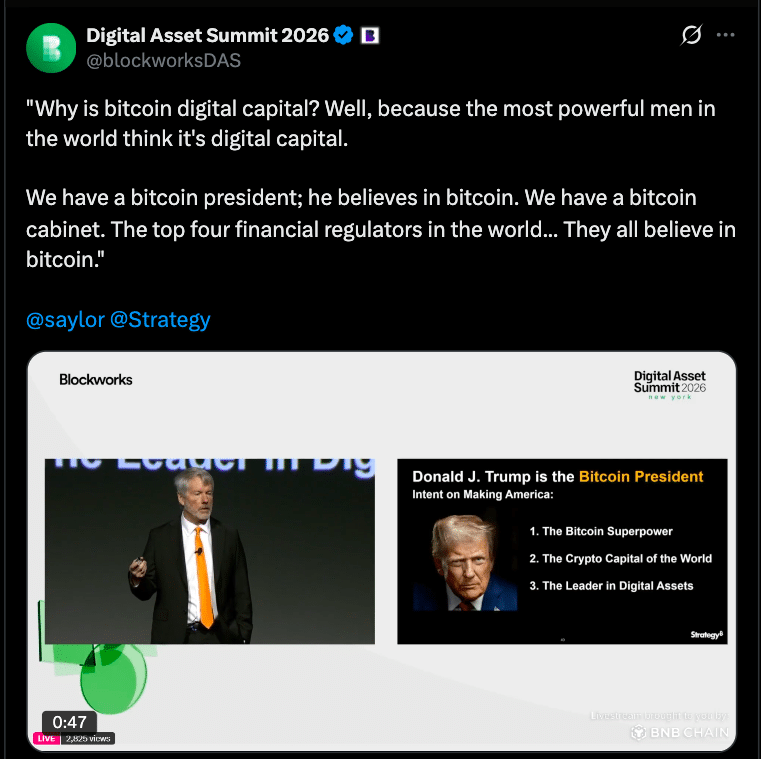
The Bitcoin digital capital narrative has received a boost recently with comments made by Michael Saylor at the Digital Asset Summit 2026.
Speaking at the New York summit, Saylor called Bitcoin a value transfer and storage system unhindered by physical constraints. He added that Bitcoin makes it possible for economic value to cross time and borders without dependence on concrete infrastructure.
Saylor continues to put Bitcoin within a financial hierarchy, referencing “digital capital” which lies between volatile crypto assets and organized financial products such as digital credit.
Bitcoin Compared to Gold, Real Estate and Sovereign Assets
One of the main tenets behind the Bitcoin digital capital idea is its comparison with traditional stores of wealth.
Saylor ranked Bitcoin with gold, real estate and sovereign debt, saying it belongs in the same class of long-term capital assets. Gold goes a long way in preserving value over time and the real estate gives utility as well as appreciation. What these assets lack, though, are the portability and programmability that Bitcoin offers.
With Bitcoin’s digital and finite attributes, Saylor maintained his stance that the asset is a superior form of capital, and thus a direct competitor to traditional methods for storing wealth.
Institutional Alignment Driving Bitcoin Digital Capital
Saylor maintained that Bitcoin evolution is further driven by increasing acknowledgment among policy makers and financial leaders. He says this goes in line with the developments across the United States, including a government-endorsed framework to establish a digital asset reserve.
In 2025, the U.S. government enacted a Strategic Bitcoin Reserve, formally recognizing Bitcoin at the national level.
Institutional products and financial engineering around Bitcoin are also on the rise. Saylor noted the development of structured products linked to Bitcoin, including yield-generating products intended to attract traditional capital markets.
This blend of regulatory legitimacy and financial innovation is helping the argument surrounding Bitcoin as digital capital in the global market.
From Payment to Store of Value Framework
Previous narratives rested almost entirely on the concept of Bitcoin as a payment system. Today, it is increasingly serving a role as a store of economic value through time. This is clearly visible in institutional behavior and holding periods.
Saylor’s argument reinforces this. Instead of focusing on transactions, he emphasizes Bitcoin’s promise to store capital and run autonomously from established financial systems.

Concerns about inflation, currency debasement and increasing sovereign debt have also led investors to look for alternative stores of value. Given this, Bitcoin’s hard supply and distributed nature makes it a candidate.
Institutional participation is also expanding. With large-scale holdings by corporate treasuries and governments as well as regulated investment products, Bitcoin is becoming more accessible to traditional capital allocators.
Despite the volatility, Saylor is still advocating that Bitcoin is a long-term solution for preserving capital.
Conclusion
According to Michael Saylor, institutional adoption, regulatory developments and evolving financial products are reinforcing Bitcoin Digital Capital argument.
Saylor’s comments at DAS 2026 reveal how Bitcoin is being re-framed inside global finance; breaking away from being purely a digital currency into an alternative form of competing capital alongside gold, real estate, and fiat based systems.
With institutional consensus becoming more aligned and macro pressures remaining, the market expects Bitcoin’s role within diversified portfolios to continue to grow, strengthening its status as a digital store of value.
Glossary
Bitcoin digital capital: Bitcoin as a store of value relative to other asset types
Store of value: A type of asset that keeps its purchasing power over the longer term.
Fiat currency: A type of currency that government has issued but is not necessarily backed by a commodity.
Institutional adoption: Large financial institutions investing mainstream:
Digital asset: A financial asset that uses a blockchain.
Frequently Asked Questions About Bitcoin Digital Capital
What is the meaning of Bitcoin digital capital?
Bitcoin being treated as a long term store of value like gold or real estate.
Why is this narrative becoming more prevalent right now?
This is due to institutional adoption, regulatory changes and macroeconomic pressures.
Does anyone pay with Bitcoin anymore?
Yes, but it is increasingly being used primarily as a store of value.
What is the difference between Bitcoin and gold?
Bitcoin is easier to transfer digitally, while gold has a richer history.
What part do institutions play in this change?
They are driving demand, and further entrenching Bitcoin as a capital asset.
References