






This article was first published on The Bit Journal.
Recent research from Galaxy Digital’s head of research has revealed that while Bitcoin soared past $126,000 in October 2025, recalculating that peak in real terms with the help of Consumer Price Index (CPI) data shows its value never effectively exceeded the $100K mark if inflation is factored in.
This discovery, originally pointed out on X by Alex Thorn and widely covered, demonstrates how inflation and changes in the purchasing power of the U.S. dollar affect perceptions of crypto milestones.
The difference between Bitcoin’s nominal price and its actual inflation-adjusted worth is now a talking point among analysts and investors, providing new perspective as macro conditions change.
Real vs. Nominal Price: Why This Matters
The peak, $126,000 in October 2025, was globally reported as a record high for the world’s largest cryptocurrency.
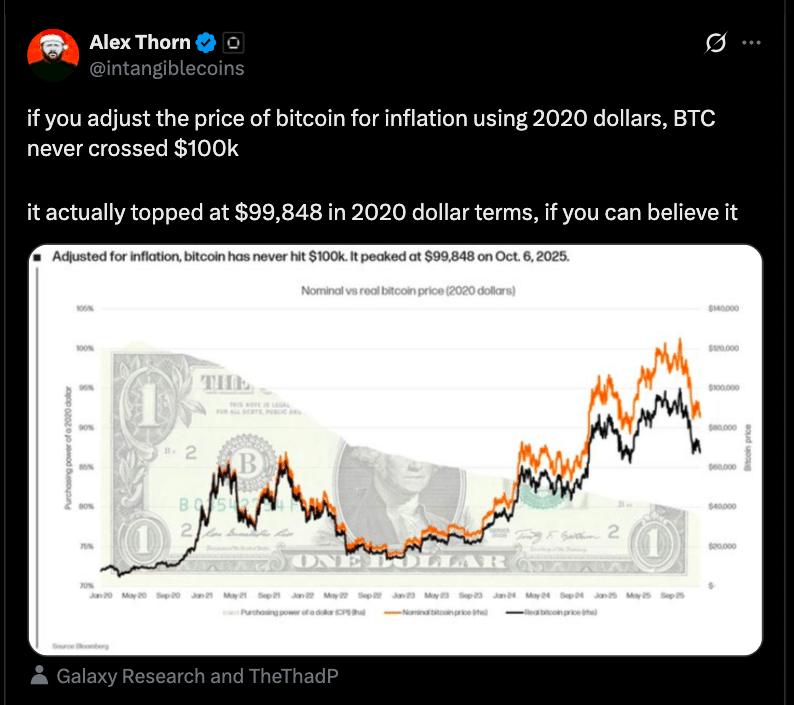
However, Alex Thorn of Galaxy Digital has explained that when this peak is adjusted using inflation data, specifically measuring the all-time high in 2020 dollar terms, this peak was in reality at $99,848.
This amount is slightly below the psychologically significant $100,000 level.
“If you adjust the price of Bitcoin for inflation using 2020 dollars, BTC never crossed $100,000,” Thorn said in his post on X. “It actually topped at $99,848 in 2020 dollar terms, if you can believe it.”
This inflation index is based on the Consumer Price Index which is compiled by the U.S. Bureau of Labor Statistics, which tracks changes in prices for a fixed “basket” of goods and services.
Year on year, the CPI was up by about 2.7%, keeping pace with a long-term decline in the dollar’s purchasing power early in this decade.
The Effect of Inflation on the Purchasing Power of a Dollar
Since 2020, the purchasing power of the dollar has fallen by almost 20 percent. So, in effect, a dollar today buys roughly 80% of what it could four years ago.
To put that in concrete terms, if Bitcoin’s price is expressed in 2020 dollars, a static measure of purchasing power, its all-time high doesn’t technically surpass the $100,000 mark.
That readjustment shows the gap between what an asset appears to be worth in today’s dollars and what it would be, adjusted for the cumulative effects of inflation.
Nominal price records fail to consider the decreasing value of money over time. Real or inflation-adjusted values can help investors and economists understand the genuine value increase, relative to general price increases in an economy, rather than simply reporting a headline price figure.
The difference is particularly acute right now because inflation, although lower than it was earlier in 2022, continues to stand above the Federal Reserve’s long-term target.
Dollar Weakness and Overall Market Considerations
Alongside inflation, the U.S. Dollar Currency Index (DXY), which tracks the dollar against a basket of major world currencies, has weakened in 2025.
Based on recent economic data, DXY traded around 97.8, representing a loss of 9.7% YTD, and the worst annual performance in almost a decade.
This decline feeds into what some market participants call the “debasement trade”, where investors seek assets that might hold their purchasing power as fiat currencies depreciate.
In this context, true value assessments, including inflation-adjusted price measurements, give a better picture of how an asset is doing against currency debasement rather than raw nominal price movements.

Reframing Bitcoin’s Milestone Narrative
When Bitcoin is viewed through this inflation-adjusted perspective, the narrative that BTC hit six figures in 2025, is challenged. When adjusted for inflation, Bitcoin’s actual high remains just below $100,000.
This reinterpretation is significant as to how records are reported and contextualized in financial analysis.
Galaxy research stresses the fact that price alone in nominal terms may not capture the true economic value an asset represents over a period of time, especially when inflation materially changes the purchasing power of money, something that has been quite pronounced over recent years as a result of continued global macroeconomic pressures.
Conclusion
Looking at inflation-adjusted numbers revealed that despite reaching an eye-catching nominal price of $126,000, it did not truly cross the $100,000 mark in real terms.
Applying 2020 dollar comparisons and CPI data, Alex Thorn, head of research at Galaxy Digital, showed the true value price peak of Bitcoin to be around $99,848.
This recalculated number demonstrates how inflation and currency purchasing power affect the reading of price records for financial assets such as Bitcoin.
Glossary
Inflation-Adjusted Value: A calculation that accounts for the change in purchasing power over time by using inflation data, often measured by CPI, to express prices in constant dollar terms.
Nominal Price: The current price paid for any asset in today’s dollars; not adjusted for inflation.
Consumer Price Index (CPI): An index produced by the U.S. Bureau of Labor Statistics measuring the average change over time in the cost of a standard consumer goods and services.
Dollar Currency Index (DXY): Measure of the value of U.S. dollar against foreign currencies.
Frequently Asked Questions About Inflation-Adjusted Bitcoin Value
Why is an inflation adjustment important to Bitcoin’s price?
Inflation adjustment indicates how Bitcoin value has changed over time, when compared to an index of consumer prices, or other indices available.
What is an inflation-adjusted peak?
It’s the highest price an asset reaches in constant dollars terms; in other words, what its peak would have been in 2020 dollars.
How much has the dollar lost in purchasing power since 2020?
Estimates calculated from the CPI data indicate that in real terms (that is, after adjusting for inflation) the U.S. dollar has lost approximately 20% of its purchasing power since 2020.
Does that mean Bitcoin never hit a record high?
Bitcoin did indeed hit a nominal record high above $126,000, the correction just indicates that in real, inflation-adjusted terms it fell short of $100,000.
References
Cointelegraph
CoinNess
Cryptonews
TradingView
Trading Economics