






The fight over stablecoin yields has risen to the center of Washington’s policy. Patrick Witt, executive director of the White House Council of Advisors for Digital Assets, has argued that stablecoin yields could in fact bring more capital into the United States banking system rather than draining deposits from it.
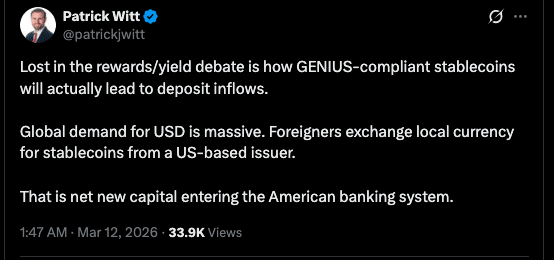
Banking industry critics argue that permitting stablecoin yields would siphon millions out of conventional bank accounts. Witt vehemently disagreed, countering that the world’s demand for US dollars means stablecoins can pull in new cash into the financial system.
“Foreigners exchange local currency for stablecoins from a US -based issuer,” Witt wrote in a recent post on X. “Global demand for USD is massive.”
Why Stablecoin Yields Are Important to the CLARITY Act Debate
Most recently, the CLARITY Act (the proposed Digital Asset Market Clarity Act) has been a subject of discussion in relation to stablecoin yields. The legislation aims to clarify who regulates various issues among agencies like the Securities and Exchange Commission and the Commodity Futures Trading Commission.
While the bill has gained traction in Washington, negotiations have broken down several times over disputes about how stablecoins should function.
Banking groups have contended that yields on stablecoins could enable digital asset platforms to directly compete with banks by offering savings accounts and other deposit products. If stablecoin issuers or companies tied up with them by offering returns on token balances, critics say the end result might move deposits away from banks.
This could potentially result in US bank deposits declining by an amount that equals approximately one-third of the stablecoin market capitalization, according to analysts at Standard Chartered.
Crypto advocates disagree with this conclusion. They argue that stablecoin mechanics differ from regular banking model and that concerns about deposit flight overlook how these tokens are in fact backed.
Patrick Witt’s Argument: Stablecoins Can Expand Dollar Demand
Patrick Witt notes that the conversation around stablecoin yields frequently neglects global demand for dollar-based assets in countries without traditional access to US financial infrastructure.
When international users purchase dollar-pegged tokens such as USDC or USDT, they must first exchange their local currency for US dollars held by the issuing entity. These reserves are typically stored in bank accounts or invested in US Treasury securities.
Due to this structure, Witt makes the claim that stablecoins growth signifies an inflow of capital into US financial system rather than out.
“GENIUS-compliant stablecoins will actually lead to deposit inflows,” he said when responding to concerns put forth by the banking sector.
The GENIUS Act, introduced in 2025, establishes a framework under which payment stablecoin issuers must maintain full reserves and are not allowed to lend/rehypothecate those funds. This rule makes a distinction between stablecoins and the fractional-reserve model of banks.
Witt made that distinction while discussing calls to regulate stablecoin yields like bank interest.
“The deceit here is that it is not the paying of yield on a balance per se that necessitates bank-like regulations,” Witt said. “The GENIUS Act clearly forbids stablecoin issuers from doing the latter.”
He means that stablecoins should not be considered bank deposits, just because they can provide returns.

Banks Resist as Regulation Fight Escalates
Banking executives have said if digital asset platforms start paying interest-like rewards, consumers could take savings out of banks and store value in stablecoins.
JPMorgan chief Jamie Dimon has been among the loudest critics of the notion. Platforms, specifically those offering returns on stablecoin balances; should fall under the same regulatory umbrella as banks, Dimon claims in a letter released Thursday.
“Rewards are the same as interest. If you are going to be holding balances and paying interest, that’s the bank,” Dimon said in previous comments regarding the issue.
The companies offering those stablecoin yields would be subject to capital standards, liquidity rules and deposit insurance requirements similar to the existing ones on regular financial institutions under his proposal.
The banking industry has also expressed concerns that if deposits flow away from bank accounts to digital platform assets, it could affect local lenders.
Christopher Williston, the president of the Independent Bankers Association of Texas, warned that if concessions were made in the back and forth around any new regulation, it could stifle local lending activity and economic production.
His comments received backlash from parts of the crypto community and a sharp rebuke from Witt, who likened the argument to “watching an arsonist threaten to burn down their own home.
Market Data Shows Stablecoin Activity Accelerating
As policymakers discuss regulation, stablecoin activity continues to grow.
According to recent data, net inflows of stablecoins soared since the beginning of the month, boasting a more than 400% increase in net inflows to $1.7 billion during the first week of March alone. The rise suggests that there is still strong demand for dollar-pegged tokens even as regulatory uncertainty looms.
Stablecoins are now a part of the crypto economy. Traders use them for liquidity between exchanges, and decentralized finance platforms collateralize them for lending, trading and payments.
As most stablecoins are backed by US dollars or Treasury securities, their growth has increasingly tied markets for digital assets with the traditional financial system.
This role explains why stablecoin yields have become such a policy issue.
Conclusion
The debate over stablecoin yields reveals the friction between traditional finance and a growing digital asset economy.
An adviser at the White House believes that stablecoins could be a pillar of America and its financial system by drawing international interest in dollar-denominated sophisticated products. In his view, every additional stablecoin issued means additional capital coming into banks and Treasury markets.
Banks, however, remain cautious. They fear that yield-bearing stablecoins will directly compete with deposit accounts and shift the balance of liquidity in the financial sector.
As Congress debates the CLARITY Act and other related legislation, stablecoin yields will probably stay near the top of any list of most politically charged issues in US crypto policy.
Glossary
Stablecoin: A type of cryptocurrency that aims to keep its value stable; often relative to the US dollar
Stablecoin yields: Rewards provided to users who hold stablecoins on certain platforms or financial products.
CLARITY Act: A draft legislation in the US which would clarify regulatory duties on digital assets; between financial regulators.
GENIUS Act: A framework introduced in 2025; governing payment stablecoins and requiring them to maintain a full reserves.
US Treasury securities: Debt instruments issued by the government; that are often used by stablecoin issuers to back dollar-pegged tokens.
Frequently Asked Questions About Stablecoin Yield
What are stablecoin yields?
Stablecoin yields, is simply referring to the rewards or returns that are gained though certain financial platforms/services by holding stablecoins.
What are banks worried about yields on stablecoins?
Banks perceive yield-bearing stablecoins as another force that can siphon funds out of traditional deposit accounts.
What is Patrick Witt’s view on the issue?
Witt claims that stablecoins can push capital flows to the US financial system due to the fact that foreign users must buy dollars to acquire it.
What will the GENIUS Act mean for stablecoins?
Issuers of payment stablecoins must back them fully with reserves and are not allowed to lend that money, according to the law.
What is the significance of CLARITY Act?
The bill aims to create clearer rules for digital assets and how they fit into traditional financial markets.
References