

Last updated: November 24, 2026
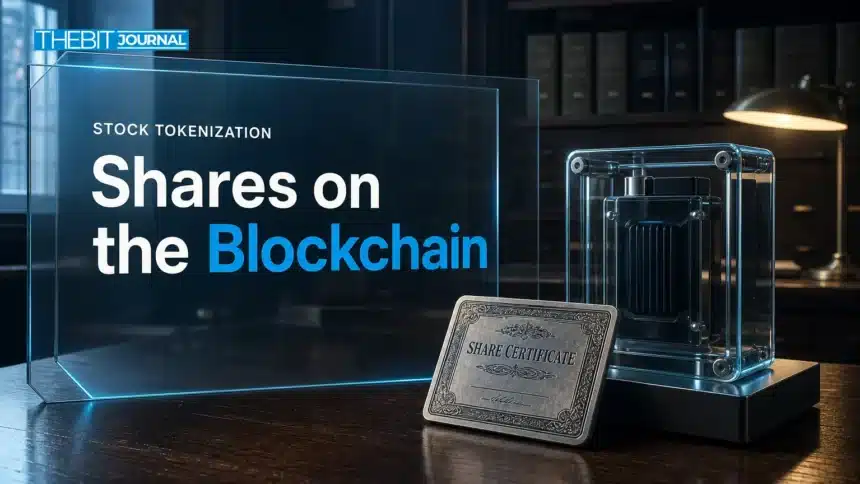
Tokenized stocks vs traditional stocks aren’t always two different kinds of ownership. A blockchain token may represent a share, an indirect claim, or only exposure to a stock’s price. Its legal rights matter most.
TL;DR
- A token can carry traditional share rights, represent an indirect interest through a custodian, or track a price without claims against the issuer.
- Blockchain can change how a security is recorded or transferred, but it doesn’t automatically change ownership rights or remove intermediaries.
- Check custody, venue, technology and regulation. A token’s label doesn’t explain these details.
Tokenized stocks vs traditional stocks: the core difference
A traditional stock is an equity security. A tokenized stock is a representation connected to that security or its price, recorded or transferred using blockchain technology. Its legal structure determines whether the holder is a shareholder, has an indirect entitlement, or has no claim on the company.
In a January 28, 2026 staff statement, the U.S. Securities and Exchange Commission said a stock remains an equity security whether its ownership record is on a blockchain or maintained another way. A token may signal an update to off-chain securityholder records without itself carrying the stock’s rights.
Tokenized stocks vs traditional stocks: three legal structures
Investor.gov describes three models: an issuer-sponsored token can carry traditional share rights in the same class; a custodial token represents an indirect interest through a security entitlement; and a synthetic token can track a stock’s price without giving its holder rights or claims against the issuer.
Tokens tracking the same company’s share price can therefore create different legal positions. Check who issues the token, whether an underlying share is held, who holds it, and which documents define the holder’s rights. The name alone isn’t enough.

How ownership, custody and trading compare
Traditional shares use the conventional securities framework. A tokenized version may link an on-chain record to an off-chain securities record or provide another kind of claim. As the SEC explains, recording something on a blockchain doesn’t establish that the token holder is listed as a shareholder.
Custody depends on the structure. Issuer-sponsored and custodial tokens place different parties between the holder and the underlying shares. A synthetic product may not involve ownership of those shares. Read the issuer’s terms and legal disclosures rather than assuming every token is backed one-for-one.
Trading also varies by product and venue. On September 17, 2026, the SEC granted a temporary, conditional exemption for qualifying venues to trade certain tokenized U.S. national market system stocks through permissioned automated market makers and liquidity pools. The order limits eligible symbols and volume, requires equivalent shareholder rights, and expires five years after publication. It doesn’t cover every tokenized stock.
Blockchain-based transfers do not ensure continuous trading, instant settlement, or availability in every country. Check the venue’s rules and hours.

What the market figures and new services show
As of November 24, 2026, RWA.xyz tracked $3.77 billion in distributed value for tokenized stocks and ETFs and $92.63 billion in monthly transfer volume. Its dashboard showed 4.99 million holders and 2,079,066 monthly active addresses. Those figures include natively issued and synthetic tokens, so they aren’t a count of conventional shareholders or proof that assets have the same rights.
The Depository Trust and Clearing Corporation launched a voluntary Tokenization Service on October 28, 2026. Under a three-year SEC no-action authorization, eligible DTC participants can tokenize select assets held at DTC. DTCC says it plans to connect the service to Solana, with DTC-tokenized assets expected there in the second half of 2027. That’s a stated plan, not a completed launch. See DTCC’s announcement of the planned Solana connection.
Nasdaq and Payward, Kraken’s parent, said they expect Nasdaq Equity Tokens to launch in the second quarter of 2027, with work underway on infrastructure linking them to Payward’s xStocks ecosystem. That’s an expected timeline, not confirmation of a launch. Read Nasdaq and Payward’s announcement.
Pros and cons of tokenized stocks vs traditional stocks
| Feature | Tokenized stocks | Traditional stocks |
|---|---|---|
| Representation | Blockchain record or stock-linked token; legal form varies. | Equity security recorded through conventional systems. |
| Rights | Share rights, indirect entitlement, or price exposure only. | Rights depend on share class and applicable terms. |
| Dependencies | May involve an issuer, custodian, blockchain, smart contracts and venue. | Relies on conventional brokers, custodians and market infrastructure. |
| Potential advantage | Blockchain-based records and transfers where supported. | Conventional securities processes and ownership pathways. |
| Key drawback | More variation in structure, custody and technical dependencies. | No blockchain-based representation or transfer by default. |
These are structural comparisons, not promises about speed, cost or performance. Features depend on the security, token, provider and jurisdiction.

Risks to understand before comparing products
Both involve market risk: a stock can fall, and investors can lose some or all of the money committed. Token holders may also face custody or exchange failure, smart-contract bugs, outages, restricted transfers, unclear legal claims, changing regulation and scams. Verify issuers and venues through official channels, and never share a seed phrase.
Traditional holdings also carry market and intermediary risks. Tokenization doesn’t remove them and may add technical or structural risks. Laws differ by country, and legal treatment and availability can vary. Consult a qualified professional about legal or tax questions in the relevant jurisdiction.
Who tokenized stocks may or may not suit
Tokenized stocks may interest people researching blockchain-based securities, ownership records or a specific product’s transfer rules. That interest doesn’t make every token equivalent to a share.
They may not suit anyone unable to verify the issuer, underlying asset, custody, legal rights or venue. Those seeking shareholder rights should pay particular attention to synthetic tokens, which Investor.gov says can track a stock price without claims against its issuer. Check transfer restrictions and what happens if a provider or platform stops operating.
Bottom line
Tokenized stocks vs traditional stocks is a comparison of legal rights and operating arrangements, not simply blockchain versus conventional records. Some tokens can carry share rights; others provide an indirect interest or price exposure without shareholder claims. The SEC guidance and Investor.gov’s categories make that distinction central.
As of November 24, 2026, new services and venue plans show that securities infrastructure is evolving. Assess each product on its own terms: read the governing documents and confirm who holds the underlying security, what rights attach to the token, and which intermediaries and technology it depends on.
Sources
- Nasdaq Deepens Relationship with Payward to Advance Tokenized Equities and Always-On Infrastructure (ir.nasdaq.com)
- RWA.xyz | Tokenized Stocks (app.rwa-xyz.com)
- Statement on Tokenized Securities (www.sec.gov)
This article is for informational purposes only and does not constitute financial or investment advice. Cryptocurrencies are highly volatile; always do your own research before investing.