

Last updated: November 22, 2026
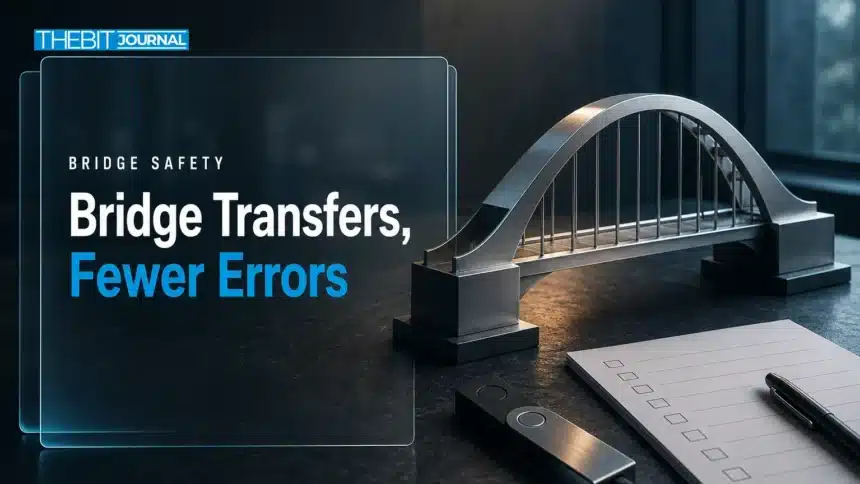
Crypto bridge mistakes can turn a routine transfer into lost funds, a token you can’t use, or a long wait for confirmation. The risks often come from choosing the wrong network, overlooking fees, or assuming a slow transfer has failed.
TL;DR
- Check the source and destination networks, token, and receiving address before approving a bridge transaction.
- Keep the destination network’s native token available for transaction fees, and don’t resend just because a transfer is slow.
- Bridges carry smart-contract, validator, wrapped-asset and scam risks. An audit does not eliminate the possibility of a contract flaw exposing assets to a hack.
How crypto bridges work, and where mistakes start
A bridge moves value or messages between separate blockchain networks. In a common lock-and-mint design, the bridge locks an asset on the source chain and creates a corresponding wrapped asset on the destination chain. That wrapped token depends on the bridge and its backing, so it isn’t automatically identical in risk to the original asset.
Ethereum.org’s bridge documentation explains that smart-contract flaws and reliance on external validators can put bridged assets at risk. Bridge aggregators can add more contract integrations and potential points of failure, too.
Common crypto bridge mistakes to avoid
Crypto bridge mistakes start with the wrong network
Similar network names and familiar wallet addresses can create a false sense of security. MetaMask warns that sending tokens directly from one network to another, instead of using a bridge, will most likely cause permanent, irreversible loss. An Ethereum-style address may appear on more than one network, but the assets and transactions remain network-specific.
Before confirming, compare the source network, destination network, token and receiving address with the bridge’s transaction details. Don’t rely on the address alone to tell you where funds will arrive. If a wallet or bridge shows a network you didn’t intend to use, stop and check the details rather than approving by habit.
Crypto bridge mistakes include forgetting destination gas
Bridging the token you want isn’t always enough to make it usable. MetaMask says destination-network transaction fees are paid in that network’s native token, such as BNB on BNB Smart Chain or POL on Polygon. Without some native gas, you may be unable to move or use the bridged asset after it arrives.
Check which token pays fees on the destination chain and whether your wallet will have any after the transfer. Review the bridge’s quoted fees as well. Review the bridge’s quoted fees before approving, and treat its transfer-time estimate as an estimate, since network conditions can cause delays.
Crypto bridge mistakes include trusting a fake site
A convincing search result, message or social post can lead to a fraudulent bridge page. A fake site may ask you to connect a wallet or approve a transaction that sends assets elsewhere. Use the bridge’s official domain from a trusted project source, and inspect the transaction details in your wallet before signing. Never share a seed phrase to complete a transfer.
Wallet connection by itself doesn’t establish that a site or transaction is safe. If the page asks for permissions or token approvals that don’t match the transfer you’re trying to make, don’t approve them. Phishing can target users of established protocols, so verify domains and transaction details even when a project is familiar.

Don’t retry a transfer just because it’s slow
Bridge transfers may take longer than expected when network conditions change. MetaMask says its quoted transfer time is an estimate and recommends checking the transfer status before treating a delayed arrival as a failure or retrying. A second transaction could create a separate transfer rather than fix the first one.
Look up the transaction on the relevant network explorer and check the bridge’s status page or transaction tracker, if available. Keep the transaction ID and note which network it was sent from. If the status is unclear, use the bridge’s official support channels rather than a stranger who contacts you privately.
Don’t ignore wrapped-asset and support changes
A bridge’s token may rely on assets locked elsewhere or on validators signing messages. If that backing or bridge system is compromised, the wrapped asset can lose its expected support. Chainalysis reported that on February 2, 2022, an attacker exploited Wormhole’s smart-contract code to mint roughly 120,000 uncollateralized wrapped ETH on Solana, worth over $320 million at the time. Chainalysis noted that other protocols using the wrapped asset as collateral could also be affected.
Support can change, too. On November 4, 2026, Wormhole announced that Linea, Moca and Plume are scheduled for full deprecation on December 2, 2026. Wormhole messages, including outgoing token transfers, are set to stop for those chains, although inbound transfers may remain possible while at least 13 of 19 Guardians are willing and able to sign them. Check current support before starting a transfer, especially if a chain is being deprecated.
Crypto bridge mistakes: pros and cons of bridging
| Potential benefit | Trade-off or risk |
|---|---|
| Moves assets between supported networks | Wrong-network transfers can cause irreversible loss |
| Can make a wrapped version available on another chain | The wrapped asset depends on the bridge and its backing |
| Aggregators can present multiple bridge routes | Extra integrations can add smart-contract and technology risks |
| Wallets may show an estimated transfer time | Network changes can delay arrival beyond the estimate |
Who bridging is and isn’t for
Bridging may suit people who understand the networks involved and have a specific reason to move assets between them. It requires checking the token, route, fees, transaction status and destination-chain requirements. The bridge itself, wallet software, validators and the receiving token can each introduce risks.
It may not suit someone who can’t verify the route, doesn’t understand the wrapped asset, or needs funds to arrive by a fixed time. Crypto assets are volatile and can lose value, and a bridge exploit, wallet error or scam can result in a total loss. A successful audit does not eliminate the possibility that a contract flaw exposes assets to a hack.
Bottom line
Several common crypto bridge mistakes can be reduced by checking both networks, reading the transaction details, accounting for destination gas and verifying the bridge’s support status. If a transfer is delayed, check its status before retrying. These steps can reduce user errors, but they can’t eliminate bridge, market or security risks.
Sources
- Bridges (ethereum.org)
- Updates to Wormhole's supported networks (wormhole.com)
- User guide: EVM networks and sidechains (support.metamask.io)
This article is for informational purposes only and does not constitute financial or investment advice. Cryptocurrencies are highly volatile; always do your own research before investing.