



Last updated: November 23, 2026
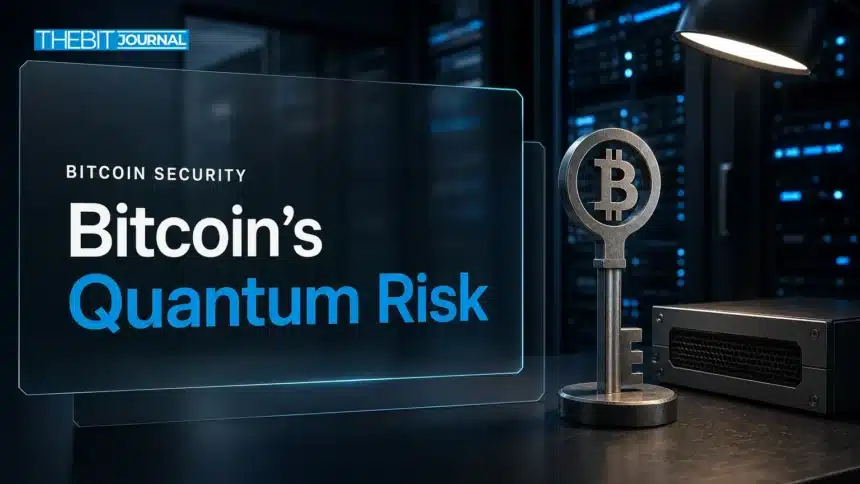
Bitcoin quantum risk concerns whether a future quantum computer could derive a private key from a public key and spend the associated coins. As of November 23, 2026, researchers have described possible attack designs, but their estimates are theoretical. They don’t show that a machine capable of stealing Bitcoin exists.
Key Takeaways
- Shor’s algorithm could threaten Bitcoin’s signature system if a sufficiently capable quantum computer becomes available.
- Coins with exposed public keys may face greater long-term risk, but exposure doesn’t mean they can be stolen today.
- Research estimates vary by model and aren’t evidence of a current attack-capable machine.
- Bitcoin upgrades and migration proposals remain proposals until adopted by the network.
What the bitcoin quantum risk actually is
Bitcoin uses public-key cryptography to authorize transactions. A public key may be shared or revealed on-chain, while its matching private key is meant to stay secret. A valid signature shows that someone controlling the private key authorized a spend.
Shor’s algorithm, if run on a sufficiently powerful quantum computer, could solve the mathematical problem behind commonly used Bitcoin signatures and derive a private key from its public key. An attacker could then potentially create an unauthorized transaction. That’s the core bitcoin quantum risk, not a way to reverse every transaction or guess a password.
Why public-key exposure matters
Bitcoin addresses and transaction histories are public, but outputs don’t all reveal public keys in the same way. A key may become visible when coins are spent. Reusing an address or holding funds in certain older output types can also affect exposure. The details depend on the script and spending history.
A June 2026 preprint by Iosif M. Gershteyn and Jacob A. Alber estimated that roughly 6.0 million BTC had public keys exposed on-chain. The authors classified about 2.3 million BTC as irreducibly at risk and roughly 3.7 million as migratable under their analysis. These estimates aren’t proof that the coins are vulnerable to current computers. Results depend on how exposure and risk are defined.

Could quantum computers break Bitcoin today?
The supplied research doesn’t show that a present-day quantum computer can derive Bitcoin private keys and steal coins. Estimates concern future hardware and depend on assumptions about error correction, circuit design and usable qubits.
On March 30, 2026, Google Quantum AI published resource estimates for circuits attacking the 256-bit elliptic-curve problem used by Bitcoin. Its estimates included fewer than 1,200 logical qubits with 90 million Toffoli gates, or fewer than 1,450 logical qubits with 70 million gates. Google estimated that a future machine with fewer than 500,000 physical qubits could run those circuits in a few minutes. These are theoretical estimates, not a report of an existing machine. Google Quantum AI published its estimate as part of its work on responsible vulnerability disclosure.
CoinDesk reported a different estimate on October 29, 2026. Based on a model from Alice & Bob researchers, it put a theoretical attack at 29,588 physical qubits and about 62 minutes. CoinDesk noted that this would be too slow to reliably target a transaction before confirmation at Bitcoin’s roughly 10-minute average block interval. The figures come from different models and assumptions, not a shared forecast.
Signatures face more concern than mining
The quantum concern isn’t evenly distributed across Bitcoin. The June 2026 preprint identifies Shor’s algorithm as the main concern for transaction signatures. Under the authors’ analysis, Grover’s algorithm doesn’t meaningfully threaten Bitcoin proof-of-work.
Mining uses repeated computations to find a valid block; signatures establish authority to spend coins. Quantum advances could raise broader questions about cryptographic security, but the cited research doesn’t find an equivalent immediate break in proof-of-work. Treating every part of Bitcoin as equally vulnerable overstates its conclusions.
How Bitcoin could respond to quantum risk
Reducing Bitcoin quantum risk would mean changing the rules wallets and nodes use to verify signatures, then gaining network adoption. NIST approved three post-quantum cryptography standards in August 2024, including digital-signature standards. They offer candidate technologies, but Bitcoin would still need protocol changes and broad agreement to use them.
BIP 360 is a draft proposing Pay-to-Merkle-Root outputs and removal of Taproot’s quantum-vulnerable key-path spend. It isn’t an activated Bitcoin rule. BIP 361 is also a draft, proposing post-quantum migration and a possible sunset for legacy signatures. It says more than 34% of bitcoin had revealed a public key on-chain as of March 1, 2026. Its suggested restrictions and recovery mechanisms haven’t become network rules.
A post-quantum signature scheme would need technical review, practical wallet support and a migration process. The first SHRINCS draft appeared on the Bitcoin development mailing list on August 26, 2026. Its authors called it prototype cryptography that shouldn’t be used in production and said it still needs peer review and completed security proofs. No proposal guarantees adoption or removes every risk.

Bitcoin quantum risk FAQ
Can a quantum computer steal Bitcoin?
In principle, a sufficiently capable machine running Shor’s algorithm could derive a private key from an exposed public key and enable an unauthorized spend. The research cited here doesn’t establish that such a machine exists today.
Are all Bitcoin addresses equally vulnerable?
No. Exposure depends on the output type and whether a public key has been revealed. Estimates vary, and exposure alone doesn’t prove an attacker can spend the coins.
Does quantum computing threaten Bitcoin mining?
The June 2026 preprint says Grover’s algorithm doesn’t meaningfully threaten proof-of-work under its analysis. Its more direct concern is Shor’s algorithm and transaction signatures.
Has Bitcoin adopted a quantum-resistant upgrade?
No. BIP 360 and BIP 361 are drafts, not adopted network rules. Any change would require implementation and network adoption. The timing and form of a possible Bitcoin migration remain uncertain.
Sources
- Safeguarding cryptocurrency by disclosing quantum vulnerabilities responsibly (research.google)
- BIP 360: Pay-to-Merkle-Root (P2MR) (bitcoin.org)
- Bitcoin price and market data (CoinGecko)
This article is for informational purposes only and does not constitute financial or investment advice. Cryptocurrencies are highly volatile; always do your own research before investing.