













Ethereum adoption is entering a new chapter as traditional finance shifts from exploring blockchain to building on it. A newly launched nonprofit, Institutional Ethereum, aims to connect global financial institutions with Ethereum’s expanding ecosystem, signaling that blockchain infrastructure is becoming a long-term priority for banks, asset managers, and fintech firms.
According to the official announcement, Institutional Ethereum was created after nearly a year of institutional engagement led by the Ethereum Foundation’s go-to-market team. Backed by BitMine Immersion Technologies, SharpLink, Ethereum co-founder Joe Lubin, and other ecosystem contributors, the independent nonprofit will serve as a neutral entry point for banks, asset managers, custodians, fintech firms, market infrastructure providers, and sovereign institutions looking to adopt Ethereum, Layer 2 networks, decentralized applications, and the broader ecosystem.
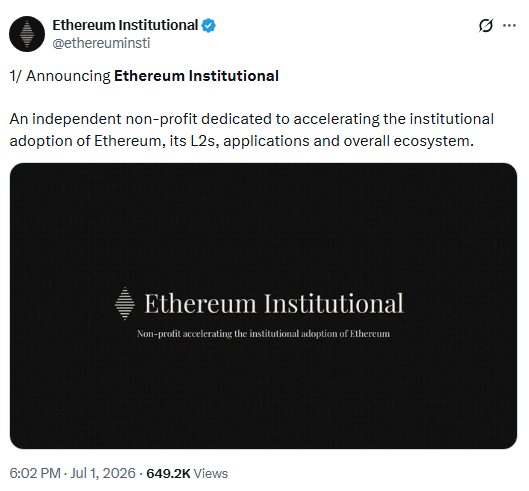
Why Ethereum adoption Needs a Dedicated Institutional Bridge
Unlike the Ethereum Foundation, Institutional Ethereum is focused entirely on helping financial organizations understand and implement Ethereum. Executive Director David Walsh said Ethereum’s credible neutrality is one of its greatest strengths, but neutrality without representation can often appear as silence. His remarks underline why institutions need a trusted organization that can answer technical and business questions while representing the ecosystem in a clear and consistent way.
The nonprofit will concentrate on five areas: institutional education and engagement, institutional intelligence, ETH ecosystem marketing, industry discovery and requirements, and institutional events. Together, these initiatives aim to remove barriers that continue to slow Ethereum adoption among large financial organizations.
Strong Institutional Demand Is Already Taking Shape
The organization begins with a solid foundation rather than starting from scratch. It has already built relationships with more than 500 institutions across banking, asset management, custodial services, sovereign organizations, fintech, and market infrastructure.
Its Institutional Ethereum Forum brought together more than 150 senior executives and digital asset leaders representing organizations with approximately $250 trillion in combined assets under management. The nonprofit will initially operate in New York, London, Hong Kong, and Singapore before expanding into Zurich, Frankfurt, Tokyo, and Abu Dhabi, helping support Ethereum adoption in key financial centers worldwide.
Stablecoins and Tokenization Strengthen Ethereum’s Position
One reason Ethereum adoption continues to attract institutional attention is Ethereum’s leadership in digital finance. The organization said Ethereum currently hosts about $180 billion in stablecoins on its mainnet, representing roughly 60% of the global stablecoin supply. Stablecoins have become a key part of digital payments and settlement, making Ethereum an attractive platform for financial firms.
Ethereum also supports about two-thirds of tokenized real-world assets, reinforcing its leadership in tokenization. The tokenized real-world asset market has expanded to about $34 billion, with Ethereum accounting for roughly 60% of its total value. As more traditional financial assets move onchain, Ethereum’s leading position gives Institutional Ethereum a strong foundation to help organizations evaluate blockchain for long-term infrastructure and investment strategies.

BitMine, SharpLink, and Ethlabs Reinforce the Institutional Push
Support from BitMine, SharpLink, and Joe Lubin adds significant credibility to the initiative. BitMine recently purchased another $90 million worth of Ether, increasing its holdings to nearly 4.7% of Ethereum’s supply, while maintaining its long-term goal of reaching 5%. SharpLink also resumed buying ETH after an eight-month pause, adding another $62.4 million while continuing to support Ethereum-focused initiatives.
Tom Lee, chairman of BitMine, said financial institutions are making infrastructure decisions that could shape capital markets for decades, with Ethereum increasingly at the center of those discussions. Joe Lubin described Ethereum as infrastructure for decentralized, verifiable, and programmable trust, adding that Institutional Ethereum will help organizations engage with the ecosystem at scale.
The launch follows the creation of Ethlabs, another nonprofit backed by the same supporters. While Ethlabs focuses on protocol research, scaling, settlement, and interoperability, Institutional Ethereum concentrates on institutional engagement, education, and market adoption. The move also follows the Ethereum Foundation’s broader restructuring, which shifted more specialized work to independent organizations.
Conclusion
The launch of Institutional Ethereum represents more than a new nonprofit. It reflects Ethereum’s broader strategy to make Ethereum adoption easier for traditional finance through education, industry collaboration, and global outreach.
With strong backing, established institutional relationships, leadership in stablecoins and tokenized assets, and growing support for Layer 2 networks, Ethereum adoption appears well positioned to attract more financial institutions, strengthen network effects, and accelerate the next phase of blockchain integration into global capital markets.
Glossary
Ethereum adoption: The increasing use of Ethereum by businesses, governments, and financial institutions for blockchain-based services.
Institutional Ethereum: The newly launched nonprofit dedicated to accelerating Ethereum adoption among global financial organizations.
Tokenized real world assets: Physical or traditional financial assets represented as digital tokens on a blockchain.
Layer 2: Blockchain networks built on Ethereum that improve transaction speed while reducing costs.
FAQs About Ethereum Adoption
What is Institutional Ethereum?
Institutional Ethereum is an independent nonprofit that helps financial institutions adopt Ethereum and its Layer 2 ecosystem.
Who backs Institutional Ethereum?
BitMine, SharpLink, Ethereum co-founder Joe Lubin, and several ecosystem contributors support the organization.
Why is Ethereum adoption important?
Ethereum adoption enables institutions to use stablecoins, tokenized assets, smart contracts, and onchain financial infrastructure.
What is Ethlabs?
Ethlabs is a nonprofit research group focused on Ethereum’s scaling, interoperability, settlement, and protocol development.
Sources