





Cryptocurrency markets are known to have severe fluctuations. Bitcoin or Ethereum can gain 10% or higher in a day. That volatility presents both profit potential and high risk to the investor. Amid these moves, stablecoins in crypto investing have become a vital tool. These digital currencies are backed by assets such as the U.S. dollar, and they integrate the strengths of blockchain with the reliability of fiat.
Stablecoins no longer have to be used in payments. They can now be used massively to hedge risks, generate yields and enable financial transactions to move rapidly across exchanges. This blog explores the top benefits of using stablecoins in crypto investing, while also highlighting risks and regulatory trends.
What Are Stablecoins in the Context of Investing
Cryptocurrencies that are stable in value are known as stablecoins. As opposed to volatile assets, they trade near $1 or some other reference asset.
Types of stablecoins include:
- Fiat-backed: Backed one-to-one by dollars or other fiat currencies (e.g., USDC, USDT).
- Crypto-backed: Over-collateralized by digital assets like ETH (e.g., DAI).
- Algorithmic: Maintain peg through supply adjustments, though past failures like TerraUSD show risks.
For investors, they serve as digital cash inside crypto markets. They allow users to pause trades without exiting to fiat, improving speed and flexibility.
1. Stability and Reduced Volatility
The clearest benefit is stability. A coin like USDC does not swing like Bitcoin. When markets fall, investors can shift into stablecoins to lock in profits. This was common during the 2022 bear market.
Pegging to fiat ensures these tokens serve as safe harbors. Unlike holding altcoins, keeping part of a portfolio in stablecoins means wealth does not vanish overnight.
2. Liquidity and Market Efficiency
Liquidity defines how quickly an asset can be bought or sold. Stablecoins dominate liquidity in crypto. Nearly every token pairs against USDT or USDC. That makes it easy to move into or out of trades.
They also support arbitrage. Traders use them to capture price gaps across exchanges. This keeps markets balanced and makes trading smoother.
3. Hedging and Risk Management
Stablecoins allow investors to reduce risk without cashing out. If an investor holds ETH but fears short-term drops, converting part of it into USDT creates a hedge.
Institutions also use stablecoins in this way. Trading desks and hedge funds park idle capital in USDC until it is needed, reducing exposure while keeping funds liquid.
4. Yield Generation and Passive Income
Stablecoins can generate returns, unlike idle cash in bank accounts. Investors use them to:
- Lend on DeFi platforms like Aave or Compound.
- Earn yields in liquidity pools like Curve.
- Deposit in centralized platforms that pay interest.
Yields vary but often exceed traditional savings rates. For cautious investors, this makes stablecoins a way to earn income without exposure to large swings.
5. Lower Transaction and Conversion Costs
International wire transfers take days and cost high fees. Stablecoins move in minutes for less than $1.
For investors moving money between exchanges or across borders, this is powerful. A trader in Asia sending USDC to a U.S. exchange avoids bank queues, middlemen, and hidden conversion costs.
6. Accessibility and Inclusion for Global Investors
Stablecoins also serve as dollar access for people in high-inflation countries. In places like Argentina or Nigeria, inflation erodes local money fast. Holding USDT protects savings.
According to Brookings, stablecoins are widely used in emerging markets as an inflation hedge. They also open global investing to millions who lack stable banks.
7. Integration with Institutional and Traditional Finance
Stablecoins are entering mainstream finance. Visa piloted USDC settlements in 2023 and expanded them in 2025. Mastercard is also testing stablecoin rails.
Asset managers explore using stablecoins for tokenized ETFs and bonds. According to McKinsey, daily stablecoin volumes could hit $250 billion within three years.
Stablecoins as a Bridge Asset
Stablecoins connect fiat and crypto. They let investors move from volatile assets to stability without leaving the blockchain.
They are also becoming the “settlement layer” for institutions. Reports from Cointelegraph show that stablecoins processed $27.6 trillion in 2024, more than Visa and Mastercard combined.
Role in Portfolio Diversification
Stablecoins are a risk hedge on a volatile market. Stablecoins, in contrast to Bitcoin or Ethereum, are expected to remain near a fixed value-typically pegged to the U.S. dollar. This makes them a good choice among investors who desire to offset riskier crypto assets with something more predictable.
During periods when markets are down, stablecoins act as a hedge against losses and maintain capital when other assets are experiencing losses. This predictability enables investors to keep some of their wealth in a less volatile form that can be redeployed at the right time when opportunities emerge. In the example of Bitcoin falling by 20 percent, a 30 percent investor in USDC is well-placed to buy the dip and accumulate assets at lower prices.
The liquidity management is also achieved through diversification with stablecoins. Since they are very liquid and widely accepted across exchanges, stablecoins can be easily transferred between exchanges without delay to arbitrage or capture yield farming or staking assets with no fear of slippage due to volatile assets.
Also, stablecoins can be used as a hedging tool. Cryptocurrency investors can use stablecoins to hedge unexpected market corrections in the same way that more conventional investors do with bonds or cash. By keeping them, all portfolio value is not tied to the market swings, producing a balanced risk-reward profile.
Stablecoins are also used as allocation tools by institutional investors and funds. To them, it does not simply mean insuring against volatility, but the possibility to settle immediately and a stable medium of exchange in decentralized finance (DeFi). This makes stablecoins a necessary element of a contemporary and well-diversified crypto portfolio.
Comparative Table: Stablecoins vs. Fiat vs. Volatile Crypto
| Factor | Stablecoins (USDC/USDT) | Fiat (USD/EUR) | Volatile Crypto (BTC/ETH) |
| Price Stability | High | High | Low |
| Earning Potential | Staking/Lending yields | Bank interest | High but risky |
| Accessibility | Global, 24/7 | Bank-limited | Exchange-limited |
| Transfer Speed | Seconds–minutes | Days | Minutes–hours |
| Risk | Reserve, regulation | Inflation | Extreme volatility |
Visual Insights
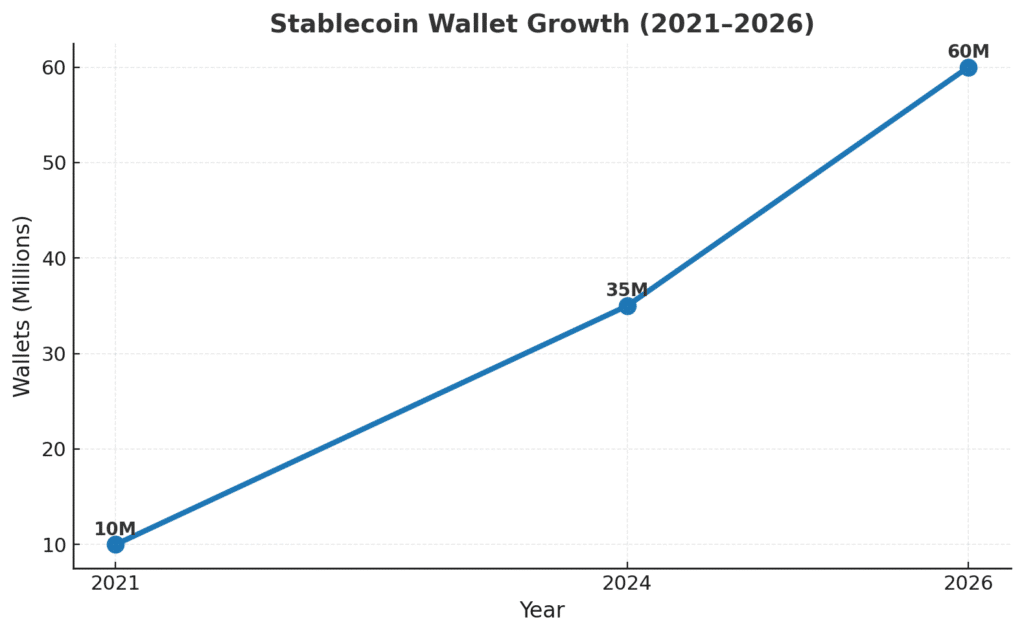
Stablecoin Wallet Growth 2021–2026
According to The Block and Thunes estimates, wallets increased to 35 million in 2024 (up by 10 million in 2021) and have a projection of 60 million in 2026.
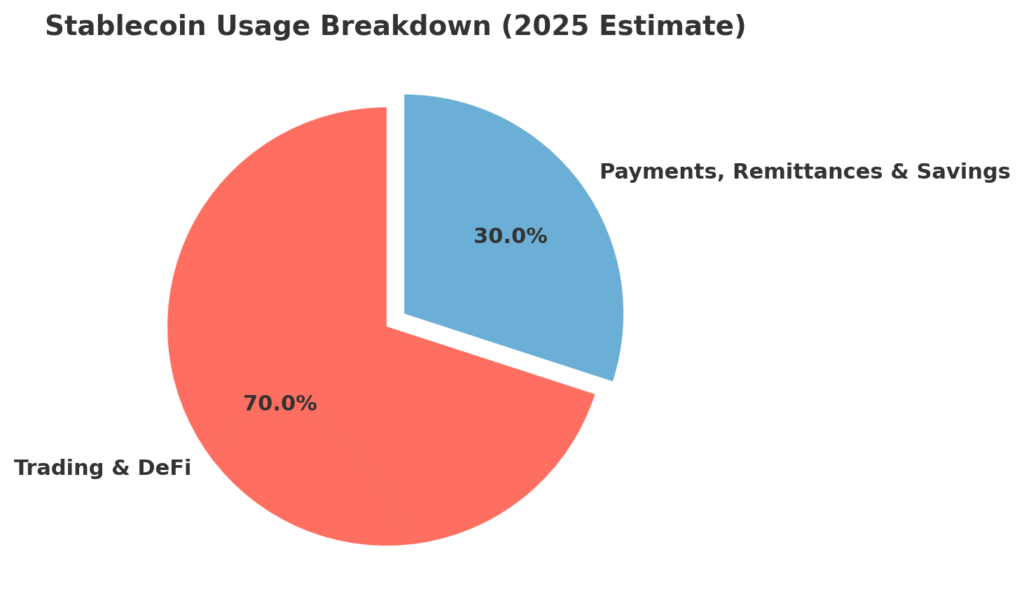
Stablecoin Usage Breakdown (2025 Estimate)
The use of stablecoins is also limited to trading and DeFi at approximately 70 percent. The other 30 percent comprises payments, remittances, and savings, but these are rapidly developing regions.
Challenges and Considerations
Stablecoins are not risk-free. Transparency remains a concern, with USDT often questioned about reserves. Regulation is expanding, with the U.S. GENIUS Act of 2025 and the EU’s MiCA setting stricter rules.
Algorithmic coins have failed, most notably TerraUSD in 2022. Even fiat-backed coins depend on issuer management and audits. Investors must choose carefully and diversify across issuers.
Future Outlook
Stablecoins are changing since the initial use as trading pairs on exchanges. They are also becoming a part of actual financial infrastructure, with them shortly anchoring tokenized treasuries, serving as collateral in crypto ETFs, and supporting decentralized lending markets. This change makes stablecoins not only a crypto tool but a common financial tool that would bridge between traditional finance (TradFi) and decentralized finance (DeFi).
McKinsey states that by 2030, the stablecoins might outperform the conventional card networks in terms of daily settlement volume, and the way payments, remittances, and corporate settlements are made. Another way central banks and fintech companies have been experimenting with hybrid models is by combining stablecoins and central bank digital currencies (CBDCs) to further accelerate adoption.
Meanwhile, legal certainty in terms of frameworks such as the GENIUS Act in the United States and MiCA in Europe will ensure that banks, asset managers, and institutions can issue and utilize stablecoins at scale. With its spread, stablecoins might be the foundation of international digital settlements, transforming capital markets and democratizing access to stable, cross-border money.
Conclusion
Stablecoins in crypto investing deliver real advantages: stability, liquidity, yields, and global access. They protect profits, fuel trading efficiency, and open markets to millions.
Challenges remain—regulation, transparency, and market share. But the trajectory is clear. Stablecoins are becoming the foundation of digital finance, linking crypto to traditional systems. For investors, they are not just a payment token but a core tool for managing risk and opportunity.
Frequently Asked Questions About Stablecoins in Crypto Investing
Are stablecoins safe for investing?
They are safer than volatile coins but depend on reserves and regulation.
How do stablecoins generate yield?
Through DeFi lending, staking, or centralized interest programs.
Can stablecoins lose their peg?
Yes, as seen with algorithmic failures, but top fiat-backed coins usually stay stable.
What are the best stablecoins for investing?
USDC, USDT, and DAI are most widely used.
Do stablecoins replace fiat for investors?
No, they complement fiat while offering on-chain efficiency.
Are there risks in staking stablecoins?
Yes—protocol hacks, exchange collapses, or withdrawal freezes.
How will regulation affect stablecoin investing?
It may increase trust but could reduce flexibility and yields.
Glossary
Stablecoin – A cryptocurrency pegged to a stable asset, usually USD.
Fiat-backed – Backed by cash or government securities.
Crypto-backed – Backed by other crypto assets.
Algorithmic – Uses supply rules to maintain value.
Peg – The fixed exchange value (e.g., $1).
Liquidity – Ease of buying or selling without price swings.
APY – Annual Percentage Yield from lending or staking.
DeFi – Decentralized finance applications.
Tokenization – Converting real assets into digital tokens.
Collateral – Assets pledged to back loans or positions.
Summary
This blog highlights the top benefits of stablecoins in crypto investing. Backed by fiat, they are stable, have liquidity, risk management, yield potential, low fees and are available. In the year 2024, more than $27.6 trillion were processed by stablecoins, beating Visa and Mastercard. wallets increased to 35 million in 2024 and they are expected to reach 60 million by 2026. Although risks persist around reserves and regulation, stablecoins are also becoming a part of institutional finance with Visa pilots and McKinsey forecasts. They could be as large as card networks by 2030.