





In the crypto space, there has been a term of greater significance than any other, and that is stablecoin. In contrast to such digital currencies as Bitcoin or Ethereum, which change in value daily, a stablecoin is intended to remain in equilibrium. It is either anchored on the U.S dollar, the euro, or even the gold..
This stability makes stablecoins unique in a market that is characterized by volatility. Stablecoins are the stepping stone between conventional finance and digital assets for many traders, investors, as well as businesses. They enable individuals to transfer funds in a fast manner, make cross-border trades, and prevent extreme fluctuations in prices.
Stablecoins are not only a technical instrument. They also lie in the middle of another of the most prominent debates in the field of finance: the regulation of crypto. The governments, central banks, and institutions are keeping a close eye. The rules and regulation will determine how far stablecoins can go when they become the future of digital money.
What Is a Stablecoin?
A stablecoin is a cryptocurrency that is stable in value. One USD Coin (USDC) will be equal to one U.S dollar. The concept is not complicated but effective. Stablecoins are more convenient to use in payments and savings because they eliminate the volatility of other cryptocurrencies.
Conventional cryptocurrencies are thrilling but erratic. One day, Bitcoin can increase by 10 percent and the next day it can decline by the same margin. This complicates their use of by people to make the day-to-day purchases such as groceries or rent. The stablecoin addresses this by pegging its value to something people already trust, such as fiat money.
By far the most popular is a fiat-backed stablecoin, in which each token in circulation is backed by a dollar, euro, or yen in reserves. Not all stablecoins are the same model, though Others have the support of other cryptocurrencies. Other companies use algorithms to achieve a balance between demand and supply.
Types of Stablecoins
Not all stablecoins are created equal. They fall into three major categories, each with unique strengths and weaknesses.
- Fiat-backed stablecoins
- Backed by traditional money such as U.S. dollars, euros, or government bonds.
- Claim to hold reserves in banks at a one-to-one ratio.
- More reliable but requires trust in the issuer’s reserve management.
- Examples: USDC, Tether (USDT).
- Crypto-backed stablecoins
- Collateralized with other cryptocurrencies like Ethereum.
- Must be over-collateralized to protect against price swings.
- Example: To issue $100 in DAI, the system may require $150 in Ether as collateral.
More decentralized but exposed to crypto market risks.
- Algorithmic stablecoins
- Do not hold reserves of fiat or crypto.
- Use algorithms to expand or contract supply to maintain value.
- Once seen as a decentralized alternative, but highly fragile.
- Example: TerraUSD (collapsed in 2022), which lost its peg and erased billions in value.
Why Stablecoins Matter
Stablecoins play a central role in the digital economy. They are not only a tool for traders but also a gateway for everyday users.
One of their biggest strengths is speed. Sending a bank wire across countries can take days. With stablecoins, the transfer can happen in seconds, no matter where the sender and receiver live.
Costs are another advantage. International transfers through banks or remittance services can cost as much as 7 percent in fees. Stablecoin transfers cost almost nothing. For workers sending money back home to their families, this difference can be life-changing.
Stablecoins also make crypto trading smoother. They act as a safe middle ground when markets swing. Instead of cashing out into dollars, traders can move into stablecoins instantly and avoid heavy banking fees.
In countries with unstable local currencies, stablecoins are becoming a safe store of value. In Argentina, Nigeria, and Turkey, people are turning to USDT or USDC to protect their savings from inflation. For many, stablecoins provide financial access where banks cannot.
Stablecoin and Crypto Regulation
The emergence of stablecoins has attracted the interest of regulators all over the world. The rationale is clear: when stablecoins are left to flourish, they may end up competing with currencies, payment systems, and even the central banks.
In the United States, bills on stablecoins have been under discussion over the years. In June 2025, one of the biggest steps was the Genius Act, which implemented more stringent regulations on audits and reserves. The legislation makes issuers of tokens prove that they have sufficient cash and short-term bonds to cover their tokens. It also establishes firm punishment for mismanagement.
The European Union has followed the same direction The regulation of its MiCA, which entered into force in 2024, regulates transparency and licensing. Reserves are to be disclosed in which location they are held and the issuers are audited regularly.
Other countries are at varying paces. Singapore and Japan have been very accommodating of stablecoins through explicit regulatory frameworks. China has, however, prohibited most crypto activities as it concentrates on its own central bank digital currency.
The demand for regulation is not the ban on stablecoins. It is not about risk elimination but control. The greatest fears of governments are fraud, money laundering, and the threat to financial stability. Regulation can offer the confidence that businesses and institutions need to turn to stablecoins in full.
Stablecoins vs. Traditional Payments
To understand why stablecoins matter, it helps to compare them with traditional payment systems.
| Feature | Stablecoins | Bank Transfers | Credit Cards |
| Speed | Seconds | Hours to days | Instant but with middlemen |
| Cost | Near zero | $20–50 for wires | 2–3% fees |
| Access | Global internet access | Requires a bank account | Requires credit approval |
| Transparency | Public blockchain | Private bank records | Private systems |
Real-World Use Cases
The stablecoins are no longer a concept millions of people and institutions are already using them.
USDC is one of the most regulated and trusted stablecoins of Circle. It also collaborates with Visa and PayPal in making international payments. To many companies, it provides an opportunity to use blockchain technology without the risk of price fluctuations.
Tether (USDT) has the largest market cap. It is very common in trading and remittances, particularly in areas with shaky economies. Its transparency is questioned but no other currency is adopted all over the world as it is.
Another way forward is illustrated by DAI, a decentralized stablecoin on Ethereum. It does not use banks but takes crypto collateral and smart contracts. This gives it increased resistance to censorship but also a more complicated interface to use.
These are some of the stablecoins in existence. Between centralized behemoths such as Tether and decentralized projects such as DAI, each serves a different niche in the digital world.
Security, Risks, and Failures
Despite their promise, stablecoins carry risks. The biggest is reserve transparency. If an issuer fails to hold enough reserves, a coin could lose its peg. Tether has faced criticism for years about whether it truly holds all the cash it claims.
Technology is another risk. Smart contract bugs or hacks could drain funds from decentralized projects. Even well-audited code can have flaws.
Regulatory pressure is also real. A government could shut down an issuer or ban a coin in its jurisdiction. This would affect users worldwide.
The most dramatic example of failure was TerraUSD. Marketed as an algorithmic stablecoin, it collapsed in May 2022, wiping out over $40 billion in market value. The event shook confidence in the entire crypto industry and proved that not all stablecoins are equal.
Stablecoin Growth Trends: 2024–2025
Recent market data affirms that stablecoins continue their rapid expansion across supply, activity, and real-world relevance.
- Supply Surge
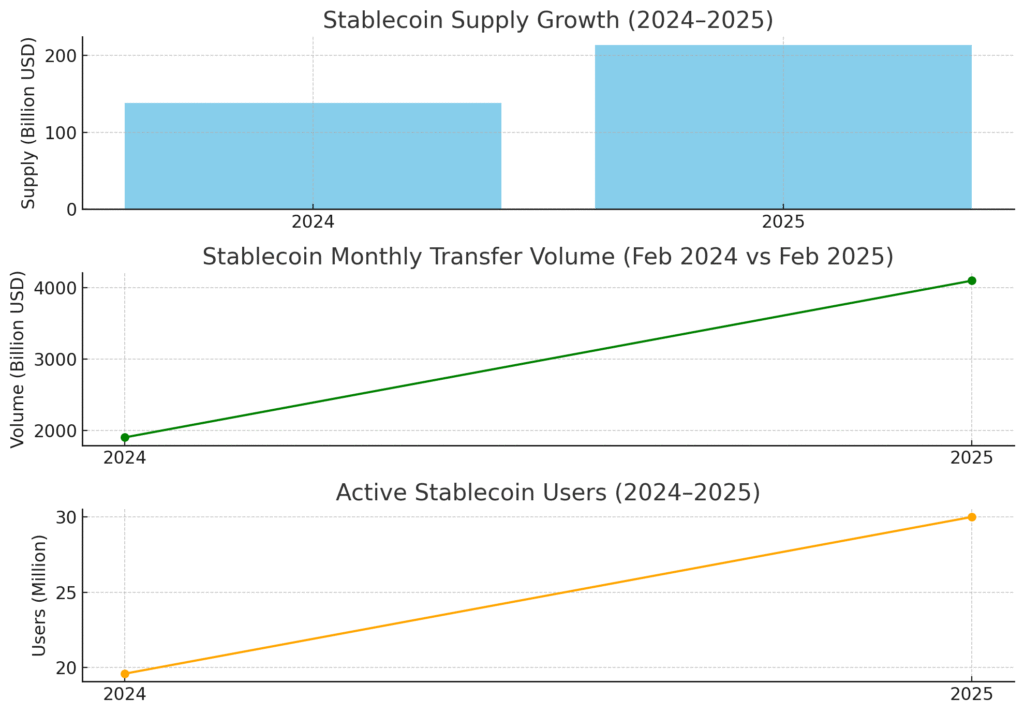
In February 2024, total stablecoin supply was about $138 billion. By early 2025, that had jumped to $214–225 billion, marking a 63% year-over-year increase.
Transfer Volume Explosion
Monthly transfer volume rose from $1.9 trillion in February 2024 to $4.1 trillion in February 2025—a dramatic 115% increase. Overall, stablecoins shuttled over $35 trillion in transfers during 2024, outpacing annual throughput of traditional systems like Visa ($15 t) and Mastercard ($9 t in Q4 alone). - User Adoption Boom
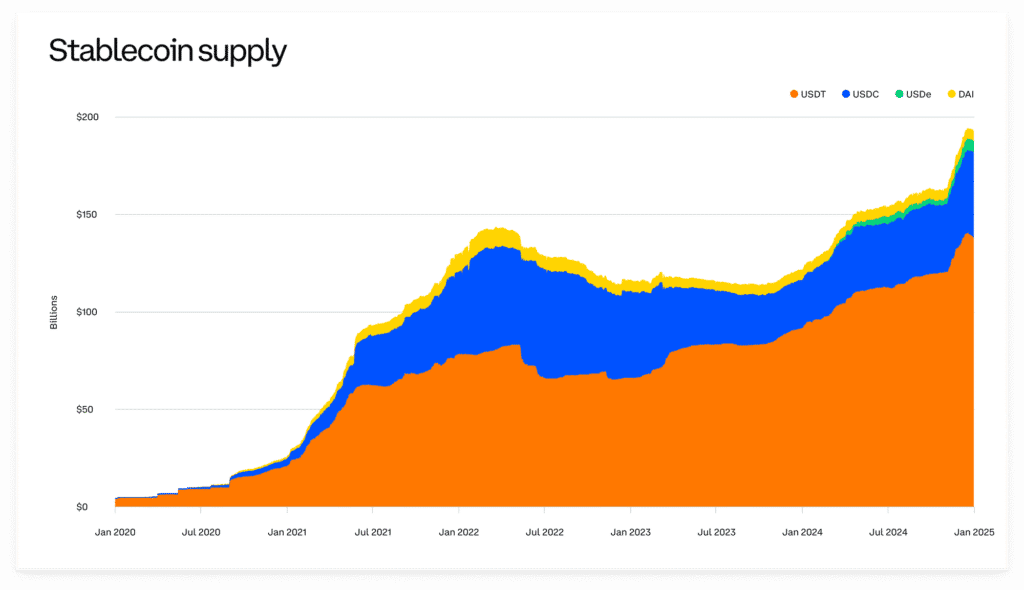
Active stablecoin addresses rose from 19.6 million to 30 million, a 53% increase in just one year Ledger InsightsThe Coin Republic+8Cointelegraph+8Medium+8. - Shifting Market ShareUSDT (Tether): Grew in absolute terms from $96 billion to $146 billion but shed market share from 69% to 64%.
- USDC (Circle): Doubled supply from $28.5 billion to $56 billion, climbing to 25% of total stablecoins.
- In transfer volume, USDC leads with 66%, up from 56%, while USDT lags behind.
- Emerging Stablecoins Gain Ground
A newcomer, Ethena, soared from $0.62 billion to $6.2 billion in supply, becoming the third-largest stablecoin as of early 2025. - Real-World Payments Rising
Artemis estimates about $26 trillion in annual on-chain stablecoin settlements are in motion, particularly in B2B channels. February 2025 alone saw a 288% increase in B2B payments compared to the prior year.
What This Trend Means
- Stablecoins are scaling beyond crypto trading.
They are now central to global payments, settlement infrastructure, and institutional liquidity. - Regulatory clarity fuels adoption.
USDC’s gains reflect its licensing under frameworks like MiCA (EU) and recognition in Canada and Dubai - Institutional interest is rising.
Banks and fintech players are now entering the stablecoin space, eyeing optimized cross-border payments - Treasury demand is increasing.
Stablecoin issuers now hold an estimated $200 billion in U.S. Treasuries, signaling a growing connection between stablecoin issuance and short-term government debt demand
Conclusion
Stablecoins are more than a footnote in crypto. They form an important brick of the digital economy. They are stable enough to be fast and globally available, which resolves issues that cannot be addressed using a traditional currency.
But their future is in the hands of trust and regulation. Confidence can disappear in the night as soon as there are no clear rules and strong reserves. Proper regulation, however, can make stablecoins the most significant currency in the 21st century.
At this time, they are a promise and a risk. Stablecoins are changing the way people think about money, whether they are being used as a global remittance, or a crypto trading instrument, or as a means of online payment. And with regulation in the future, their role will be expanded.
Frequently Asked Questions About Stablecoin
How are stablecoins different from other cryptocurrencies?
They are made to maintain a constant value, which is normally pegged to a fiat currency, the dollar.
Are the stablecoins as reliable as bank money?
This is dependent on the issuer. Audited and regulated coins such as USDC are more reliable than opaque coins.
Is it legal to Q? Are stablecoins legal?
Yes, in the majority of countries. Rules are also different and there are strict limits in some places.
What happens when a stablecoin de- question mark is de-pegged?
Its price falls below 1 dollar, and it results in losses to holders. This occurred with TerraUSD.
Are stablecoins an alternative to the traditional banks?
Not entirely. They are good at payments and savings though they are not yet full-fledged banks.
What is the regulator’s view on stablecoins?
With caution. Governments are interested in oversight to avoid fraud and safeguard financial systems.
Which is the safest stablecoin?
Stablecoins with clear reserves and auditing are safer, like USDC.
Summary
Stablecoins are cryptocurrencies that are pegged to stable assets like the American dollar. They also stabilize the volatility of cryptocurrencies and accelerate digital payments to be cheaper and more accessible everywhere. Fiat-collateralized coins such as USDC and Tether prevail on the market, whereas crypto-collateralized and algorithmic models provide alternatives. Stablecoins are now being used as important instruments of remittances, online payments and trading. Risks are still in reserves, technology, and regulation. Governments globally are acting to regulate stablecoins to make them transparent and stable. Stablecoins are full of opportunity and risk because of the amount of money in circulation, over 150 billion dollars. Their development indicates that they can influence the future of finance as they combine traditional banking and digital development.