





Money has always evolved. With gold coins and banknotes and then digital cards, every transaction was quicker and easier. A new player is transforming the system now: stablecoins.
Contrary to Bitcoin or Ethereum, stablecoins maintain a fixed value because they are pegged to a currency such as the US dollar or the euro. That is why they are less risky to banks, businesses, and ordinary users.
It is not only a story about crypto. It is concerning the way Stablecoins in Traditional Finance are forging a pathway between the old money systems and the new world of blockchain. This bridge is revolutionizing the movement of money across the border, how corporations can pay and how the financial services will expand in future.
Stablecoins In Simple Words
A stablecoin is a token on a blockchain. It has a very easy task; to remain equal with something stable, commonly fiat currency.
There are three main types:
- Fiat-backed stablecoins: Every coin is backed by cash or short-term bonds (as the case with USDT, USDC).
- Crypto-backed stablecoins: Secured by other crypto (such as DAI).
- Algorithms: Attempt to maintain value by code and supply gimmicks (as with the failed Terra).
Fiat-backed stablecoins are targeted by most banks and regulators. They are simple to interpret and less dangerous. This is the reason why they fuel the majority of the Stablecoin adoption at the present time.
Why Traditional Finance Needs A Bridge
Traditional Finance has strengths: it is regulated, trusted, and used widely. But it also has pain points:
- Delayed transfers: Cross-border wire transfer takes 1- 3 days.
- The prices are high: Remittance fees are 6.5% on $200.
- Poor access: Billions of individuals have no bank accounts.
- Limited hours: Banks are not open during weekends and holidays.
The solutions are stablecoins. They transfer value in seconds, cost cents to transfer, and operate 24/7 across the world.
That is why stablecoins are not a mere crypto token. They are an interface that links the pace of blockchain with the credibility of banking.
How Stablecoins Bridge The Gap
Stablecoins fill the gap in three evident capacities:
Familiar Value On New Rails
Stablecoins are anchored to common currencies such as dollars or euros. The fact that they behave as cash online makes people trust them.
Faster Settlement At Lower Costs
Whereas banks charge up to 20-50 dollars to send international wire, a stablecoin transfer can be as little as one dollar.
Integration With Both Worlds
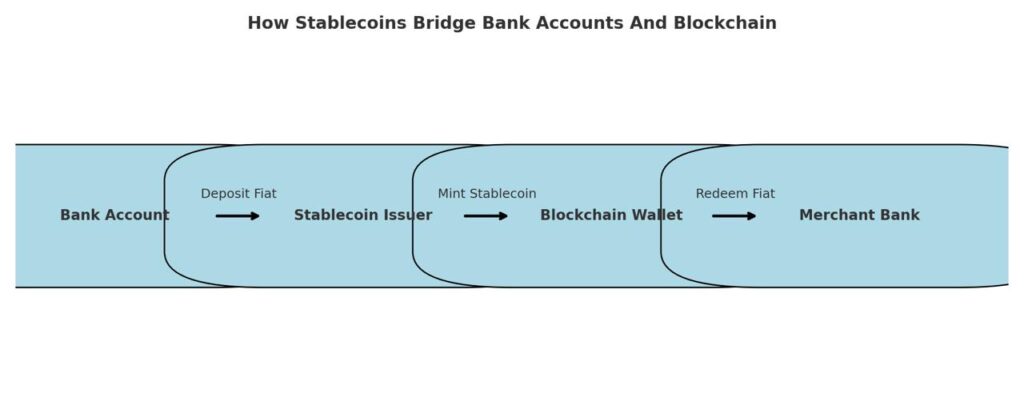
Stablecoins may be transferred to a blockchain wallet and back to a bank account. USDC is already used by payment companies such as Visa and Stripe to interoperate merchants, banks, and digital wallets.
Example: A Payment Flow
- A buyer pays a merchant using USDC.
- Visa or Stripe processes the transaction instantly on blockchain.
- The merchant’s account receives fiat money the same day.
Real-World Adoption Stories
Visa
Visa now uses USDC on Solana to settle transactions with acquirers like Worldpay and Nuvei. This means merchants in one country can get paid almost instantly from customers abroad.
Stripe
Stripe reintroduced crypto payments in 2024. It accepts USDC on Ethereum, Solana, and Polygon, converting it to fiat for merchants.
Societe Generale
The French bank launched EURCV, a euro-pegged stablecoin, under EU rules. It shows how banks themselves are now issuing regulated stablecoins.
These examples prove stablecoins are no longer just experiments. They are entering mainstream finance.
The Numbers Behind Adoption
Stablecoin adoption is growing fast. Let’s look at the data.
Stablecoin Market Share (Aug 2025)
| Stablecoin | Market Share |
| USDT | 60% |
| USDC | 23% |
| DAI | 5% |
| PYUSD | 2% |
| Others | 10% |
Key takeaway: Two coins, USDT and USDC, dominate more than 80% of the market.
Cost To Send $200 Internationally
| Method | Average Cost |
| Domestic Bank Wire | $26 |
| International Bank Wire | $44 |
| Traditional Remittance (avg) | $12.98 (6.49%) |
| Stablecoin Transfer | $0.50 |
Key takeaway: Stablecoins are dramatically cheaper, especially for small payments.
Annual Transaction Volumes (2024)
| Network | Volume (USD Trillions) |
| Stablecoins | 27.6 |
| Visa | 13.2 |
| Mastercard | 9.8 |
Key takeaway: Stablecoin transaction volume already exceeds Visa + Mastercard combined.
Rules That Build Trust
For banks to use stablecoins, rules must be clear. Three regions lead:
- European Union (MiCA): Since June 2024, stablecoins must meet reserve and redemption rules. Circle is now licensed in France to issue USDC and EURC.
- United States: The GENIUS Act and NYDFS guidance require strict reserves, redemption rights, and disclosures.
- Singapore (MAS Framework): A global leader in clear rules, with labels for MAS-regulated stablecoins.
These frameworks make it safer for banks and fintechs to adopt stablecoins.
Lessons From The Past
In 2022, Terra’s algorithmic stablecoin collapsed. It showed the risks of coins without real reserves.
Since then, most growth has moved to fully backed coins like USDT and USDC. Regulators now demand proof of reserves, audits, and redemption guarantees.
Lesson learned: Trust comes from transparency.
Beyond Payments: What Comes Next
Stablecoins are not just for payments.
- Treasury: Companies hold stablecoins for quick payouts or idle cash.
- DeFi: Lending, borrowing, and trading on blockchain rely on stablecoins.
- Tokenization: Assets like bonds and funds are being tokenized, often settled in stablecoins.
- Programmable Money: Smart contracts allow conditional payments, escrow, or streaming salaries.
This shows stablecoins are not just a bridge; they are building blocks for the future of finance.
Stablecoins And CBDCs Together
Stablecoins are private. CBDCs are public.
- CBDCs: Issued by central banks, ensuring state-backed trust.
- Stablecoins: Run by private firms, driving innovation.
They are not enemies. They can complement each other. CBDCs may serve as base money, while stablecoins provide speed and flexibility.
Risks And Roadblocks
Despite growth, risks remain:
- Peg risk: If reserves are weak, a stablecoin can lose value.
- Regulatory gaps: Not all countries have rules yet.
- Cybersecurity: Hacks and wallet thefts remain threats.
- Market impact: Large stablecoin flows can affect Treasury yields.
These risks explain why strong regulation is needed.
Global Adoption Trends
The adoption of stablecoins does not take place everywhere. Most of the stablecoins in the United States are pegged to the dollar and a crypto trading base layer.
Banks remain careful, however, until federal laws such as the GENIUS Act provide a clear green light.
The MiCA regulation turned the EU into one of the first regions to have a single framework in Europe. This gives banks confidence.
Circle now issues USDC and EURC from France under MiCA. That is a pattern of how stablecoins can be integrated into the orthodox banking.
In Asia, Singapore is ahead. Its MAS structure introduces a rigid reserve policy and even a label of MAS-controlled. Japan also had legislation that enabled stablecoin to be issued by licensed banks and trust companies. Hong Kong is preparing the same rules.
Stablecoins are used in everyday Latin America. In the high inflation countries such as Argentina, individuals switch to saving in dollar pegged coins.
Stablecoins are becoming a remittance instrument in Africa, where the rate of remittances is excruciating due to expensive cross-border fees and depreciated currencies.
This demonstrates that stablecoins are not only a Western experiment in finance. They are an international aid to very different purposes.
Stablecoins In Everyday Life
For many people, stablecoins are not about complex finance. They are about solving simple, daily problems.
- Remittances: Migrant workers send money home. Traditional methods take days and cost up to 10%. A stablecoin transfer can arrive in minutes for a fraction of the cost.
- E-commerce: Some online merchants now accept stablecoins directly. For international sellers, this means faster access to funds without waiting for bank clearing.
- Savings in unstable economies: In countries with inflation, stablecoins act like digital dollars. They protect families from currency collapse and provide access to a global store of value.
Each of these use cases makes stablecoin adoption spread faster, especially in regions underserved by traditional banks.
Institutional Interest In Stablecoins
It is not only individuals who care. Large financial institutions are also watching stablecoins closely.
Hedge funds use stablecoins to move money between exchanges. Stablecoins reduce settlement risk because trades can be closed instantly.
Asset managers explore stablecoins as a way to hold liquidity between trades. Instead of cash, they can use USDC or USDT on blockchain, earning yield on tokenized money market funds.
Corporate treasurers are also testing stablecoins. For example, a global company paying suppliers in multiple countries can use stablecoins to reduce FX fees and speed up settlement.
These use cases show that stablecoins are slowly moving from crypto-native users to mainstream finance.
Technology Under The Hood
Stablecoins run on blockchains, but the choice of chain matters.
Ethereum is the most secure but often expensive. Solana is cheaper and faster, making it popular for Visa’s USDC settlement. Polygon and Avalanche are also used for cheaper transactions. Tron dominates in Asia and emerging markets due to low costs.
Stablecoins also bring programmability. Smart contracts allow automated payments, escrow, and conditional transfers. Imagine payroll that streams by the minute or an insurance payout that triggers automatically when an event occurs.
This is where stablecoins go beyond being “digital dollars” — they become programmable money, something bank transfers cannot offer.
Future Outlook For Stablecoins
The future of stablecoins can go through the various routes, yet one thinwg is certain: they will not cease being a bridge between Traditional Finance and crypto.
The first consequence may be Mainstream Integration. With stablecoins adopted in mass, banks, card networks, and remittance firms would roll them out as easily as a debit card. The merchants would be paid immediately, consumers could pay without straining and businesses would transfer money globally without rubbing shoulders.
Another possibility is Regulated Consolidation. As rules tighten, only a handful of issuers may survive. Coins like USDC, PYUSD, and regulated bank-issued tokens could dominate. Smaller, unregulated coins may fade, leaving a market that looks more like banking today — controlled, trusted, and standardized.
A third path is Competition With CBDCs. Central banks are testing digital currencies of their own. In some regions, CBDCs may replace private stablecoins. In others, stablecoins may continue to lead thanks to their global reach and flexibility.
Whatever the scenario, adoption is rising and regulations are catching up. Payment giants like Visa and Stripe, and banks like Societe Generale, are already testing real use cases. Stablecoin transaction volumes are already in the trillions.
The bridge is getting stronger. In the coming years, stablecoins may not just be an option for crypto users — they may become a trusted, fast, and global way to move money for everyone.
Conclusion
Stablecoins truly bridge the gap between Traditional Finance and crypto. They bring stability to the speed of blockchain. They cut costs in cross-border payments. They run all day, every day.
With rules from the EU, US, and Singapore, they are safer than ever. With adoption by Visa, Stripe, and global banks, they are moving mainstream.
Stablecoins in Traditional Finance are no longer experiments. They are the future rails of money — the bridge between the old and the new.
Frequently Asked Questions For Stablecoins in Traditional Finance
What makes stablecoins different from Bitcoin?
They hold a fixed value by being pegged to fiat money, unlike volatile crypto.
Why are banks interested?
They enable faster, cheaper payments and new financial services.
Are stablecoins safe?
Yes, if backed by strong reserves and regulated. Algorithmic stablecoins are riskier.
How much are stablecoins used today?
Over $27 trillion in transaction volume in 2024.
Do stablecoins replace CBDCs?
No, they complement each other.
What risks exist?
Peg breaks, weak reserves, hacks, and unclear regulation.
Which companies use stablecoins now?
Visa, Stripe, and banks like Societe Generale.
Glossary
- Stablecoin – A digital token pegged to fiat currency.
- Peg – The fixed 1:1 link to money like the US dollar.
- Reserve – Assets like cash or Treasuries that back stablecoins.
- Redemption – The right to swap a stablecoin for fiat.
- MiCA – EU regulation for crypto markets.
- NYDFS – New York regulator with strict stablecoin rules.
- MAS – Singapore’s financial regulator, with a stablecoin framework.
- CBDC – Central bank digital currency.
- DeFi – Decentralized finance using blockchain.
- Tokenization – Converting assets into blockchain tokens.
Summary
Stablecoins occupy the space between Traditional Finance and crypto: they combine the speed of blockchain with the trust of fiat. They are also not volatile like cryptocurrencies, because they are supported by reserves. They are used by banks, merchants, and fintechs to make payments, remittances, and settlements. Visa and Stripe process transactions with USDC, while Societe Generale issues a euro stablecoin under EU rules.
It is changing toward global adoption rapidly. The stable coin market has almost 280 billion in value, and in transfers, it is above 27 trillion each year. Laws such as the MiCA of the EU, the GENIUS Act of the US and MAS of Singapore give greater regulation. There are still risks, particularly when the coins are not backed, but a clear reserve and audit inspire trust.
In addition to the payment, the stablecoins drive DeFi, corporate treasury, and tokenization. They do not substitute CBDCs, they supplement them. It is remaking the financial system across the globe as stablecoins continue to gain momentum, being fast, inexpensive, and increasingly regulated.