



Last updated: November 21, 2026
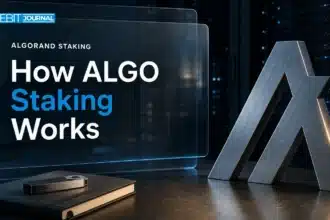
An Algorand staking guide should start with one distinction: having ALGO in an account can allow consensus participation, but protocol reward eligibility has a higher balance threshold. As of November 21, 2026, Algorand describes solo participation as non-custodial and without a lockup, while reward amounts remain variable.
Quick answer
You can participate in Algorand consensus with as little as 1 ALGO, according to Algorand’s FAQ, but an account needs at least 30,000 ALGO to qualify for protocol staking rewards. Smaller holders may use a pool or delegation service, but that adds provider and technical risks, and reward amounts depend on service terms and performance.

Algorand staking guide: steps to get started
Staking on Algorand means helping the network reach consensus by running a node and making eligible ALGO available in a participating account. It differs from the older governance reward program. Algorand says governance rewards ended after Governance Period 14; later governance sessions are for community decision-making, while consensus staking rewards are separate.
- Choose your participation route. Decide whether to run your own node or use a pool or delegation service. Solo participation gives you direct control, while a third party may make it possible to participate in rewards with a smaller balance. Read the provider’s terms and understand who controls the assets.
- Check the balance threshold. Algorand’s published FAQ says an account needs at least 30,000 ALGO to qualify for protocol staking rewards. The published solo-staking range has a 70 million ALGO maximum. Participation in consensus may be possible from 1 ALGO, but that alone does not meet the reward threshold.
- Prepare your wallet and node. For solo staking, keep control of your wallet and never share its recovery phrase. Algorand’s node guidance lists at least 8 vCPU, 16 GB RAM, a fast 100 GB NVMe SSD or equivalent, and a good internet connection, ideally 1 Gbps.
- Configure participation and check status. Follow Algorand’s current node documentation to connect the account and node. Confirm the node is operating as expected, then monitor its performance. A node that performs poorly can be removed from consensus and miss rewards.
- Review rewards and access regularly. Algorand says the reward model allocates 50% of transaction fees in a block to its proposer, alongside a Foundation-funded bonus. That bonus started at 10 ALGO per block and decays by 1% every million blocks. Algorand reaffirmed support for staking rewards through January 2028 in its November 6, 2026 community update. These details are not a fixed APR or a promise of future income.
If you’re new to the network, our guide to how Algorand and ALGO work covers the underlying system. Algorand’s official staking instructions provide network-specific setup details. This Algorand staking guide is educational, not a substitute for checking current documentation before changing account settings.
Solo staking and pools compared
The main difference is who runs the validator and what risks sit between you and any reward. In solo staking, the ALGO remains in your wallet, according to Algorand. A pool can lower the entry barrier, but you rely on the operator and the service’s rules.
| Route | Who operates the node? | What to check |
|---|---|---|
| Solo participation | You | Hardware, uptime, setup and reward eligibility |
| Pool or delegation | A service or validator | Fees, custody, payout terms and operator track record |
| Liquid staking | An application or its validators | Smart contract, token liquidity and redemption conditions |
Algorand’s staking page says liquid-staking applications and pools may be available for any ALGO amount. Liquid staking typically issues a token representing staked ALGO, but that token can have separate liquidity and smart-contract risks. Pool rewards depend on the validator’s rewards and the provider’s terms, so compare the actual arrangement rather than assuming it matches solo staking.

Common mistakes and risks
A common error is treating consensus participation as automatic reward eligibility. The 1 ALGO participation minimum and the 30,000 ALGO reward threshold are different requirements. Check the current official rules because reward arrangements and network parameters can change.
Another mistake is assuming rewards are fixed or that past network totals predict what an individual will earn. Blockworks’ Q3 2026 Algorand report said validators earned 20.06 million ALGO during that quarter. That is a network-wide historical figure, not a personal yield estimate. Algorand says solo-staked ALGO is not subject to slashing, but a poorly performing node can miss rewards. Pools introduce counterparty risk, and liquid-staking tokens add smart-contract and market-liquidity risks.
Staking also does not remove ALGO’s price volatility. A reward paid in ALGO can be worth less in fiat if the token’s market price falls, and a participant can lose some or all of their funds through wallet compromise, a flawed application, a dishonest service or other operational failures. Never share a seed phrase to access a staking service. If you’re still acquiring tokens, this separate guide explains how to buy Algorand without conflating purchasing with staking.
Algorand said on November 6, 2026 that Project King Safety was paused indefinitely and reaffirmed reward support through January 2028. Treat that as a dated statement; the source does not establish program details beyond the announced period.

Algorand staking guide FAQ
Can I stake Algorand with a small amount?
Algorand says accounts with as little as 1 ALGO can participate in consensus, but at least 30,000 ALGO is required for protocol staking reward eligibility. Pools or delegation services may offer ways for smaller holders to participate in rewards, subject to their terms and risks.
Does Algorand staking lock my ALGO?
For solo consensus participation, Algorand says ALGO stays in the user’s wallet without a lockup. A pool or liquid-staking service can have different withdrawal rules, so check them before depositing or connecting an account.
Are Algorand staking rewards fixed?
No. Reward amounts can vary with network activity, the Foundation-funded bonus, node performance and any pool’s terms. Algorand’s published support commitment through January 2028 is dated information; the source does not state a fixed return or describe rewards after that period.
Sources
- Stake Your ALGO For Rewards | No Slashing Risk | Algorand (algorand.co)
- Algorand price and market data (CoinGecko)
- Algorand Staking Rewards FAQ (algorand.co)
This article is for informational purposes only and does not constitute financial or investment advice. Cryptocurrencies are highly volatile; always do your own research before investing.