







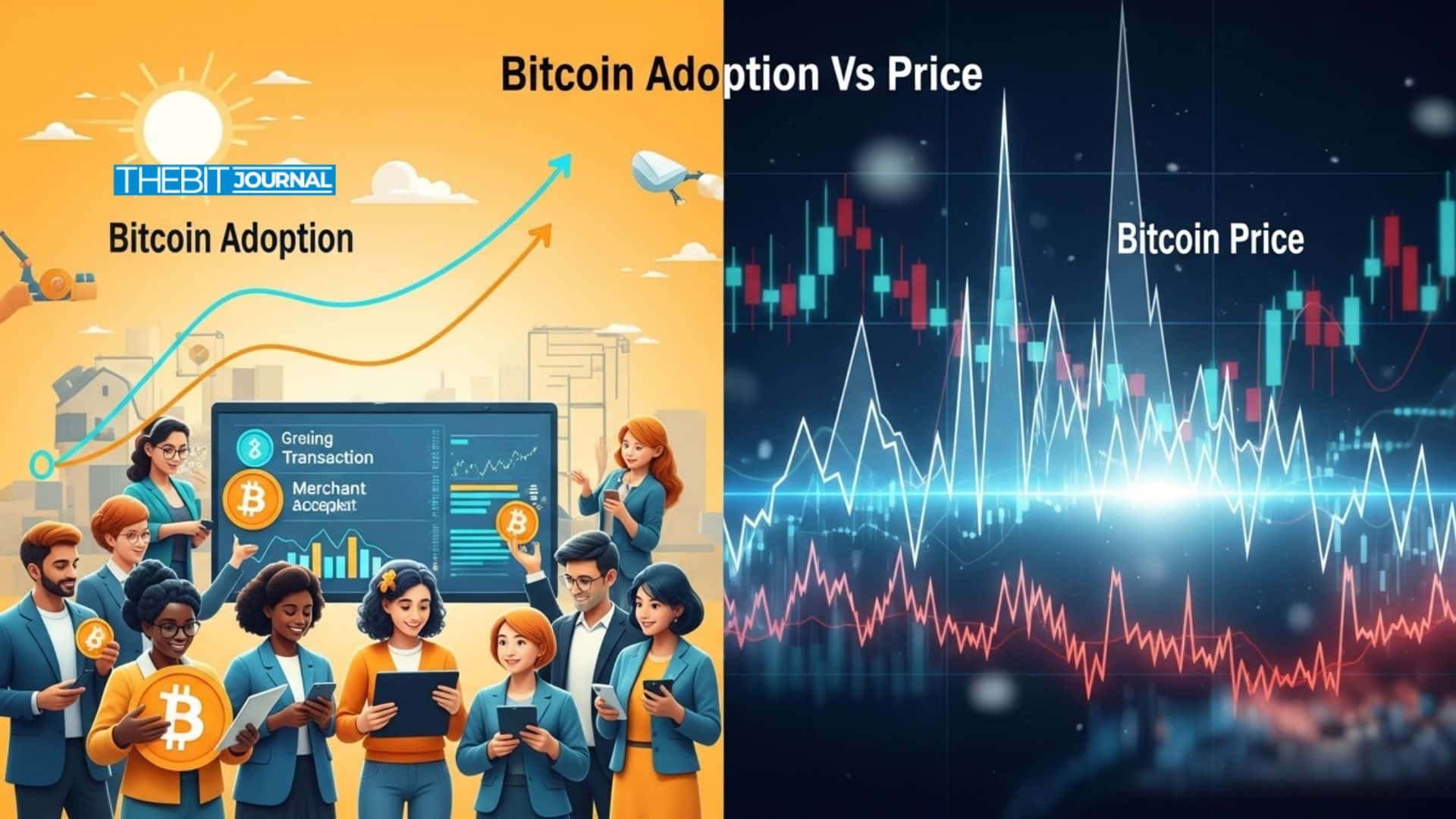
The increasing difference between Bitcoin adoption and market price, is one of the factors currently influencing crypto markets. At first glance, Bitcoin seems stuck in place. The asset’s value has remained relatively tame, hovering around $70K and spending months below its previous highs.
But behind that price action; the data tells a different story.
Over the past year, adoption across institutions, banks, corporations, merchants and even governments has accelerated sharply; even as performance on price was muted.
Why the surge in adoption, while price can’t seem to get out of its own way?
Adoption and Price Show Two Alternate Realities
To appreciate the Bitcoin adoption compared to the price gap, one must first understand that both measures are following entirely different forces.
Adoption shows long-term structural change. It addresses questions such as who exactly is hoarding Bitcoin, what institutions are adopting it and how extensively it is being deployed across payments and finance.
Price, meanwhile, is set in real time. It responds to marginal demand and supply, liquidity conditions, derivatives positioning and the wider macro sentiment.
This makes clear why vigorous adoption alone does not drive prices up.
As recent market analysis finds, ownership can grow considerably without igniting a rally if demand from new buyers is matched by selling among holders. And that is exactly what has occurred in this cycle.
829K BTC Added But Price Did Nothing
In 2025 alone, institutions which range from businesses and governments to funds and ETFs accumulated around 829,000 BTC, a massive transfer in ownership structure. That accounted for one of the biggest single-year leaps ever in institutional exposure.
Much of that demand was met by distribution from long-term holders and early adopters. Rather than increasing prices, Bitcoin supply just changed hands.
That explains why the division between Bitcoin adoption and price have become so stark.
As one report pointed out, adoption is “compounding in ways that aren’t impacting the price, yet.”
ETFs, Banks and Advisors Are Opening the Door
There has also been explosive growth of financial infrastructure around Bitcoin, beyond direct accumulation.
Registered investment advisors who together manage around $146 trillion worth of assets have now been net buyers into Bitcoin for eight quarters in a row, deploying close to $1.5 billion per quarter into Bitcoin ETFs. This steady flow is important, as it represents consistent, long-term capital coming into the market.
Meanwhile, nearly 60% of major US banks are working on Bitcoin-related products; custody and trading and advisory services. But scaling these developments takes time.
A lot of these products are still in a tentative stage of rollout, and most are intended for institutional or high-net-worth clients. That means their influence on price is still slow, not direct.
This is yet an additional reason why the Bitcoin adoption vs price gap exists.
Merchant Growth and Lightning Volume Break New Records
In 2025, merchant adoption increased seriously, as the number of businesses accepting Bitcoin rose and global payment usage increased by 74%.
The Bitcoin Lightning Network has been a huge factor in this transition. Lightning Network Volume Reached $1.17 Billion in November 2025, proving that Bitcoin is now being spent beyond small retail transactions.
Other estimates track the network at over $1.1 billion monthly volume and about 300% year-over-year rise in transaction growth. This growth is accompanied by an important caveat.
The majority of merchants still immediately convert Bitcoin payments into fiat. That means activity in transactions doesn’t always manifest as sustained buying pressure on the market.
Price action is therefore confined alongside utility improvement.
Sovereign and Corporate Adoption Expands Globally
Five other nations added Bitcoin to reserves in 2025, with sovereign wealth fund participation from Saudi Arabia and Luxembourg, as well as purchases by Brazil, Taiwan and the Czech Republic.
This increased the number of countries that had some form of Bitcoin exposure to about 23. Corporate adoption has also accelerated.
Corporates were the biggest buyers of the year, with treasury-weighted institutions boosting their holdings. According to some estimates, corporate Bitcoin adoption is increasing 2.5-fold year over year as billions more are added to balance sheets.
Most of that accumulation happens via over-the-counter trades or stealth purchasing tactics meant to not shake up the market. That means that large-scale buying is not always a sign of immediate impact on prices.
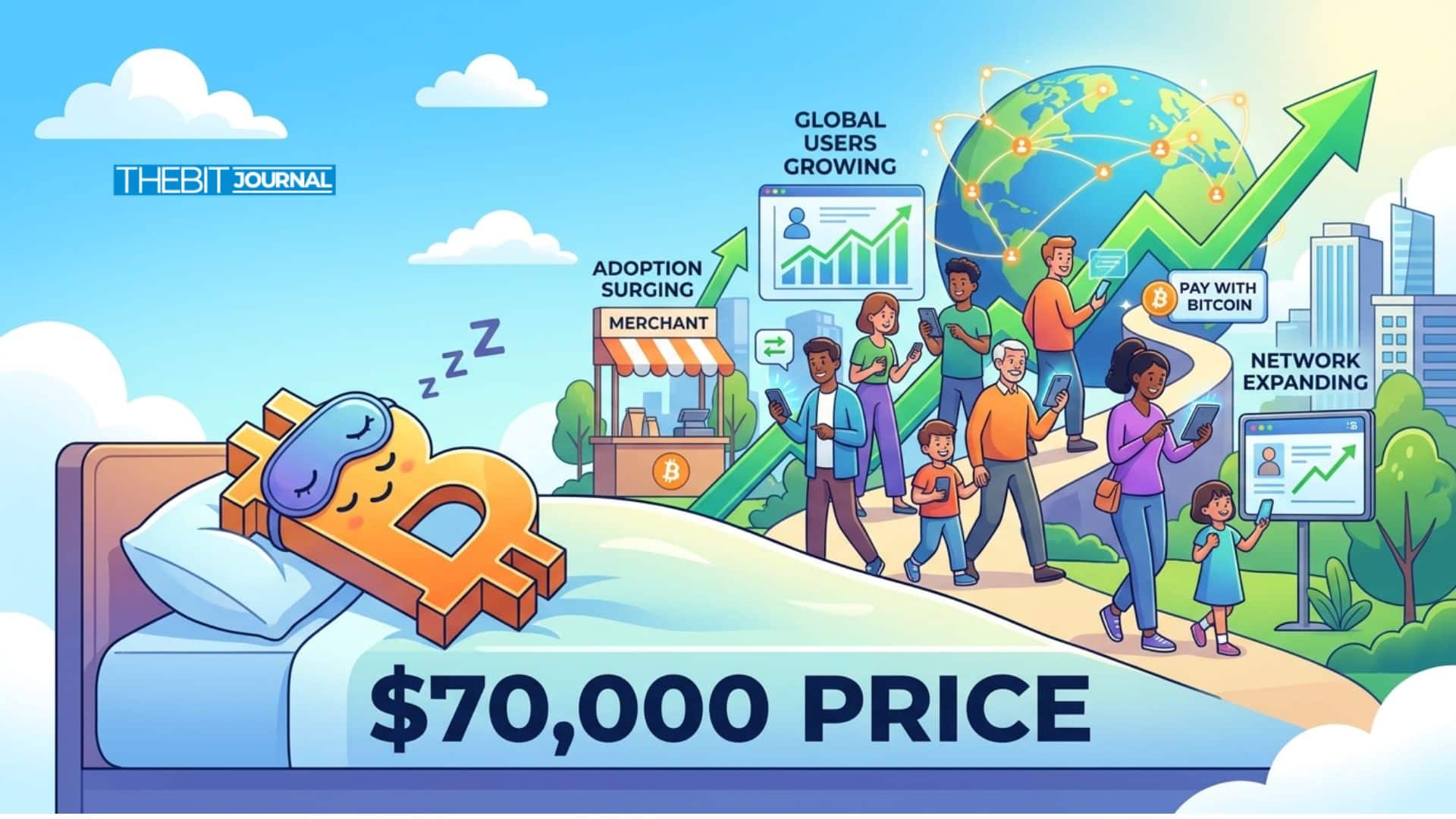
The Supply Dynamics Quietly Influencing the Market
As of March 15, 2026, more than 20 million BTC (over 95 percent of total supply) had already been mined with a maximum supply of 21 million.
Several million coins are estimated to be permanently lost through spending errors, misplaced keys, burned wallets etc. This scarcity notwithstanding, price is sensitive to how supply moves between holders.
The large amounts of Bitcoin that the market can absorb without immediately raising its price appear to come from long-term investors distributing into new institutional demand.
This change of ownership is one of the most compelling explanations for the divergence seen today.
Volatility Declines as Market Matures
Another development is the decreasing volatility of Bitcoin.
More recently, volatility is lower than previous cycles and has become increasingly similar to traditional asset classes such as equities and commodities. The change means deeper liquidity, wider ownership distribution and increased institutional involvement.
But as lower volatility makes Bitcoin more appealing to big investors, it also makes explosive price movements less likely.
Conclusion
The current Bitcoin adoption and price gap shows that the market stands on a different phase of development.
Adoption is growing across all levels as institutions hoarded 829,000 BTC, advisors have been deploying $1.5 billion per quarter consistently, banks are building tools and infrastructure, and sovereign entities (country level) are coming into the fold.
Merchant adoption is steadily rising, Lightning volume has passed $1.17 billion and worldwide ownership is still increasing.
All this, and price is still around $70K because supply is just being redistributed, allocation sizes remain minimal and macro conditions are holding over short-term trading.
Instead of indicating weakness, this stage shows a quiet shaking out of Bitcoin ownership and infrastructure.
Glossary
Institutional Adoption: Significant amounts of money invested by funds, companies and governments.
Bitcoin ETF: A fund that trades on an exchange and gives exposure to Bitcoin
Lightning Network: This is a second-layer system that facilitates speedier and more cost-effective Bitcoin transactions.
Open Market Supply: Bitcoin that is available for trading on exchanges.
Volatility: The amount prices vary over time.
Frequently Asked Questions About Bitcoin Adoption and Price Gap
Why is Bitcoin price not going up?
Because demand from institutions is countered by selling from long-term holders, balancing the price.
How much Bitcoin did institutions acquire?
829,000 in 2025 across funds, companies, governments and ETFs.
What is the role of advisors in adoption?
They control $146 trillion in assets and allocated approximately $1.5 billion every quarter towards Bitcoin ETFs.
How large is the current Bitcoin payment adoption?
Meanwhile, total Lightning Network volume hit $1.17 billion as global payments outposts surged.
References