







This article was first published on The Bit Journal.
Bitcoin seems to be closing out November with a drop, diving about 16.8% which came as a surprise to those who anticipated an end-of-year rally.
Most of the gains in early 2025 were largely wiped out by the slide, which was brought about partly by macroeconomic uncertainty, concerns over interest rates and heavy sell-offs.
But even as the price falters, some market observers are looking to traditional seasonal trends in Bitcoin which often show December providing a bounce.
With this in mind, observers may be wondering: Will December turn things around for $BTC or is there more trouble down the road?
Historical Seasonality: Will December Save Bitcoin?
Bitcoin has an interesting seasonality track record but with caveats. A recent analysis points out that while some months (November in particular) sport the minty-fresh breath of big average returns, the “mean” can be misleading because of big outliers.
A single November in 2013, for instance, recorded an eye-popping 449% gain that inflated the average. Lose the outlier and November’s average return is a measly 8.8%.
Looking at the 12 year spread of Q4 performance, Bitcoin has closed the quarter positive 8 times. One note reads that monthly trends also support a strong finish, with December historically offering modest upside.
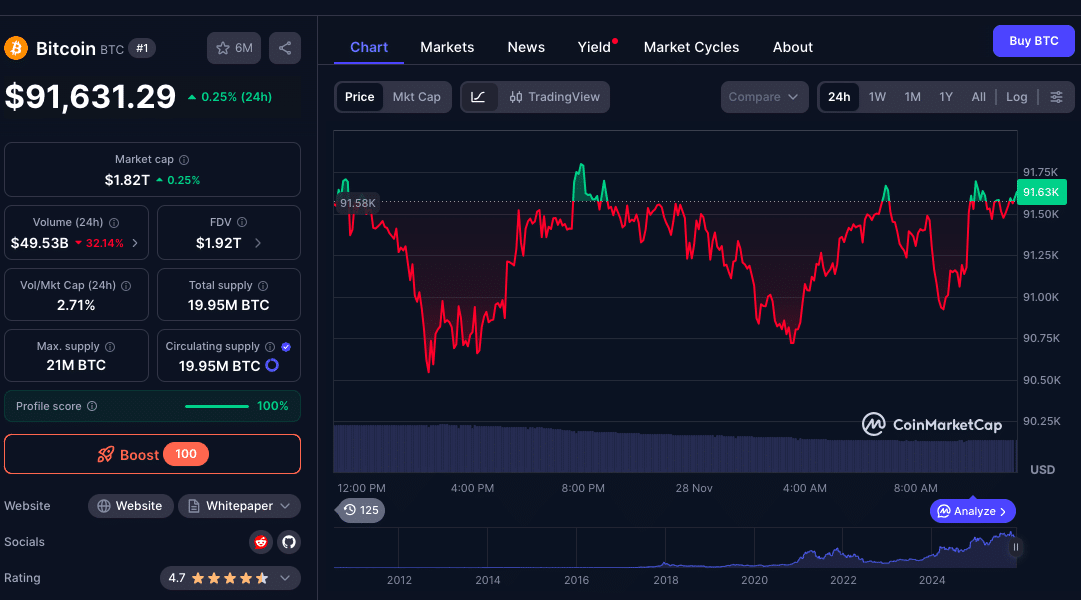
Past December performances do vary, however. Some years did consolidate to the downside, or pull back in December, after strong runs into year end (e.g. Dec 2024 finished red despite prior gains)
Therefore, although December comes with a perception of being a strong seasonal month for Bitcoin, history tells us that this should not be treated as given; but rather be something traders keep an eye on in combination with price action, macro environment and liquidity conditions.
What Has Changed in November 2025? Why the Crash is Important
November 2025 ranks as one of the worst months in recent memory. According to analysts:
Bitcoin dropped beneath the 2025 “realized price” of around $103,227, so many buyers from 2025 are now underwater.
The drop echoes the magnitude of the April 2025 correction, though the timeline is shorter, implying sharper drawdown pressure.
The sell-off resulted in considerable deleveraging, margin calls, and institutional outflows, which have put structural pressure on spot and derivatives markets.
These factors make it so that, compared to previous typical cycles of gradual build-up, Bitcoin enters December on a strong note of weakness, adding pressure behind any push higher, but also the potential for a significant mean reversion if sentiment turns.
Bitcoin December Outlook: Bull, Base, Bear Cases as of December 2025
Here is a scenario-based outlook for Bitcoin’s performance through the end of December, according to historical seasonality, current market indicators and probable macro-events.
| Scenario | Key Assumptions | December BTC Range |
| Bullish | Macro tailwinds (eg, interest-rate optimism), ETF flows resume, volatility subsides, liquidity returns | $100,000 – $115,000 |
| Base / Moderate | Consolidation around support, modest demand returns, no major macro shocks | $85,000 – $95,000 |
| Bearish | Continued risk-off environment, weak flows, further margin calls, macro pressure | $70,000 – $80,000 |
Why these ranges? The bullish range depicts a rally back up to pre-sell-off levels, motivated by renewed interest and/or some “year-end rally” dynamics.
The base case is a consolidation where $BTC funds support and trades flat.
The bearish zone represents a certain level of sustained negativity, macro headwinds, or additional loud liquidation especially if the confidence rug gets seriously pulled.

What Each Scenario Would Require
Bullish scenario: Bitcoin needs to reclaim resistance levels around $95,000-$100,000 on strong volume in tandem with bonds stabilizing and supportive macro themes (e.g.dovish rate-cut talks) as well as a renewed interest from the likes of institutions or ETFs.
Base case: $BTC establishes firm support in the $85,000-$90,000 range and trades sideways with steady accumulation and no loud shockwaves from outside.
Bearish case: Additional outflows, liquidity squeeze, negative macro shocks (e.g. rate hikes) or big leveraged liquidations could drive $BTC back toward $70K or lower, particularly if exchange-based pressure returns.
Conclusion
Bitcoin’s sudden plunge in November erased most of 2025’s gains and shook confidence throughout the crypto market. Yet history offers the hope, though there are never guarantees that December will be one of those good months.
In the current environment, relief can be easily imagined, particularly if macro conditions converge and liquidity comes back.
However, some caution is needed. In the absence of encouraging catalysts, Bitcoin could consolidate within a lower range or even retest more critical support.
The next few weeks should tell. For traders and investors, it can be worth watching how those macro conditions shape up, as well as flow data and on-chain liquidity, not just seasonal lore.
Glossary
Realized Price: This measures the average cost basis of all Bitcoin ever held, weighted by when coins last moved. It is helpful to estimate how many investors are underwater.
Margin Calls/Liquidations: Forced selling that happens when leveraged positions lose value, which in many cases causes prices to fall further.
Seasonality: The propensity for assets to perform well or poorly during specific calendar months, based on historical data, not an assurance of future results.
Support/Resistance Levels: Price area where demand (support) or supply (resistance) is significantly in place.
Frequently Asked Questions About Bitcoin December Outlook
Can December’s historical performance as a “good” month for Bitcoin be trusted?
From a seasonal standpoint, December often closes in the positive historically. But that is not a guarantee of a rally as many previous Decembers also finished flat or negative. Seasonality should be context, not strategy.
Does the crash of November 2025 signal there is more downside to come?
Not necessarily. Though the drop shook confidence in the asset, it also reset cost basis for many holders. That reset, if sentiment recovers and macro conditions improve, could support a rebound.
What are the main triggers to watch?
Factors that move the markets are macroeconomic events (interest-rate movements, Fed announcements), ETF and institutional flow data, on–chain liquidity and exchange outflows and general market risk sentiment.
Should you buy Bitcoin now?
It is a function of one’s own risk tolerance. The “base” scenario sees consolidation, which could provide a lower-volatility entry point. But the “bearish” scenario remains real. Any purchase should recognize volatility and exhibit a cautious sizing. In all, DYOR.
References