






This article was first published on The Bit Journal. The latest Bitcoin forecast indicates that the cryptocurrency’s recent price action is echoing familiar patterns from earlier this year, raising new concerns about what lies ahead for investors.
In recent weeks, Bitcoin has fallen below a three-month consolidation zone that has resembled a collapse that occurred in March following the achievement of new all-time highs by the asset. According to analysts, this move can be part of a larger macro trend and not a single market occurrence.
Rising Liquidity Pressures Cloud Bitcoin Forecast

In a new analysis shared on X, market strategist EndGame Macro offered a cautious Bitcoin forecast, suggesting that Bitcoin could find short-term support and stage a bounce in early 2026. The analyst however cautioned that the move would not mark the onset of a long term trend of rally against the surge experienced in April-May 2025.
A Rally With an Expiration Date
Both versions of the chart…BTC vs USD and BTC vs EUR are telling the same story, which is what makes them useful. Bitcoin didn’t just lose momentum in dollar terms; it lost momentum in euro terms too. That takes the maybe it’s just currency noise… https://t.co/MhgYtdInBk
— EndGame Macro (@onechancefreedm) November 16, 2025
A number of liquidity-related reasons were mentioned, such as the tightening of liquidity in the U.S. during tax season, reconstruction of the Treasury General Account (TGA), and a significant decrease in general market risk appetite. According to this Bitcoin forecast, tightening liquidity in Q2 2026 may further trigger the market into a bear-market.
Macro Trends Affect Bitcoin Forecast Significantly
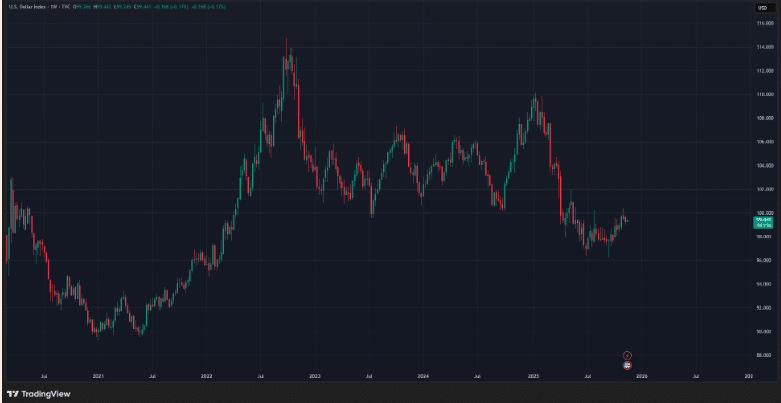
The U.S. Dollar Index (DXY) is an important indicator that can be used to formulate any Bitcoin forecast because macro trends are critical. Traditionally, an increase in DXY is an indicator of dollar power and a fall in the risk assets like Bitcoin. The bear market in Bitcoin started in 2021 when the DXY gained strength.
At present, the DXY is continuing to assume a bearish format that favors positive Bitcoin forecast. The outlook has been complicated, though, by the waning hope of a Federal Reserve rate cut. The likelihood of a December reduction fell to 44% out of 88, suggesting the risk that the declining dollar pattern may plateau. A backward transformation in the DXY would strain the optimistic Bitcoin predictions over the next few months.
ETF Outflows Signal Bitcoin Market Weakness
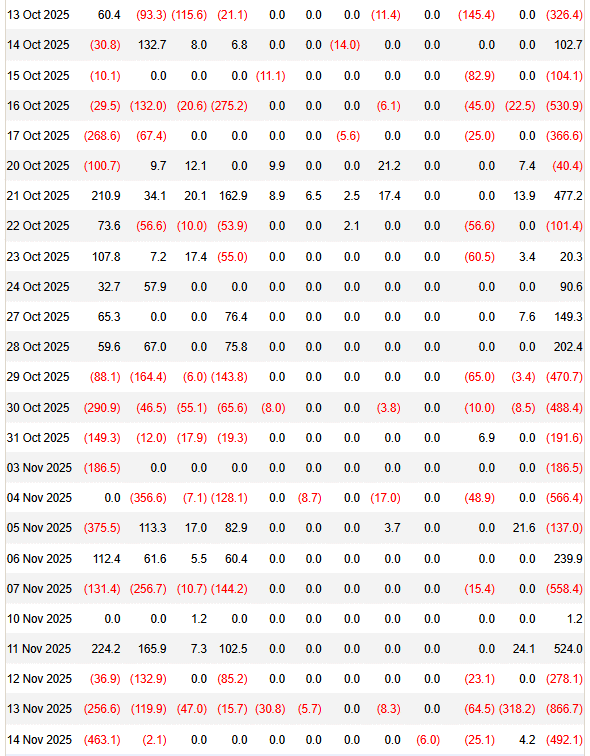
U.S. listed Bitcoin ETFs have suffered significant outflows since the market fall on October 10. The trend highlights the negative environment that shapes most Bitcoin predictions nowadays, analysts say.
Although the ETF outflows do not indicate the long term losses, they are a clear indicator of the prevalent sentiment: wary, risk-averse, and generally bearish.
Benjamin Cowen, founder of Into The Cryptoverse, was another cautionary voice in the growing Bitcoin forecast market, as a Bitcoin death cross is now formed. Traditionally, the signals are observed close to market bottoms.
Death Cross Signals Potential Macro Lower High
Cowen wrote that unless Bitcoin breaks the 50-day moving average (50 DMA) at $110,000 over the next one week, the death cross can prove the existence of a macro lower high. This would suggest another temporary rise in the coming months one that would be part of a bigger, long-term fall.
Bitcoin had a death cross today.
Note that prior death crosses marked local lows in the market.
Of course, when the cycle is over, the death cross rally fails.
The time for Bitcoin to bounce if the cycle is not over would be starting within the next week.
If no bounce occurs… pic.twitter.com/Rg8pSxYMva
— Benjamin Cowen (@benjamincowen) November 16, 2025
This would be in line with the wider Bitcoin prediction that would see the cryptocurrency experience volatility and renewed weakness in Q2 2026.
Conclusion
As Bitcoin navigates tightening liquidity and weakening sentiment, analysts caution that any near-term bounce may prove temporary. As technical indicators give out red flags and macro forces build up, the next year may either see the BTC even out or plunge further into a longer bear market.
Follow us on Twitter and LinkedIn, and join our Telegram channel to be instantly informed about breaking news!
Summary
- Bitcoin’s recent breakdown mirrors earlier patterns, hinting at deeper bearish pressure.
- Analysts expect tightening liquidity to trigger weakness into Q2 2026.
- ETF outflows and uncertain Fed cuts reinforce bearish sentiment.
- A new death cross signals a potential macro lower high ahead.
Glossary of Key Terms
Treasury General Account (TGA): U.S. Treasury account affecting market liquidity.
Risk Appetite: Willingness to take investment risks.
U.S. Dollar Index (DXY): Measures dollar strength against major currencies.
Federal Reserve Rate Cut: Lowering interest rates to boost markets.
Death Cross: Short-term moving average falls below long-term average.
50-Day Moving Average (50 DMA): Average Bitcoin price over 50 days.
Macro Lower High: Short-term rally below previous high in downtrend.
Bear Market: Prolonged period of falling prices.
Market Volatility: Rapid or unpredictable price changes.
Frequently Asked Questions about Bitcoin Forecast
Q1: Why is Bitcoin’s recent drop concerning?
Bitcoin broke below a three-month range after new all-time highs, signaling potential further weakness.
Q2: What is expected for Bitcoin in early 2026?
Analysts predict a short-term bounce, but not a sustained rally.
Q3: How do DXY and Fed rate cuts impact Bitcoin?
A strong dollar or uncertain rate cuts can reduce risk appetite, hurting Bitcoin.
Q4: What does the Bitcoin death cross indicate?
It signals a potential macro lower high, suggesting future rallies may be temporary.
References