







This article was first published by The Bit Journal.
Bitcoin’s price in 2026 remains a headline, but professional analysts are now more focused on market fundamentals that drive demand and network economics.
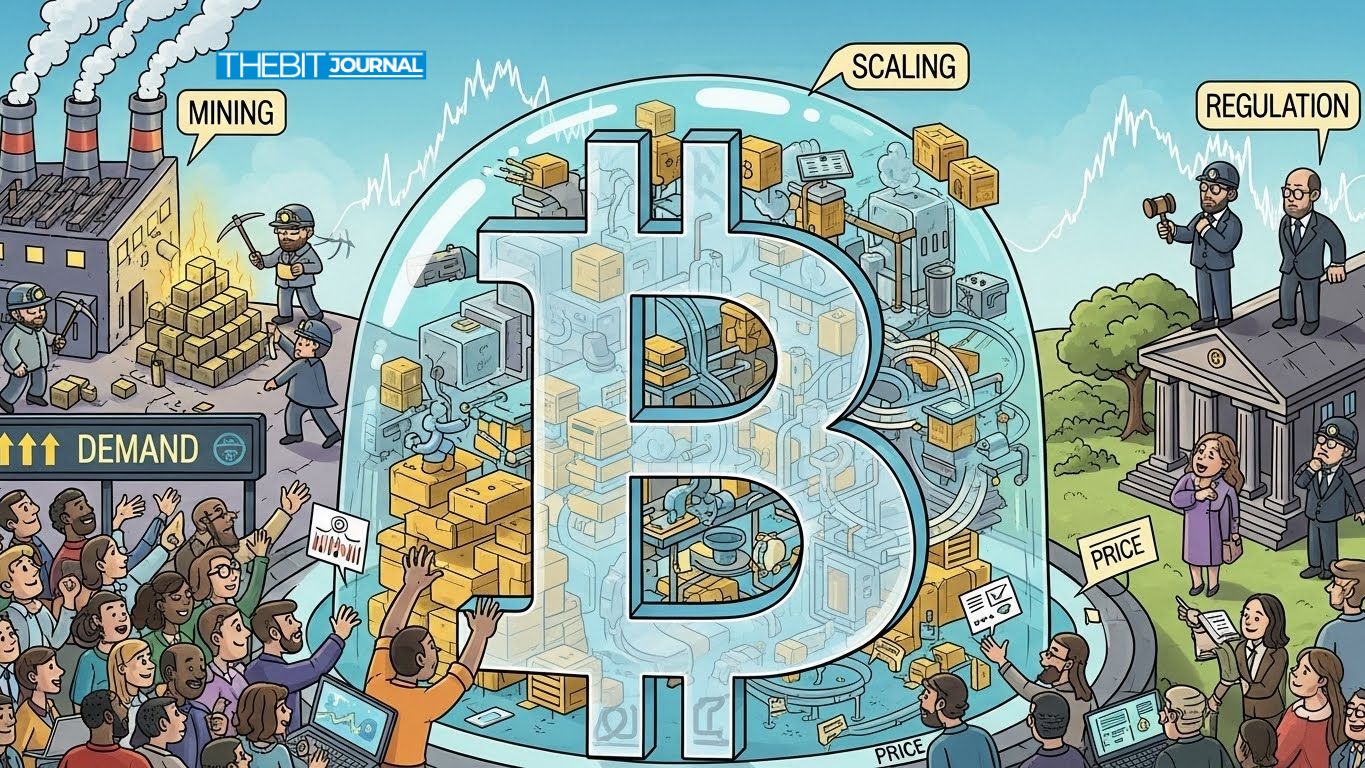
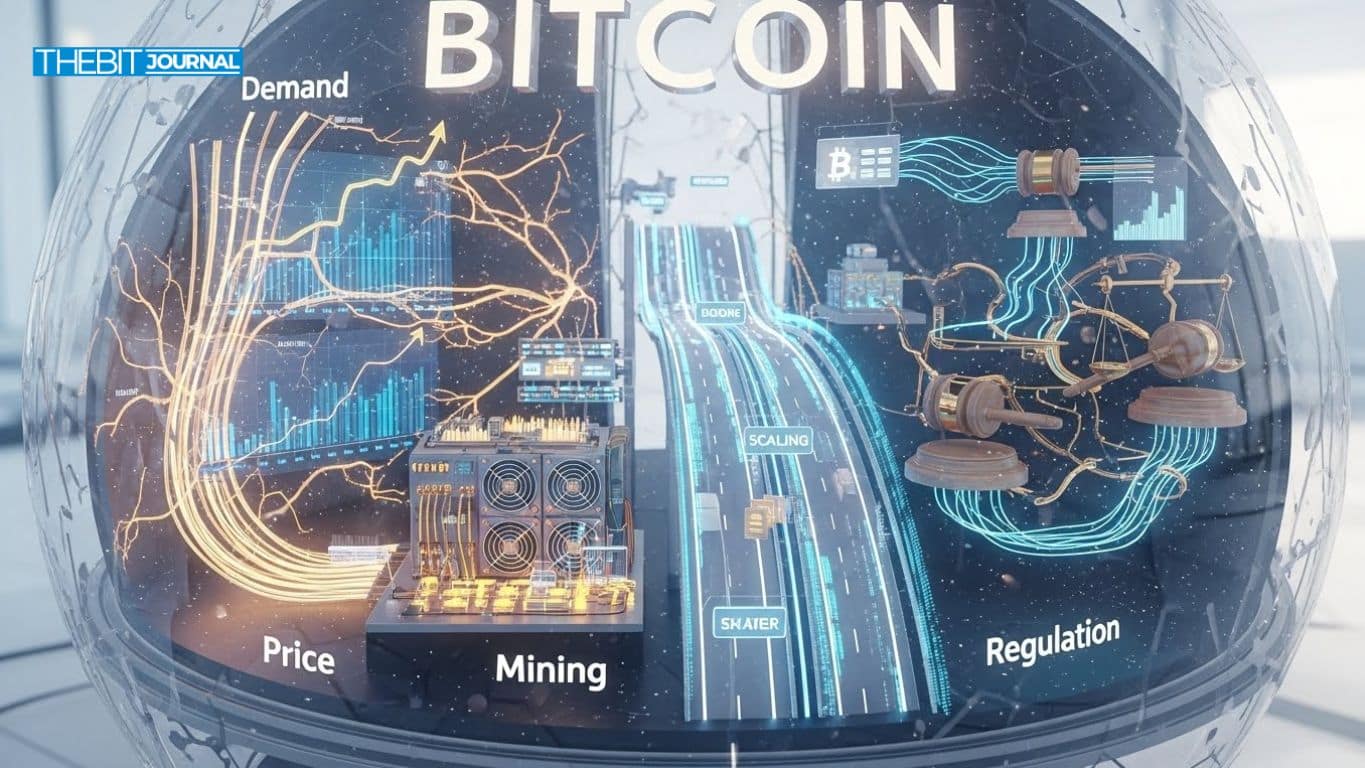
Bitcoin in 2026 now reaches far past the lines on a chart and is now more about flows of capital to regulated vehicles, corporate balance sheets that hold BTC, mining dynamics post-subsidy cut, the rise of scaling tech for payments, and shaping regulation across major markets.
Knowing about these signals provides a more complete perspective on where Bitcoin fits into the overall financial and tech ecosystem this year.
Institutional Inflows Via ETFs Point to Structural Flows
Among the most-watched signals by analysts is institutional flows into Bitcoin exchange-traded funds (ETFs). This is because they show real allocation decisions by wealth managers and professional investors, not short-term trading.
Recent Farside Investors data showed that ETFs continued absorbing hefty sums in 2026. U.S. spot Bitcoin ETFs attracted around $753 million in net inflows over two days following a run of outflows, showing institutional interest remains despite volatile trading conditions.
ETFs have raked in hundreds of billions of dollars in net inflows this year, while overall traditional ETFs saw more than $46 billion in early 2026, a sign of keen interest for regulated financial products across asset classes.
Bloomberg ETF analysts called the pace “abnormally high to start the year,” a sign that broad institutional allocations are changing.
Market trackers also observe that while institutional activity via ETFs is influenced by price volatility, it has in some ways decoupled from short-term price fluctuations.
Corporate and Treasury Holdings Redefine Exposure to Bitcoin
Beyond ETFs, it is becoming increasingly common for companies to add Bitcoin to their corporate treasuries as a strategic reserve asset. Data shows that this trend continued to gain traction in 2025 with companies going so far as to put parts on their balance sheet.
There’s a growing number of corporates and public companies buying Bitcoin, and according to analysts, corporations held millions of BTC at the end of December last year with strategies that treat BTC like gold or cash reserves.
For one, corporate Bitcoin holdings represent an additional layer of longer-term structural demand within the ecosystem. Second, when these stakes materialize in public corporate filings or equity indexes, they affect market perception and institutional capital allocation activities.
This is why corporate BTC accumulation is another important part of Bitcoin in 2026
Miner Economics and Security Post-Halving
Bitcoin’s security model relies on miners to validate transactions, and the mix of their revenue has changed since the previous halving in 2024.
In at least one post-halving block subsidy era, the share of miner revenue derived from transaction fees fell to multi-year lows,and was sometimes under 1% of total rewards on other occasions, industry reports indicate.
Analysts see this reduction in fee pressure as something that could impact miner profitability and network incentives over the long term.
Also mentioned in JPMorgan-related reporting were signs of strain in mining economics at the end of 2025, with average hashrate shrinking 3 percent in December, and total daily reward revenue down sharply from a year earlier.
These changes have led industry observers to track miner revenue composition and hash price trends more closely as components of the larger storyline for Bitcoin in 2026.
While inexpensive block confirmations are good for users, low fee conditions create immediate concerns about how mining operations will support themselves once the yield from new blocks diminishes.
To observe these trends, hashrate stability as well as network participation will be needed to understand the changing security budget for Bitcoin.
Scaling Tech: Lightning, Layer-2 Growth and Protocol Upgrades
Bitcoin’s capability for everyday spending and mass acceptance is increasingly a function of second layer scaling solutions. In fact, The Lightning Network, a layer-2 payment protocol, has continued to grow in capacity, with reported metrics showing thousands of BTC committed to Lightning channels by late 2025.
Analysts point out that not just the capacity milestones are important, but the distribution of liquidity throughout the network, which aids decentralized payments rather than concentrating them on a few large players.
Together with Lightning, more recent layer-2 design attempts and BTCFi projects for bringing liquidity into second layer ecosystems have grown substantially, with research pointing towards massive potential bridging of BTC to L2 places over time.
Such developments are observed with talks about a possible base-layer upgrade, like improvements that would enable trustless bridges and upgrades to the protocol.
In all, scaling technologies are a critical mechanism for Bitcoin in 2026, they show how the network evolves to accommodate user demand and optimize for speed, low cost and utility beyond traditional on-chain transfer.
Regulation and Access
In 2026, who can offer, hold or transact in Bitcoin and on what terms they can, is now a matter of regulatory systems.
In the U.S., federal policy initiatives have rewritten how Bitcoin is treated in a strategic context, including proposals to establish a “Strategic Bitcoin Reserve” at the federal level, with the aim of framing BTC as a government-held asset not intended for sale.
Meanwhile, regulations around stablecoins like the GENIUS Act and Markets in Crypto-Assets (MiCA) in the European Union are establishing licensing and operational requirements for payment tokens and market participants, influencing the infrastructure that serves crypto markets.
Regulatory clarity is a huge factor in how institutions and retail users interact with Bitcoin, therefore, it is an important part of Bitcoin in 2026 beyond just valuations.
This regulatory context affects product availability, custody, settlement and reporting standards, and remains an important lens through which analysts are trying to understand Bitcoin’s role within mainstream finance.
Conclusion
The market for Bitcoin in 2026 is driven by forces far more than its price. These include structural capital inflows to ETFs and corporate treasuries, miner economics in a post-halving world, growing scaling technologies such as Lightning and second-layer protocols as well as shifting regulatory environments in key jurisdictions.
These are not direct data points that fully map out where real demand, network health and access are going but they provide insights that do matter in a crypto market where price alone doesn’t tell the full story.
Glossary
Bitcoin ETF: A regulated investment fund that offers exposure to Bitcoin through traditional markets by holding up the cryptocurrency.
Corporate Treasury BTC: Bitcoin that a company owns on its balance sheet as part of its strategic reserves.
Hashrate: The combined computational power that is being used to maintain the Bitcoin network.
Lightning Network: A layer-2 protocol that permits speedier, less expensive Bitcoin transactions.
Layer-2 (L2): Protocols that are built on top of Bitcoin to scale the network’s capacity and utility.
MiCA: Markets in Crypto-Assets regulation across the European Union, containing governing provisions for crypto service providers.
Frequently Asked Questions About Bitcoin in 2026
Why do Bitcoiners care about ETF flows?
ETF flows provide insight into where the institutional money is moving to Bitcoin, indicating long-term strategic demand.
What does Bitcoin’s future look like in terms of mining economics?
On-chain analysts are observing miner revenue and network hashrate to see how Bitcoin’s proof-of-work security fares as subsidies drop.
What are the roles of scaling solutions?
Scaling technologies such as Lightning and Layer-2 protocols allow Bitcoin to accommodate more transactions at lower fees, making it more useful.
How is regulation impacting access to Bitcoin?
Policy efforts in the U.S. and EU also help direct how companies can provide Bitcoin services, affecting institutional and retail interest.
References