






This article was first published on The Bit Journal.
The tale of Bitcoin Performance 2025 is one of stalled breakout attempts and increasing market jitters as the year draws to a close. Bitcoin, which hit record highs earlier in the year, has faced difficulties sustaining its momentum during the final weeks of December.
Recent options data suggests market participants are hedging more than betting on upside, and spot Bitcoin ETF institutional flows have been a moving target.
Traders are playing defense ahead of the New Year, as price action remains trapped below a key resistance level and liquidity conditions haven’t yet settled.
Bitcoin’s Price Struggle: Staying Range Bound and Defensive
Bitcoin has moved mostly sideways in late December 2025, swinging between about $85,000 and $94,000. For the year as a whole, Bitcoin has not delivered gains for investors, with reports noting that it is “on the verge of closing 2025 in the red” unless it closes above $94,000 by New Year’s Eve.
Technical data and options trading suggest a wary market. Short-term positioning suggests players are seeking downside protection, rather than upside bets, according to the options analytics service Laevitas.
Laevitas’ 1-week 25-Delta Risk Reversal (a measure to assess demand for bullish vs bearish options) fell into negative territory, suggesting that sophisticated traders were leaning towards hedging more than aggressive longs.
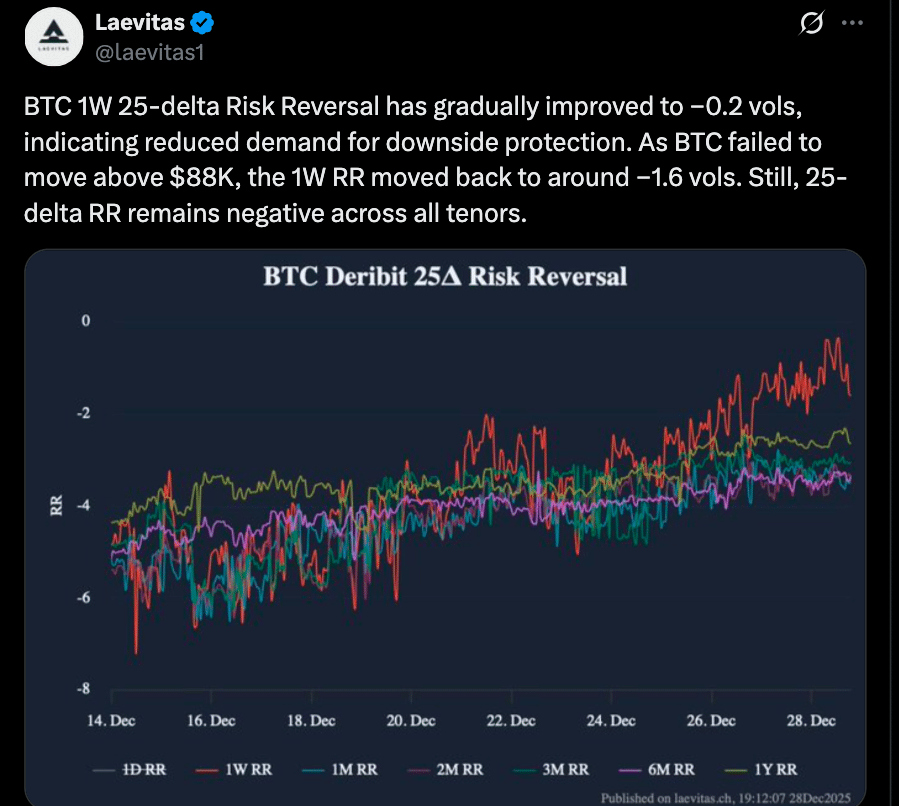
All of those tenors, for one week to one year, showed skew toward downside puts rather than calls, a configuration that can indicate defensive positioning in the markets.
This defensive interpretation was mirrored by Singapore-based trading desk QCP Capital, which said that further direction in Bitcoin may be lackluster until liquidity picks up after year-end expiries given the steep drop in open interest after options expired on 26 December.
Institutions and Spot ETF Flows
The institutional demand dynamics has been a critical part of Bitcoin Performance 2025. Bitcoin ETFs were plagued with heavy inflows earlier in the year, but the late-2025 trend data are showing some mixed flows.
Exchange aggregating flows of Bitcoin spot ETFs in December also showed net outflows in several products, with one report citing about $782 million of such ETF outflows near late December.
Nonetheless, on a year-to-date basis, Bitcoin ETF flows are still in the black and total assets under management (AUM) exceeds last year, suggesting the outflows reflect position adjustments rather than investors running for the exits.
The weekly flows reveal that most of Bitcoin spot ETPs had negative flows, one of which was BlackRock’s iShares Bitcoin Trust (IBIT). All 12 Bitcoin ETFs tracked over that period saw net outflows, showing a recurring theme of profit taking or risk reduction in year’s-end trading.
Other sources also point out that the “record outflows” reported late December can be misleading, without considering a broader view.
Cumulative numbers for 2025 are in and Bitcoin ETF products overall played a huge part in capturing inflow throughout the year with cumulative flows still positive.
These numbers suggest that while short-term outflows may be visible, they don’t reverse the trend of institutions’ interaction with Bitcoin exposure through ETFs.
Price Support and Ranging Trading
The price pattern is showing a very strong resistance zone above the $90,000 level for Bitcoin in this last weeks of 2025. Several market-watchers indicate that price attempts to move higher toward $94,000 has frequently been rejected in recent days, trapping Bitcoin below that level.
This prolonged sideways range action suggests a lack of momentum for an upside break as the calendar turns to 2026.
Sideways action has been fueled by a range-bound market due to subdued liquidity, hesitant institutional positioning and an uncertain overall market. With open interest in Bitcoin derivatives falling sharply following large expiries and liquidity fleeing the market, directionality is minimal until new money flows back into the market.
QCP Capital noted that the capital remains on the sidelines and markets must wait till buyers come back in 2026 before clear trend formation may be ascertained.
Confluence With Market Conditions
The performance of other markets in late 2025 has affected Bitcoin’s as well. Traditional equities reached record highs toward year end, while Bitcoin price remained below critical resistance. Reports noted that equities surged without the corresponding reaction from crypto markets, showing a divergence that contributed to a cautious outlook among traders and fund managers.
While the price action is mixed, some data suggests there are long-term conviction views on various areas of the market. Flows data for the year aggregated across funds show that Bitcoin ETF products have collectively attracted tens of billions of dollars in assets since launch, with BlackRock’s IBIT being responsible for a sizable chunk of them, even amid late-2025 outflows.
Conclusion
As 2025 wraps up, Bitcoin Performance 2025 depicts a year full of opposites: strong institutional participation via spot ETFs and record trading volume at the beginning of the year, contrasting with defensive posturing, hedging demand, and an inability to break key price levels in later months.
Downside hedging has begun to overwhelm upside speculation, and institutional flows moved from being dominated by net inflows to periodic outflows as liquidity dried up.
Price stayed in a range under overhead resistance at $94,000, with momentum flat to the start of January 2026.
These patterns indicate that, the market’s near-term direction was being traded more for risk management than breakout conviction.
Glossary
Bitcoin performance 2025: The visible price market structure in institutional activity that is guiding Bitcoin’s trading environment in the year.
Spot Bitcoin ETF: An investment fund that holds Bitcoin as an asset on its balance sheet and is directly traded on traditional stock exchanges.
25-Delta Risk Reversal: A measure showing the difference in prices between bullish and bearish options, with negative readings indicating stronger demand for downside protection.
Open Interest: The number of outstanding derivative contracts (such as futures and options) that have not been settled, used as a measure of market activity or participation.
Liquidity: The availability of capital in markets that enables buyers and sellers to transact efficiently without causing large price moves.
Frequently Asked Questions About Bitcoin Performance 2025
What has determined Bitcoin performance 2025?
Defensive positioning in options markets has helped prevent any long-lasting breakout, while large shifts in institutional flows in ETFs have kept price mostly sideways into the late part of the year.
Why is there so much hedging, relative to bullishness?
The negative prints on the 25-Delta Risk Reversal over several tenors indicated the sophisticated traders were willing to pay more for protection (puts) than bullish exposure (calls) as year-end risk proliferated and liquidity began to fade.
What has been the role of spot Bitcoin ETFs in 2025?
Spot ETFs registered both big inflows earlier in 2025 and sizable outflows later that year. Year-to-date cumulative flows are still positive, so institutional interest appears to be alive even as short term repositioning occurs.
Why is Bitcoin unable to breach above the $94k level?
Repeated rejections around $90,000-$94,000 and the low-liquidity conditions resulting from open interest decline indicate that there was not enough buying conviction behind price attempts to thrust through.
How does Bitcoin’s late-2025 price compare with stocks?
Though U.S. stocks hit record highs in late 2025, Bitcoin’s price lagged showing a disconnection between crypto and traditional markets’ performance near year end.
References
AMBCrypto
CryptoSlate
Trading News
Investing
The Guardian