






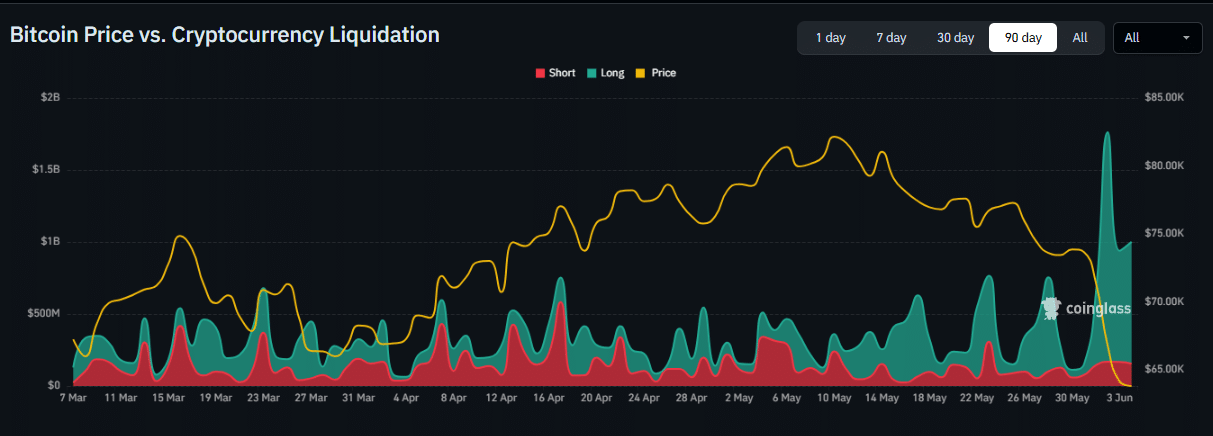
The latest Bitcoin price crash has rattled crypto markets and raised fresh questions about where investor money is heading in 2026. Bitcoin briefly slipped below $62,000 during Asian trading hours, triggering a massive liquidation event that erased billions of dollars from leveraged positions. However, analysts believe the real story extends far beyond a sudden drop in price.
According to the source, more than 208,000 traders were liquidated over the past 24 hours as losses exceeded $1.5 billion across the crypto market. At the same time, persistent Bitcoin ETF outflows and changing expectations around Federal Reserve rate cuts added pressure to an already fragile market environment.
A Wave of Forced Selling Fuels the Steepest Decline in Months
The recent Bitcoin price crash quickly turned into the market’s steepest decline in months as leveraged traders rushed toward liquidation. Bitcoin briefly traded below $62,000, while losses spread across major cryptocurrencies, including Ethereum.
Market data showed that more than $800 million in Bitcoin positions and another $386 million in Ethereum positions were liquidated. These losses were not caused solely by declining prices. Instead, they were amplified by a wave of forced selling.
When leveraged positions lose too much value, exchanges automatically close them to prevent further losses. This process forces assets onto the market, increasing selling pressure. As more positions are liquidated, additional selling follows, creating a chain reaction that deepens the Bitcoin price crash and accelerates market declines.
Bitcoin Price Crash Deepens Amid Persistent Bitcoin ETF Outflows
The selloff coincided with continued weakness in institutional demand. Investors withdrew approximately $1 billion from U.S. spot Bitcoin funds this week, extending a record streak of Bitcoin ETF outflows.
These ongoing Bitcoin ETF outflows have become a growing concern because exchange-traded funds played a major role in attracting institutional capital during previous rallies. Strong inflows once helped support higher prices, but sustained Bitcoin ETF outflows now suggest large investors are becoming more cautious.
The combination of the Bitcoin price crash and continued Bitcoin ETF outflows points to weakening confidence among institutions at a time when economic uncertainty remains elevated.
The Hidden Battle for Capital: Gold and AI Stocks Gain Ground
According to analysts at Presto Research, the latest Bitcoin price crash may reflect broader competition for investor capital rather than any single crypto-specific catalyst.
Presto Research noted that several of Bitcoin’s major drawdowns throughout 2026 occurred at the same time gold and artificial intelligence-related stocks rallied, suggesting investors repeatedly redirected capital toward those sectors. This pattern indicates that money leaving crypto markets is often finding opportunities elsewhere.
Gold continues attracting investors seeking stability during uncertain economic conditions. Meanwhile, artificial intelligence companies remain among the market’s strongest growth stories, drawing capital from investors pursuing higher returns. As these sectors gain momentum, Bitcoin faces increased competition for investment dollars.
Unlike previous downturns caused by exchange collapses, regulatory concerns, or security incidents, this Bitcoin price crash appears closely linked to changing macroeconomic conditions.
Why Fed Expectations and Liquidity Hold the Key
One of the biggest factors behind the current market weakness is the changing outlook for Federal Reserve policy. Earlier this year, investors expected multiple rate cuts. However, persistent inflation has forced markets to reduce those expectations.
Bitcoin is widely considered a liquidity-sensitive asset. Simply put, it often performs best when borrowing costs are lower and money moves more freely through financial markets. When investors expect fewer rate cuts, liquidity tightens and risk assets frequently come under pressure.
According to Presto Research, Bitcoin’s next recovery may depend less on crypto-specific developments and more on improving macroeconomic conditions. Analysts believe easing inflation concerns, renewed expectations for rate cuts, slowing Bitcoin ETF outflows, and stronger demand for liquidity-sensitive assets could help stabilize the market and support a recovery from the ongoing Bitcoin price crash.

Conclusion
The latest Bitcoin price crash highlights how closely digital assets are connected to broader financial markets. While liquidations accelerated the decline, the deeper story revolves around shifting investor priorities, persistent Bitcoin ETF outflows, and growing competition from gold and AI stocks.
As markets reassess inflation risks and Federal Reserve policy, Bitcoin’s future direction may depend less on crypto headlines and more on where global capital chooses to flow next.
Glossary of Key Terms
Liquidation: The automatic closure of a leveraged trading position when losses exceed a set threshold.
Spot Bitcoin ETF: An exchange-traded fund that directly holds Bitcoin as its underlying asset.
Institutional Demand: Buying activity from large investors, hedge funds, asset managers, and financial institutions.
Liquidity-Sensitive Asset: An asset that tends to perform better when money is readily available and borrowing costs are low.
Federal Reserve Rate Cuts: Reductions in U.S. interest rates designed to stimulate economic activity and increase liquidity.
FAQs About Bitcoin Price Crash
Why did Bitcoin fall below $62,000?
Bitcoin declined due to heavy liquidations, institutional weakness, and changing expectations surrounding Federal Reserve rate cuts.
What caused the $1.5 billion liquidation event?
A sharp price decline triggered leveraged positions to close automatically, creating a wave of forced selling across crypto markets.
Why are Bitcoin ETF outflows important?
Bitcoin ETF outflows can signal weaker institutional demand and reduced buying pressure for the cryptocurrency market.
What could help Bitcoin recover?
Easing inflation, stronger liquidity conditions, lower rate expectations, and a slowdown in Bitcoin ETF outflows could support recovery.
Sources/References