







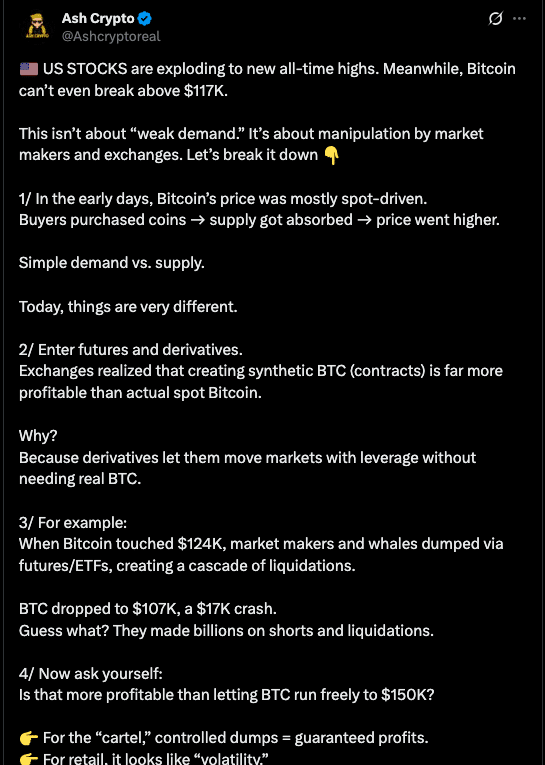
Bitcoin has been stuck in a tight range between $110,000 to $117,000 even as US equities rise and massive ETF inflows pour in. Market analyst Ash Crypto says this is a sign of Bitcoin price manipulation, with derivatives, synthetic contracts, and leveraged exposure holding back the price.
Though this is a big claim but recent data shows falling exchange reserves, strong institutional demand, rising whale sales and changing sentiment.
What the Bitcoin Price Manipulation Claims Mean
Ash Crypto and others are saying that while demand looks strong, that strength is being masked. Points of this view are that more and more people are using futures and derivatives instead of spot Bitcoin trading, so big players can move the price without actually moving the Bitcoin.
Declining reserves on centralized exchanges means there are fewer coins available to sell, potentially restricting supply. Lastly, the presence of synthetic contracts or leveraged positions that amplify price movements or suppress gains.
The claim is that these mechanisms create an “illusion of weakness” even when the fundamentals (demand, supply constraint) point up.
According to TradingView,
“spot demand for Bitcoin continues to build, ETFs are absorbing more coins, exchange reserves are dwindling and long term holders are not selling”.
Also read: Bitcoin Price at Risk? Over 3 Million Coins May Be Lost Forever
Recent data: What Supports Bitcoin Price Manipulation Claims
Several trends support the manipulation arguments. Bitcoin reserves on centralized exchanges have fallen to near historic lows. As reported by DeFi-Planet, by May 2025, there were only 2.6 million BTC on major exchanges, a level that means a supply constraint if demand increases.
Spot ETF inflows have been huge, absorbing more and more of the Bitcoin. Reports have it that US spot Bitcoin ETFs added +15,827 BTC ($1.8 billion) in the last week, taking total ETF assets above $1.3 billion.
Whale sales are still causing short-term volatility but are being absorbed by institutional buyers, a sign that while big holders move the market, the structure is maturing.
Meanwhile, reports also divulge that companies that hold large Bitcoin reserves often called “crypto treasury firms” such as MicroStrategy (Strategy) are seeing their stock premiums decline. For example, Strategy recently bought 525 BTC ($60 million) at an average cost of $114,562 but their stock premium is at its lowest since early 2024, indicating investor caution.
What Refutes the Manipulation Theory
Not all data support the Bitcoin price manipulation. Some signs point to normalization rather than manipulation.
Long-term holders are not moving large amounts into exchanges, so experts claim it is not fear, which goes against the idea of wholesale suppression. Exchange supply dropping could be holders moving coins off exchanges for safer custody rather than market makers buying synthetics.
Additionally, seasonal patterns like the previous September weakness have been noted. But 2025 is an unusual September for Bitcoin, which might just be big rather than manipulation.
Financial Magnates says Bitcoin is up 6.79% month-to-date in September, despite previous seasonality that should be weighing on performance.

What Happens If The Manipulation is Real
If the claims of Bitcoin price manipulation are true, market behavior could be distorted in several ways. One, retail investors could be misled by synthetic weakness and sell or exit positions early.
Two, resistance levels (like $117,000) might be be stronger than they appear, maintained by derivative pressure rather than actual sell orders. Three, regulatory oversight could increase as authorities see derivatives, synthetic contracts and opaque exchange practices as risks to fair markets.
Institutional demand will continue to rise via ETFs, treasuries and will absorb some of the distortions but price discovery in the spot market could be suppressed if derivatives dominance persists.
Also read: BTC Headed to $190K? Institutional Wave Fuels Bold Bitcoin Price Prediction
Conclusion
Based on the latest research, the evidence for Bitcoin price manipulation is strong in several areas. While some can be interpreted in multiple ways, the consistency of these trends lends credibility to manipulation claims being more than just rumors.
At the same time, alternative explanations have merit. Investors and observers are advised to watch for changes in derivative position reports, exchange reserve metrics, ETF flows and regulatory signals.
For in-depth analysis and the latest trends in the crypto space, our platform offers expert content regularly.
Summary
Ash Crypto is sounding the alarm on Bitcoin price manipulation, citing strong demand hidden by derivatives, shrinking exchange reserves and low selling pressure from long-term holders. Recent data shows centralized exchange reserves down to 2.6 million BTC, large ETF inflows adding billions of dollars of capital, and “crypto treasury” firms like Strategy buying more Bitcoin even as their stock premiums fall.
Glossary
Derivatives / Futures – Financial contracts whose value is based on the price of a fundamental asset.
Exchange Reserves-Amount of Bitcoin on centralized exchanges, which represents supply available for immediate trading.
Whale – Large holder of Bitcoin whose trades can move the market or price.
ETF (Spot Bitcoin ETF) – Fund that owns physical Bitcoin and allows investors to get exposure without holding the coin directly.
Synthetic Contracts – Financial instruments that track the performance of an asset without owning it directly; used for leverage.
FAQs about Bitcoin Price Manipulation
What’s the evidence of manipulation in the current price of Bitcoin?
Derivatives and futures activity, declining exchange reserves, large ETF inflows and quiet spot coin movement are all mentioned by Ash Crypto as signs.
Could shrinking exchange reserves just mean more long term holding and not manipulation?
The reduction in coins on exchanges could also mean people are moving their holdings into cold storage or custody which reduces the supply but isn’t manipulation in itself.
Do ETF inflows support or contradict manipulation claims?
They support the idea of strong demand.