




This article was first published on The Bit Journal: What has informed JPMorgan’s transition from strong crypto skeptic to firm believer that has launched a tokenized money market fund? Read on to find out.
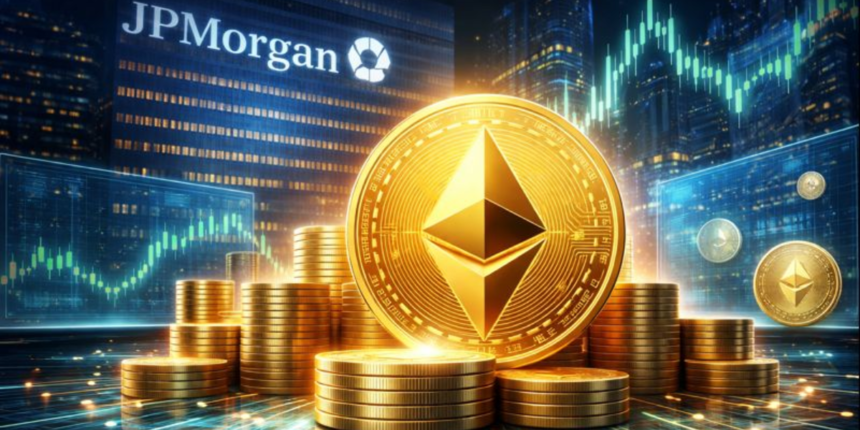
Global bank and Wall Street giant JPMorgan Chase is creating a niche in the blockchain space after launching a tokenized money market fund on the Ethereum network. The bank becomes the largest globally systemically important Bank to launch such a financial tool on a public blockchain.
According to an official press release, the global bank with over $4 trillion in assets under management was responding to the growing demands of institutional clients. The fund, dubbed My OnChain Net Yield Fund (MONY), will be supported by the bank’s tokenized platform Kinexys Digital Assets.
MONY will be Redeemed Via cash or the USDC Stablecoin
The tokenized money market fund will be a short-term debt instrument and will issue daily interest payouts, just like traditional money market funds. However, the point of departure will be the fact that its shares will be domiciled on the Ethereum blockchain. Investors who buy MONY would be able to redeem their investment in cash or USDC.
Commenting on the development, John Donohue, head of global liquidity at JPMorgan Asset Management, stated:
“There is a massive amount of interest from clients around tokenization […]we expect to be a leader in this space and work with clients to make sure that we have a product lineup that allows them to have the choices that we have in traditional money-market funds on blockchain.”
By rolling out the tokenized money market fund MONY, JPMorgan Chase has joined a growing group of world-class financial giants that have previously launched similar funds on blockchain, with money-market funds as the trailblazers. Among the first conventional financial institutions to launch a tokenized money market fund was Franklin Templeton with the BENJI fund in 2021. Soon after that, BlackRock entered the race in 2024 with its BUIDL fund, in partnership with tokenization specialist Securitize, attracting $2 billion in assets to date, per RWA.xyz data.
Not immediately available to Retail Investors
As stated, JPMorgan Chase has seeded MONY with at least $100 million of its own capital, and qualified investors will be able to access the tokenized money market fund beginning December 16, 2025. The initiative now places JPMorgan Chase in direct competition with other financial giants that have already placed their traditional assets onto blockchain networks.
According to the Press release, MONY will not be immediately available to retail investors, as the minimum investment required is $1 million and access is restricted to qualified investors. For interested individual investors, you will be required to have at least $5 million in investable assets, while institutions need at least $25 million.
Conclusion
Besides serving as a catalyst for broader institutional adoption of tokenized financial products, the launch of JPMorgan Chase’s tokenized money market fund, MONY, will intensify competition among participating financial institutions. If MONY and other related products succeed, it will determine whether tokenization will eventually become a fore component of the growing global financial system.
Glossary to Key Terms
Tokenized money market fund: A traditional, low-risk investment fund (like a mutual fund buying T-bills) where ownership shares are represented as digital tokens on a blockchain.
JPMorgan: The world’s largest bank, formed from the 2000 merger of J.P. Morgan & Co. and Chase Manhattan Bank
Tokenization: Converting real-world assets (like real estate, art, stocks, or even gold) into digital tokens on a blockchain, creating a digital representation of ownership.
Frequently Asked Questions about Tokenized money market funds
What are tokenized money market funds?
These are investment funds that hold underlying short-term, high-quality debt instruments, just like a conventional money market fund.
What are their main benefits?
Blockchain enables near-instant settlement of transactions (minutes instead of days), reducing counterparty risk.
How do they differ from the traditional money market funds?
Unlike traditional MMFs with limited market hours, TMMFs can be traded 24/7/365 on digital platforms, allowing global investors more flexibility.
References