






Bitcoin ETFs have become the pulse of the crypto market once again. Since July, these funds have attracted more than $1.19 billion in net inflows, signaling an aggressive return of institutional capital to digital assets.
BlackRock’s iShares Bitcoin Trust led the pack, fueling bullish momentum across trading floors. Yet, whispers of a possible correction are growing louder as analysts weigh whether the rally is running too hot.
Institutional Appetite Grows as Bitcoin ETFs Dominate
In a financial landscape craving yield and stability, Bitcoin ETFs are emerging as the go-to exposure for hedge funds and asset managers. Over the past few months, data has shown sustained inflows week after week, even as broader risk markets waver. The steady accumulation by these funds underscores one thing, the institutional narrative is back in full swing.
A senior market strategist wrote on X, “Bitcoin ETFs are doing what spot markets could not, attracting disciplined, long-term capital without the retail noise.” The sentiment highlights how professional investors now prefer the ETF structure over direct crypto trading. It is cleaner, regulated, and compatible with existing portfolios.
This institutional flow has become a cornerstone of modern crypto valuation models. Many Bitcoin ETFs are seeing record volumes, and their performance is starting to influence the broader sentiment around Bitcoin itself.
BlackRock Leads the Charge in ETF Dominance
BlackRock remains the heavyweight in the ETF arena. Its product, IBIT, accounts for the majority of the $1.19 billion inflows recorded since July. Analysts believe this dominance gives traditional investors confidence that Bitcoin ETFs are not a passing fad but a structural bridge between Wall Street and the blockchain economy.
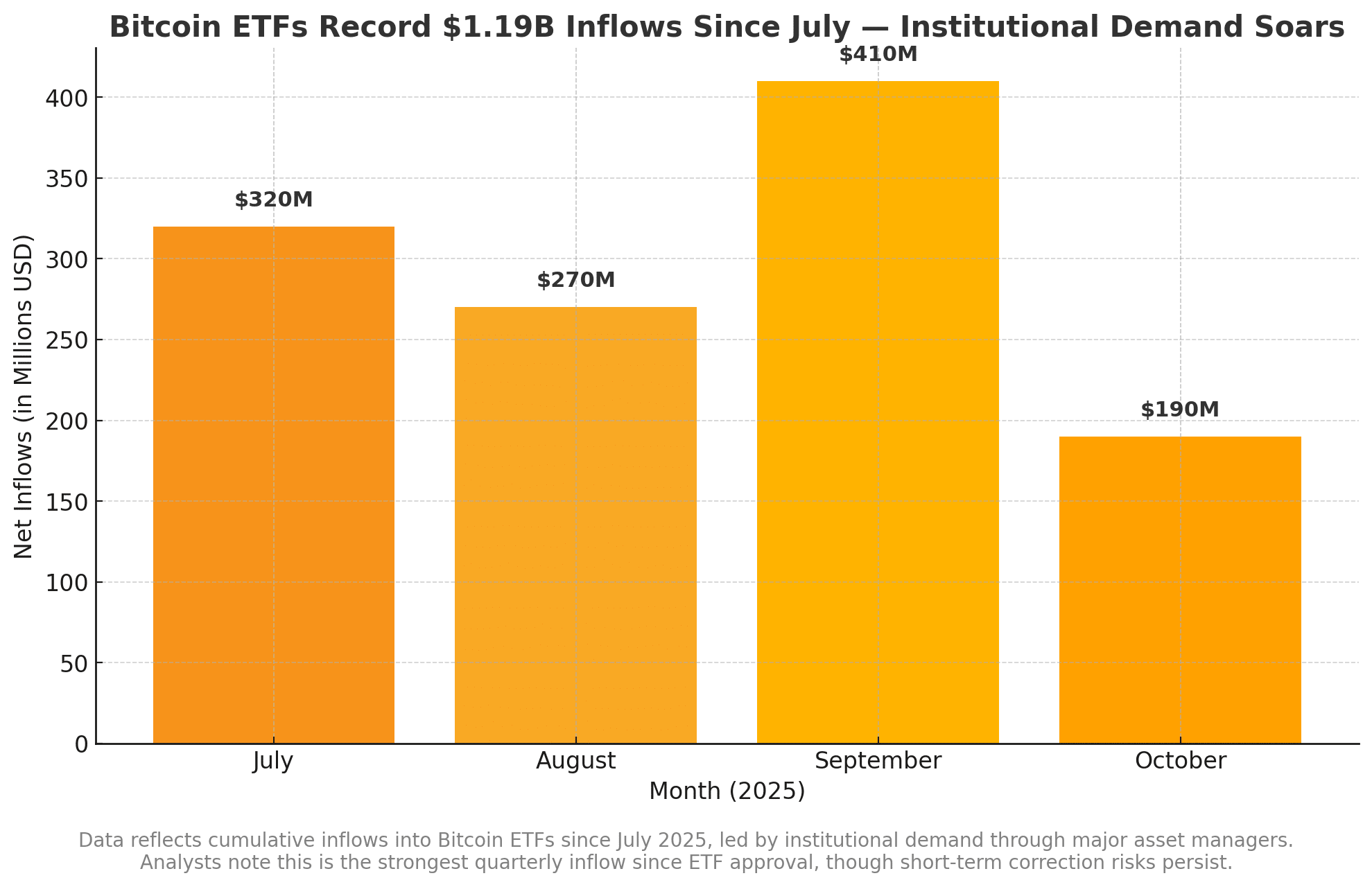
Fund managers point to the blend of liquidity, transparency, and custody solutions as key factors behind the surge. The world’s largest asset managers are no longer sitting on the sidelines; they are building exposure in a regulated environment that fits their compliance frameworks.
This renewed faith in Bitcoin ETFs has also coincided with Bitcoin’s price stabilizing above $120,000, a level unseen before institutional entry. But stability can also precede volatility, which is why some voices are urging caution.
Analysts Warn: Overheating May Trigger a Pullback
While the excitement around Bitcoin ETFs is palpable, not all analysts are celebrating. Some chart technicians see clear warning signs of short-term overheating. The RSI (Relative Strength Index) is now flashing overbought signals on daily charts, while funding rates in futures markets have turned sharply positive.
“Everyone wants exposure to Bitcoin ETFs right now, and that is often when corrections sneak in,” said a derivatives trader on X, hinting at potential short-term pain if momentum fades. Historically, major inflow surges have occasionally marked local tops before the next accumulation phase begins.
Long-Term Fundamentals Still Intact
Despite the talk of corrections, the long-term outlook remains robust. The continuous inflow into Bitcoin ETFs confirms that institutional investors view Bitcoin as a strategic asset, one that hedges inflation and diversifies portfolios. The broader market maturity, improved custody solutions, and transparent structures all support this shift.
The real question is not whether a correction is coming but how deep it will be. Even if short-term volatility strikes, the institutional foundation built through Bitcoin ETFs is expected to provide strong support during pullbacks.
Conclusion
The surge in Bitcoin ETFs represents a turning point in crypto finance. It bridges traditional markets with decentralized value systems and marks a milestone in Bitcoin’s evolution from a speculative asset to a legitimate store of value. Whether a correction occurs or not, the fact that institutional investors are pouring billions into these funds shows that Bitcoin’s legitimacy is no longer in question, it is part of the financial mainstream.
Frequently Asked Questions
1. What is driving the surge in Bitcoin ETFs?
Institutional investors are seeking exposure to Bitcoin through regulated products that offer safety, liquidity, and compliance.
2. Is a correction expected after the $1.19B inflows?
Analysts suggest a short-term correction could occur due to overheated sentiment, though long-term fundamentals remain strong.
3. Which ETF leads in inflows?
BlackRock’s IBIT dominates the inflow race, securing the largest share of institutional investment since July.
4. How do Bitcoin ETFs affect the overall market?
They increase legitimacy, attract new capital, and help stabilize volatility by broadening the investor base.
Glossary
Bitcoin ETF: An exchange-traded fund that tracks the price of Bitcoin, allowing investors to gain exposure without holding the asset directly.
RSI (Relative Strength Index): A momentum indicator measuring overbought or oversold conditions in markets.
Inflows: The net amount of new money entering an investment vehicle, signaling investor demand.
Custody Solutions: Secure services that safeguard digital assets for institutional investors.