




Cybersecurity has become one of the biggest concerns for every company today. Within minutes of time, there is a new report of a data breach or ransomware attack and companies end up losing millions of dollars in recovery. In 2024, it was reported that the number of cyberattacks on organizations grew by over 38 percent and experts are of the opinion that it will continue to grow in 2025.
Blockchain is gradually altering that narrative. It is no longer exclusively about cryptocurrency. It is becoming a reality to protect enterprise data. Through blockchain-based cybersecurity measures, businesses are identifying new methods of keeping sensitive information safe, minimizing insider threats, and preventing hackers from manipulating systems.
This blog describes how blockchain can assist the enterprises in developing robust and transparent security systems. It will demonstrate the difference in blockchain-based cybersecurity, what protocols are employed, and how they are implemented in real businesses in the financial sphere, healthcare, and other sectors.
What Is Blockchain-Based Cybersecurity?
To understand blockchain cybersecurity, it is first important to know what blockchain really means. Simply put, blockchain is a type of common digital notebook that stores data on numerous computers. Rather than storing all data in a single location as it would be the case with a normal database, blockchain distributes it within a network.
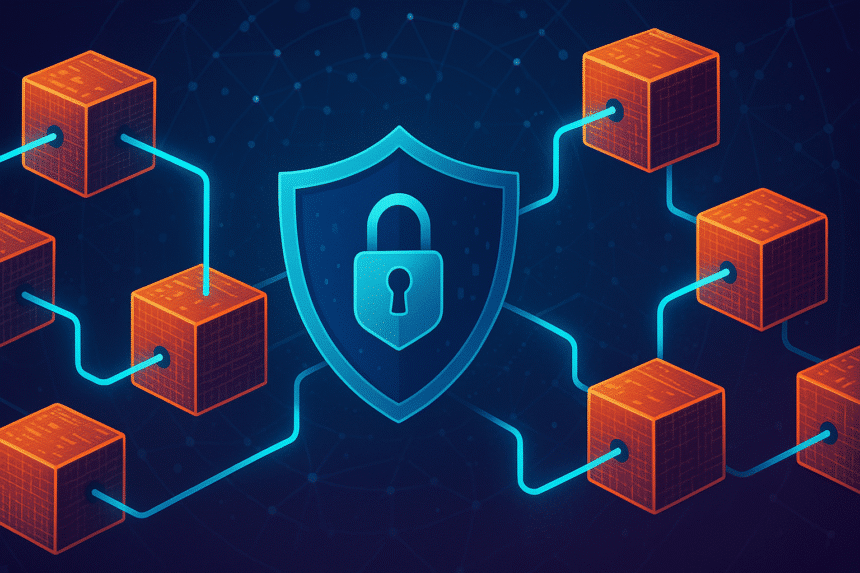
All the data, which are referred to as blocks, are connected in a chain. After a block has been written, it can not be altered without the consensus of all members of the network. This renders it nearly impossible to have hackers to perform the manipulation and deletion of information in the background.
This structure is used in blockchain cybersecurity to achieve stronger data protection that is stronger. No single system manages the entire network, and as such, hackers cannot easily take down the entire network. All the transactions become permanent, hence any move to intrude or modify records is easily noticed by all parties.
Below is a quick comparison that shows the difference between traditional security systems and blockchain-based ones.
| Feature | Traditional Security | Blockchain Security |
| Data Control | Centralized | Decentralized |
| Risk of Single Point Failure | High | Very Low |
| Tamper Resistance | Moderate | Extremely Strong |
| Audit Trail | Limited | Built-in Ledger |
Enterprises that switch to blockchain models gain a huge advantage in transparency, traceability, and trust. Even if one server goes down, the rest of the blockchain continues working as usual.
Why Enterprises Need Strong Cybersecurity in 2025
Enterprises handle massive amounts of private information daily, client data, payroll, internal communications, trade secrets, and much more. This type of information is even more vulnerable in 2025 due to the level of interconnectivity that has been achieved. Hackers are given more opportunities to attack cloud platforms, IoT devices, and AI systems.
IBM in its 2024 Cost of Data Breach Report, has pointed out that the average cost of a data breach is currently 4.45 million dollars per breach to companies. That figure encompasses the lost business, fines by the regulators, and recovery costs. The small and mid-sized enterprises have been vulnerable to a single attack, and the damage is irreparable.
Governments also put pressure. The European General Data Protection Regulation (GDPR) and the California Consumer Privacy Act (CCPA) are laws that require companies to adhere to stringent data privacy regulations. Breach of them may result in fines of millions of dollars.
Meanwhile, insider employees or contractors, nevertheless, also remain one of the greatest threats. Internal abuse or stealing of credentials in most instances gives a backdoor to the outside attackers.
| Threat Type | Description | Risk Level |
| Phishing | Fake emails or messages that trick users into giving info | High |
| Insider Threats | Employees or partners misusing access rights | High |
| Malware | Software that damages files or systems | Medium |
| DDoS Attacks | Flooding servers to make them crash | Medium |
| Data Tampering | Changing records or transactions without permission | Very High |
The need for stronger cybersecurity solutions has never been higher. This is exactly where blockchain technology becomes useful. It gives enterprises the tools to verify, trace, and lock down their data in ways that older systems just can’t.
How Blockchain Strengthens Enterprise Cybersecurity
Blockchain improves cybersecurity not by replacing existing systems but by adding new layers of protection. It is a very difficult design to be found with weaknesses or tampered records by the attackers.
Decentralization Removes Central Failure Points
In the traditional IT systems, all data is usually stored in one or two central servers. Hackers can get access to everything in case they obtain access. In blockchain, the data is dispersed among hundreds or thousands of nodes. In case one node is compromised, the others in the network have preserved the data and made sure that it is not altered.
Decentralization also eliminates the possibility of an insider being in complete control of the company systems. Each operation on the blockchain is logged and authenticated by several nodes forming an inbuilt surveillance mechanism that will not sleep.
Immutability Ensures Data Integrity
Each record that is introduced into a blockchain is time stamped and cannot be altered later. This characteristic is known as immutability and it prevents the covert distortion of key information. In case a person attempts to do so, the system denies it automatically since the other part of the network fails to acknowledge the change.
This can be used in audit trails, record-keeping and in fraud detection. The enterprises can always follow up on what was changed, when, and who gave the approval.
Smart Contracts Automate Security Rules
Smart contracts are another reason blockchain boosts enterprise cybersecurity. These are small computer programs that automatically run actions when certain rules are met. For example, a smart contract can allow only verified employees to access sensitive files or can block suspicious login attempts automatically.
Smart contracts help eliminate human mistakes that often lead to security breaches. Everything follows coded rules, reducing the chance of someone overlooking an issue.
| Feature | Security Impact |
| Decentralization | Reduces hacking risks |
| Smart Contracts | Automates trust and security checks |
| Consensus Algorithms | Validates all transactions |
| Encryption | Keeps private data safe from outsiders |
By combining these features, blockchain builds a strong security foundation that is both transparent and self-verifying. It makes cyberattacks not just difficult but economically impractical for most hackers.
Key Blockchain-Based Cybersecurity Protocols Used by Enterprises
Enterprises use several types of blockchain-based protocols to protect their networks and digital assets. These protocols help improve authentication, encryption, and identity verification.
Zero Knowledge Proofs (ZKP)
ZKP enables one system to demonstrate something to a different system without disclosing the information. To illustrate, an employee will be in a position to identify him or herself to a company system without necessarily disclosing his or her password. This ensures that sensitive information is not shared even in verification.
It eliminates data leaks, which normally occur when the credentials or keys are stored in plain text in servers.
Hashing Algorithms (SHA-256, Keccak)
Hashing is analogous to the conversion of a file to a digital fingerprint. A math formula is used to convert the content of the file into a unique code. Any modification in the file will give a completely different hash. This will be used to monitor tampering and to make sure that files or records are not being altered without the owners being aware.
Distributed Identity (DID) Protocols
These systems generate digital IDs, which are blockchain-based and safe and are under complete user control. Dids allow enterprises to provide access to data to employees without saving the passwords in databases. It also restricts the extent of personal information that has to be exchanged between systems.
Secure Multiparty Computation (SMPC)
This protocol allows other systems or departments to collaborate with private data without exposing the data to one another. As an example, two companies are able to study common customer trends without either party showing their client lists.
| Protocol | Function | Example Use |
| ZKP | Privacy-based verification | Employee login checks |
| SHA-256 | Cryptographic hashing | File integrity verification |
| DID | Secure digital identity | Access management |
| SMPC | Encrypted data collaboration | Secure data analytics |
All these blockchain protocols share one goal: to make enterprise cybersecurity more private, transparent, and self-managed. They allow organizations to move from reactive protection (fixing after attacks) to proactive defense (stopping them before they start).
Real-World Enterprise Use Cases
Blockchain-based cybersecurity is not just theory anymore. Many global enterprises have already started using it in real-world situations. The results are proving that blockchain can make digital protection faster, more reliable, and more transparent than old systems.
Banking and Finance
The banking industry has always been a big target for hackers. With millions of daily transactions, a single data breach can cause huge losses. Banks like JPMorgan, Mastercard, and Santander are using blockchain to improve security in transaction records and identity management.
For example, blockchain helps track every transaction in real time and prevents fake data entries. Since every change must be approved by the network, it’s almost impossible for a hacker to modify payment logs. It also reduces the cost of fraud monitoring systems.
Healthcare
Hospitals and insurance companies store huge amounts of personal data, like patient health records and billing information. A single leak can expose private details of thousands of people.
Blockchain is being used to fix this issue by giving each patient a digital identity that can be verified on the blockchain. Only authorized doctors or nurses can access records. The best part is, all access attempts are recorded permanently so that no data can be viewed or changed secretly.
IBM Watson Health and Guardtime are two examples of platforms already using blockchain to protect healthcare data. They create a secure audit trail of medical transactions that can’t be erased.
Supply Chain Management
Businesses such as Walmart, Nestle, and Maersk are employing blockchain in securing their supply chain business. Blockchain monitors all movements of the products, including their origin in the factory and the location in the store shelves.
This assists in tracing counterfeit products, theft and ensuring that data of products is not tampered with. A blockchain record will indicate precisely where the issue occurred even in the event that a shipment is lost or delayed.
Government and Defense
Blockchain is also beginning to be used by governments as a means of cybersecurity. An example is the U.S. Air Force that experimented with blockchain-based solutions to protect communication channels and defense contracts. Because blockchain generates transparent and unalterable records, hackers or corrupt officials will find it more difficult to modify government data.
The possibilities of blockchain in the public system are still in their infancy, but its potential has the potential to entirely transform the national information security of countries.
Challenges of Adopting Blockchain for Cybersecurity
Even with so many advantages, blockchain cybersecurity isn’t perfect. Enterprises still face a few challenges when trying to use it on a large scale.
Scalability and Cost
Blockchain networks can be expensive to set up and maintain. Some blockchains handle limited transactions per second, which slows down big systems that need to process large amounts of data.
For companies dealing with millions of users, upgrading hardware and maintaining nodes can increase costs quickly. Many enterprises now use Layer-2 solutions or private blockchains to reduce cost and improve speed.
Integration With Legacy Systems
Most enterprises already use old IT infrastructure, and connecting it with blockchain is not always smooth. Traditional databases, access systems, and security tools may not easily support blockchain functions.
It often takes months of testing, data migration, and training before a company can fully switch to a blockchain model.
Compliance and Legal Barriers
Blockchain systems can store encrypted or anonymized data across multiple locations. This sometimes creates confusion about which country’s privacy laws apply.
For example, under the GDPR, users have a “right to be forgotten,” but blockchain data is permanent. So, many enterprises hesitate to go all-in until global rules become clearer.
How Enterprises Can Start Using Blockchain for Cybersecurity
Adopting blockchain cybersecurity does not have to happen all at once. Enterprises can take small, careful steps to test how it fits their systems.
Step 1 – Risk Assessment
A company must review its existing systems before implementing blockchain. It entails inquiring to determine the most vulnerable areas in terms of attacks, such as access by employees, financial operations, or storage of files. After identifying those weak points, teams are able to strategize where blockchain will be the most useful.
Step 2 – Choose the Right Blockchain Platform
All blockchains are not created equally. The most popular among the enterprises are platforms such as Hyperledger Fabric, Ethereum, and Corda.
- Hyperledger suits for private and permissioned.
- Ethernet is optimal with smart contracts and open verification.
- Corda specializes in known party business transactions.
The selection of an appropriate platform will be based on the desire by a company to have privacy, scalability or open collaboration.
Step 3 – Build a Pilot Program
Businesses ought to have humble beginnings. As an example, they may apply blockchain to secure the employee log in systems or authenticate internal reports.
The test phase will assist the IT department to know how much the technology will be used in other areas, its performance, cost and training requirements of the staff.
Step 4 – Train Staff and Integrate Gradually
Technology is only as strong as the people who use it. Many cybersecurity breaches happen because employees don’t follow safety procedures.
So, staff must learn how blockchain works, how to read audit trails, and how to verify digital identities. This makes the entire security network stronger.
Once the pilot program works smoothly, enterprises can expand blockchain integration across finance, HR, and operations.
Conclusion
Experts believe that blockchain and artificial intelligence (AI) together will create the next stage of enterprise security. The future systems will not just react to attacks but predict them before they happen.
AI has the ability to learn behavior patterns in blockchain activity and automatically indicate that something is suspicious. This, together with the immutability of blockchain, makes enterprise systems intelligent and immutable.
The other significant trend is quantum-resistant cryptography. The older encryption method may be broken with the advances of quantum computers. Algorithms capable of withstanding quantum-level attacks are being developed by blockchain developers to keep the data safe even decades ahead.
By 2030, analysts expect the global blockchain cybersecurity market to cross $13 billion, with most adoption happening in finance, defense, and healthcare sectors.
FAQs: Blockchain-Based Cybersecurity for Enterprises
What is blockchain-based cybersecurity?
Blockchain-based cybersecurity means using blockchain technology to protect data and systems from hackers. Instead of storing all data in one place, blockchain keeps it across many computers (nodes). This makes it harder for anyone to change or delete data without everyone else knowing.
How does blockchain make enterprise data safer?
Blockchain adds extra security by using decentralization, encryption, and smart contracts. Once data is added to the blockchain, it can’t be changed easily. Every transaction is verified by the network, which means there’s a permanent record that can’t be erased or faked.
Can blockchain stop data breaches completely?
No system is 100% perfect, but blockchain makes data breaches much harder to pull off. Because it doesn’t rely on one central server, hackers would have to attack many nodes at once. That’s expensive and almost impossible for most attackers.
Glossary
| Term | Meaning |
| Blockchain | A shared digital ledger that records transactions across many computers |
| Smart Contract | A self-executing program that runs based on set rules |
| Zero Knowledge Proof (ZKP) | Proves info is true without revealing private data |
| Hashing | A method that converts data into a secure digital code |
| Decentralization | Data stored across multiple nodes instead of one server |
Summary
Blockchain-based cybersecurity is turning into a foundation for safer enterprises. It brings together decentralization, encryption, and automation to fight modern threats.
By using tools like Zero Knowledge Proofs, smart contracts, and distributed identity systems, companies can stop breaches before they happen and track every action securely.
Even though challenges like high costs and legal uncertainty still exist, many enterprises are already seeing how blockchain makes their data protection stronger and more transparent.
As technology continues to evolve, blockchain will likely sit at the center of enterprise cybersecurity frameworks, helping organizations stay secure, compliant, and trusted in the digital world.