












The idea of a sovereign BTC reserve is no longer dismissed as a fantasy. From Capitol Hill to the Swedish Riksdag, politicians are seriously floating proposals to include Bitcoin in national reserves, alongside gold and foreign currencies.
While skeptics caution against volatility and policy risks, the momentum suggests that the question is shifting from “if” to “when.” This BTC reserve debate is starting to echo past reserve currency transitions, where geopolitics and innovation collided.
Sweden Breaks Ground on BTC Reserve Talk

Sweden has become one of the first European nations where lawmakers formally introduced the concept of a BTC reserve into parliamentary debate. Legislators Dennis Dioukarev and David Perez urged the government to begin by evaluating Bitcoin as a potential diversification tool.
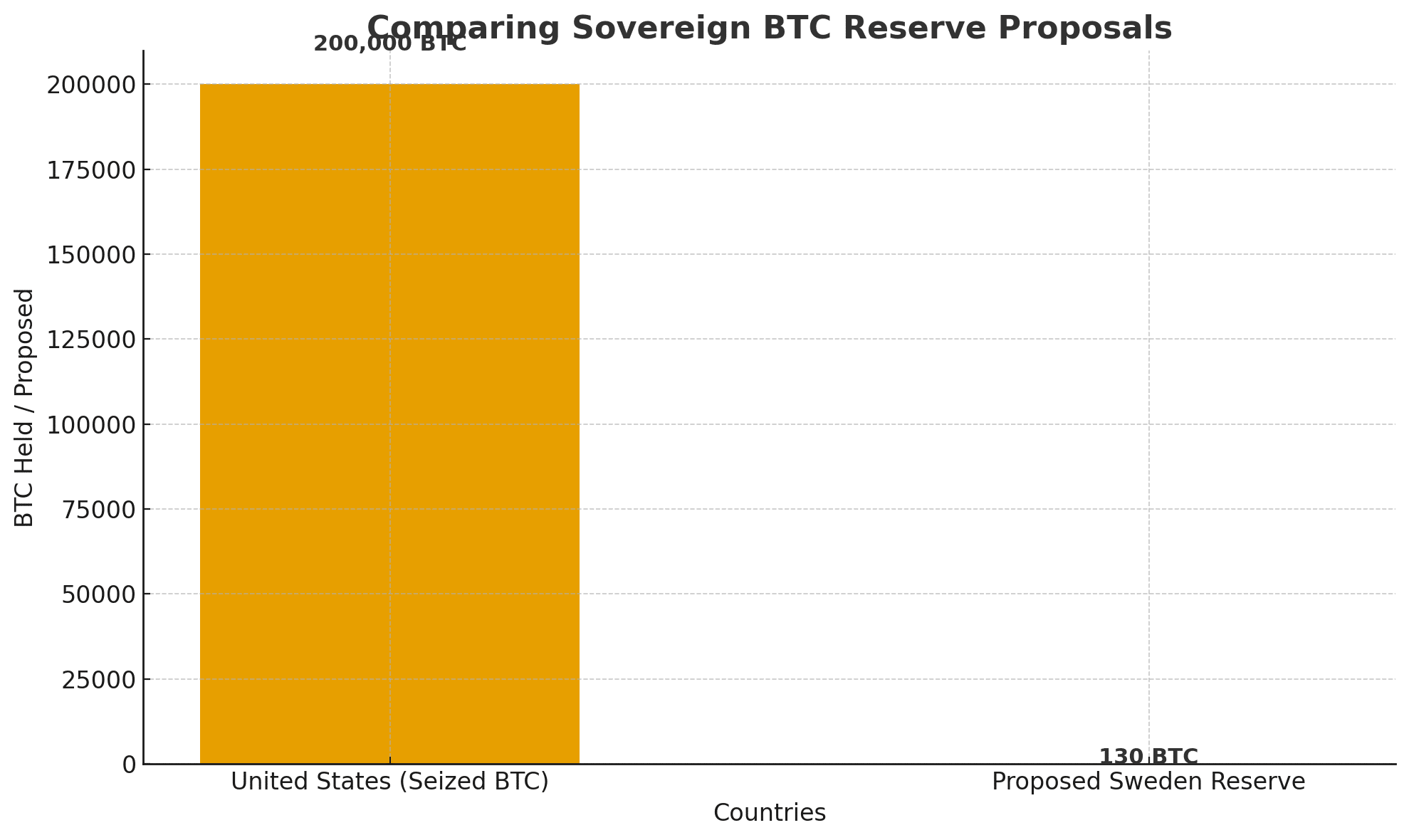
Their motion proposed allocating millions in reserves, even suggesting seized digital assets could seed the initial BTC reserve.
Proponents argue that such a step could protect Sweden’s financial system against currency risk. In their view, Bitcoin’s independence from national policy creates a hedge similar to gold. “Bitcoin is not bound to any one state’s economy, which makes it a unique candidate for inclusion in sovereign reserves,” Dioukarev explained during recent discussions.
The U.S. Push for a Strategic BTC Reserve
Across the Atlantic, the United States is weighing its own framework. Representative Nick Begich recently introduced a draft modeled on earlier versions of the BITCOIN Act. His plan calls for establishing a strategic BTC reserve of up to one million coins over five years, with mechanisms designed to remain budget neutral.
America already holds a sizable amount of Bitcoin, mainly through asset seizures tied to criminal proceedings. Estimates suggest close to 200,000 BTC sit in federal custody. Formalizing those holdings as an official BTC reserve could alter global perception.
By disclosing purchases and maintaining a structured plan, the U.S. could introduce predictable demand into the market. “A reserve system would send a clear message: Bitcoin has matured into a legitimate asset class,” Begich said in recent commentary.
Skeptics Question the Reserve Strategy
Not everyone is convinced. Central banks across Europe remain cautious, pointing to Bitcoin’s volatility, regulatory uncertainty, and lack of legal clarity. A senior Czech central banker was quoted stating he was “highly skeptical of Bitcoin as a reserve asset,” warning that its price swings pose unacceptable risks to monetary stability.
Legal hurdles also loom large. Classifying Bitcoin as a reserve asset means addressing accounting standards, custody solutions, and disclosure rules. For conservative institutions built on slow change, these unknowns are daunting. Critics argue that building a BTC reserve could expose taxpayers to the whims of speculative markets.
The Global Financial Context
What makes the BTC reserve debate fascinating is the timing. Institutional demand has surged through Bitcoin ETFs, with inflows exceeding newly mined supply. Meanwhile, governments worldwide are reassessing reserve strategies amid inflationary pressures, digital currency developments, and shifting geopolitical alliances.
If Europe and the U.S. accelerate efforts, other nations may feel compelled to follow, turning the BTC reserve experiment into a competitive race. This echoes the Cold War space race, where innovation and prestige fueled rapid developments.
Whether symbolic or substantial, sovereign adoption of Bitcoin could reshape its price dynamics, making it less tethered to short-term speculation and more aligned with policy-driven demand.
Conclusion
The road toward a BTC reserve in Europe or the U.S. remains rocky. Legislation, central bank mandates, and political will all need to align. But the debate has moved into mainstream corridors of power, signaling that governments no longer view Bitcoin solely as a speculative toy.
If implemented, a BTC reserve could redefine financial strategies, diversify risk, and push Bitcoin closer to the status of digital gold. While skepticism remains strong, momentum suggests that this debate is unlikely to subside anytime soon.
Frequently Asked Questions
Q: What is a BTC reserve?
A BTC reserve is when a government holds Bitcoin as part of its official reserves, alongside assets like gold or foreign currencies.
Q: Does the U.S. already own Bitcoin?
Yes, the U.S. government controls a significant amount of Bitcoin from criminal seizures, but it has not formalized these holdings as a reserve.
Q: Why would countries want a BTC reserve?
Supporters argue it provides diversification, a hedge against currency risk, and a signal of innovation in sovereign finance.
Glossary of Key Terms
Sovereign Reserves: Assets like gold, foreign exchange, or now potentially Bitcoin, held by governments to back stability and policy.
Volatility: Rapid and unpredictable price fluctuations, often cited as a key risk with Bitcoin.
Budget Neutrality: A fiscal principle ensuring new spending or acquisitions do not increase the deficit.
Custody: The secure holding of digital assets, often requiring advanced solutions for sovereign institutions.
ETF (Exchange-Traded Fund): A market-traded fund that tracks the price of Bitcoin, driving institutional inflows.