








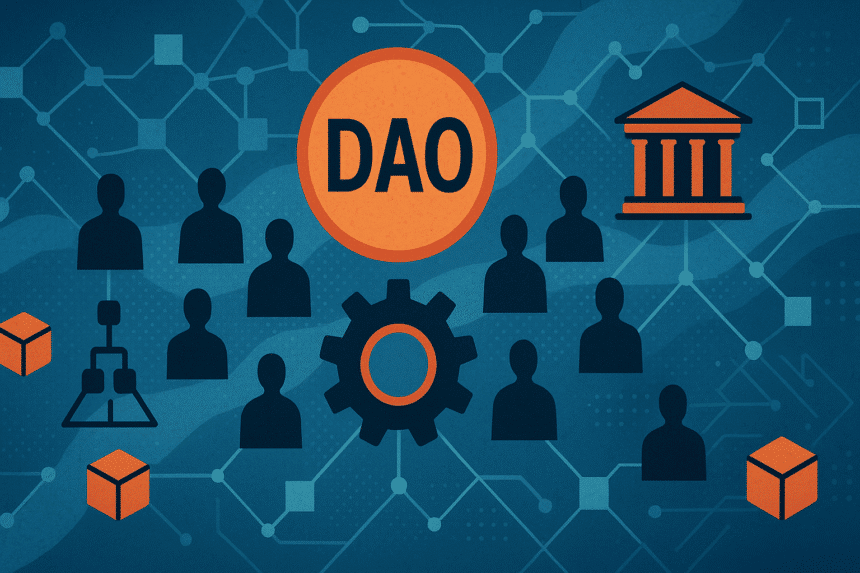

Business today is changing fast. New technology is changing the way companies are run. One of the most interesting ideas is the Decentralized Autonomous Organization, also called DAO. A DAO is a new way for people to work together and make decisions using blockchain. It removes the need for one boss or a single board to control everything.
DAOs are becoming important because they can make business more open, fair, and global. Instead of a company having to trust only a few managers, the decisions in a DAO come from the community. These decisions are written in smart contracts, which are programs that run on the blockchain.
This blog will explain DAOs in simple words. It will also show how DAOs are used in business governance, why they are useful, and what problems they face.
What is a Decentralized Autonomous Organization (DAO)?
A DAO is like a digital company but with no CEO. It runs on blockchain technology. The rules of the DAO are written in smart contracts. These smart contracts are like code that cannot be changed unless members vote on it.
In a normal company, managers and the board make the decisions. In a Decentralized Autonomous Organization, people who hold tokens can vote. These tokens give them the right to help make decisions. It is called “autonomous” because once rules are set, they run automatically.
The first big DAO was launched in 2016. It was just called “The DAO.” It showed the world how people could use blockchain to govern money and projects. Even though the DAO had problems, it started a new wave of decentralized governance.
| Feature | Traditional Company | DAO |
| Control | Board & CEO | Token holders |
| Rules | Legal contracts | Smart contracts |
| Location | Registered in one country | Online, global |
| Transparency | Limited | Open on blockchain |
How DAOs Work in Business Governance
DAOs are used to manage businesses in a new way. Everything happens in steps. First, someone makes a proposal. This could be about spending funds, starting a project, or changing rules. Then, token holders vote on the proposal. If enough people agree, the decision is passed. After that, the smart contract runs the decision automatically.
For example, if the
Decentralized Autonomous Organization decides to give funds to a project, the smart contract will send the money without needing a banker or manager to approve. This makes the process faster and removes middlemen.
| Step | Action | Who Controls It |
| Proposal | New idea submitted | Any token holder |
| Voting | Members vote | Token holders |
| Execution | Smart contract acts | Automated |
This way, DAOs make sure that decisions are not made by only one person. They are made by the whole group. The blockchain records every step so that everything is open and clear to everyone.
Benefits of Using DAOs for Business Governance
DAOs give many benefits that normal companies cannot. One big benefit is transparency. Every decision and every vote is written on the blockchain. Nothing can be hidden.
Another benefit is equal access. Anyone who has tokens can take part in voting. It does not matter if they live in New York, Tokyo, or Nairobi. DAOs are global by nature.
DAOs also help reduce costs. In a normal company, lawyers and managers are paid to run contracts and meetings. In a Decentralized Autonomous Organization, smart contracts do the job automatically. This makes things cheaper.
DAOs also give faster decisions. Proposals are voted on quickly, and smart contracts act right away. There is no waiting for paperwork or signatures.
Finally, DAOs bring fairness. No one person has total power. The community shares control. This can make businesses more democratic and less corrupt.
Challenges DAOs Face in Business Governance
While DAOs have many good things, they also face problems. One of the biggest challenges is legal issues. Many countries still do not know how to treat DAOs. Some governments do not see them as legal companies. This makes it hard for DAOs to sign deals or open bank accounts.
Another problem is security. DAOs run on smart contracts, and if the code has a bug, hackers can steal money. This happened in 2016 with the first
Decentralized Autonomous Organization, when millions of dollars were lost. Even today, many DAOs worry about cyberattacks.
DAOs also face the problem of whales. Whales are people who own many tokens. If one whale owns most tokens, they can control voting. This makes the DAO less fair and less decentralized.
Finally, DAOs sometimes lack human judgment. Smart contracts follow code, but they cannot think about emotions or special cases. In business, not everything can be solved by code alone.
| Challenge | Why It Matters | Example |
| Legal issues | Not recognized everywhere | DAO court cases |
| Security bugs | Can cause fund loss | The DAO hack |
| Centralization risk | Whales control votes | Few holders dominate |
| Lack of judgment | Code cannot adapt | Complex business issues |
Real Examples of DAOs in Business Governance
There are already many Decentralized Autonomous Organization running important projects. One big example is MakerDAO. It is used for managing the DAI stablecoin. People all over the world can vote on interest rates and new rules for DAI.
Another strong example is Uniswap DAO. Uniswap is a decentralized exchange where people trade tokens without banks. The Uniswap DAO allows token holders to vote on changes to fees, rewards, and upgrades.
Aragon is another project. It provides tools for businesses and communities to build their own DAOs. Many smaller companies and startups use Aragon to make decisions in a simple way.
There are also DAOs for investment funds. People put their money together in a DAO and then vote on where to invest it. This makes group investing more transparent and fair compared to traditional funds.
These examples show that DAOs are not just a theory. They are already being used by thousands of people to manage billions of dollars in assets.
How DAOs Can Help Small and Large Businesses
DAOs can help both small and large businesses, but in different ways.
For Small Businesses
Small businesses can use DAOs to raise money. Instead of going to a bank, they can create a DAO where people invest tokens. These tokens give investors voting rights. It is also cheaper for small businesses since smart contracts reduce paperwork and legal fees.
For Large Corporations
Big companies can use the Decentralized Autonomous Organization to improve transparency. They can let stakeholders and even customers vote on some decisions. This builds trust. For example, a large corporation can run a DAO for product decisions, so the community feels included.
DAOs also help large businesses by showing accountability. Since every vote is on the blockchain, shareholders can see how decisions are made. This reduces corruption and secret deals.
| Business Size | DAO Advantage | Example Use Case |
| Small | Easy fundraising | Startup DAO funding |
| Medium | Global reach | Community-backed growth |
| Large | Governance trust | Corporate decision audits |
The Legal and Regulatory Side of DAOs
One of the hardest parts for DAOs is the law. In many countries, DAOs are not seen as legal companies. This means they cannot easily sign contracts, hire workers, or open a bank account.
Some places are trying to fix this problem. For example, the state of Wyoming in the United States passed a law in 2021 that allows DAOs to register as legal entities. This gives them some protection, like limited liability, the same way normal companies have.
But most of the world still does not have clear rules. This creates risk for businesses that want to use DAOs. If a DAO signs a deal in one country, it may not be accepted in another. That makes it hard to grow across borders.
Governments also worry about DAOs being used for illegal work, like money laundering. So regulators are slowly building laws. In the future, more countries may accept DAOs, but for now, the legal system is still catching up.
| Region | Legal Status | Notes |
| USA (Wyoming) | Legal entity allowed | First state with the DAO law |
| Europe | Unclear | Some pilot projects |
| Asia | Mixed | Some countries testing |
| Global | Mostly unrecognized | Needs more regulation |
The Future of the Decentralized Autonomous Organization in Business Governance
The future of DAOs looks big. As more people use blockchain, DAOs may become common in both small and large companies. They could be part of Web3, where the internet is more open and decentralized.
One possible future is that traditional corporations adopt DAOs for part of their decisions. For example, they may keep a CEO but use a DAO system for voting on company policies or product directions.
AI may also play a role in DAOs. Smart contracts could be linked with AI to make better decisions. This would allow DAOs to handle complex cases where simple code is not enough.
In the long run, DAOs could replace some normal governance structures. Instead of companies being registered in one country, they could exist fully online as global organizations. That would change how businesses are built and managed forever.
FAQs Section
What does Decentralized Autonomous Organization mean in business governance?
A DAO is a Decentralized Autonomous Organization. It is a group run on blockchain where decisions are made by token holders using smart contracts.
Are DAOs legal companies?
Not in most places. Some regions, like Wyoming in the USA, give DAOs legal status, but many countries do not yet.
Can a DAO replace a CEO?
Yes, in some cases. A DAO does not need a CEO because token holders vote. But in large corporations, a CEO may still be used along with DAO tools.
What is the difference between DAO and a normal corporation?
Normal corporations are run by a board and legal contracts. DAOs are run by token holders and smart contracts on the blockchain.
Glossary Section
Decentralized Autonomous Organization – Decentralized Autonomous Organization. A group or business that runs on blockchain rules instead of managers.
Smart Contract – Computer code on the blockchain that runs rules automatically when conditions are met.
Token Holder – A person who owns tokens of a DAO. These tokens give voting rights and sometimes rewards.
Governance – The way decisions are made in an organization, such as voting, rules, and control.
Blockchain – A digital ledger where data and transactions are stored in blocks. It is open and cannot be changed easily.
Conclusion
DAOs are one of the biggest changes in business governance in recent years. They allow people from around the world to come together, make decisions, and run projects without a single leader. By using blockchain and smart contracts, DAOs bring transparency, speed, and fairness to organizations.
But DAOs are not perfect. They face problems like unclear laws, hacking risks, and control by big token holders. Even with these issues, the Decentralized Autonomous Organization continues to grow, and more businesses are testing it.
In the future, DAOs may be used by both startups and large corporations. Some companies may even combine traditional systems with DAO-style voting. This mix can bring more trust and fairness into business.
DAOs are still young, but they already manage billions of dollars and many global projects. If laws catch up and technology improves, DAOs can become a normal part of business governance in the digital age.