





Blockchain Security protects money that moves on open networks. It treats code, keys, and people as one system. Attackers test every weak spot, from wallets to bridges to admin tools. One bad key or unsafe function can drain a treasury. Teams need clear steps that work under pressure.
This guide explains the main risks and how to reduce them. It covers smart contract flaws, key management, oracles, and cross chain moves. It also outlines rules, data, and simple habits that cut losses. Each section shows what to watch and what to do next. Strong defense starts before code ships.
What Is Blockchain Security
Blockchain Security is the set of tools, rules, and habits that keep assets safe on public and private chains. It spans key custody, node security, smart contract safety, bridge design, wallets, and user education. It links code to policy. It links on-chain logic to real business goals.
Key Blockchain Security Risks
The biggest risks fall into a few buckets. Each one links to real losses and real users.
Smart Contract Bugs
Code runs value. That code can have bugs. Reentrancy, access control mistakes, faulty math, and bad upgrade logic are common traps. The OWASP Smart Contract Top 10 lists these and more. It gives builders a shared checklist for reviews.
Compromised Keys And Wallets
Keys are the crown jewels. Attackers phish, SIM swap, and steal seed phrases. In the first half of 2025, wallet compromise drove most losses, with phishing close behind.
Oracles, Bridges, And Cross-Chain Risk
Oracles feed prices. Bridges move assets between chains. Both expand attack surface. Bridge logic has failed before and led to major losses. Good design and strict monitoring reduce the blast radius.
Centralized Platforms
Exchanges and custodians hold pooled funds. Private key leaks and hot wallet hits have led to large single-point failures. 2024 saw several high-value centralized platform incidents.
Human Factors
Security slips often start with people. Rushed deploys. Weak admin controls. Poor monitoring. No test coverage. Training and basic hygiene cut risk fast and cheap.
Blockchain Vulnerabilities In Plain Terms
Below is a quick map from common holes to simple fixes.
| Attack Path | How It Works | Simple Fix |
| Reentrancy | External call re-enters before state update | Use checks-effects-interactions. Add reentrancy guards. |
| Access Control Gaps | Anyone can call admin-only functions | Use role-based access control. Test each role path. |
| Integer Logic Errors | Math or scale errors in fees and shares | Use safe math. Add property tests and invariant checks. |
| Price Oracle Abuse | Attacker moves price then drains pool | Use time-weighted prices. Cross-validate sources. |
| Upgrade Proxy Misuse | Wrong admin or slot breaks logic | Lock upgrade roles. Use timelocks and audits. |
| Signature Replay | Old signatures still pass checks | Include nonce, chain ID, and expiry in every sign flow. |
| Flash Loan Exploits | One block loan skews state and logic | Add rate limits, sanity checks, and TWAP guards. |
| Key Leakage | Seed or private key exposed | Use hardware keys, multi-sig, and limited hot wallets. |
Trusted Sites And Data Sources
- Chainalysis: Crime And Hack Trend Data
Chainalysis tracks on-chain crime and hacks across major networks. Its annual and midyear reports show where losses rise or fall. Use it to cite totals, attack types, and long-term trends.
- TRM Labs: Global Policy And Illicit Volume Analysis
TRM Labs publishes research on illicit flows, sanctions, and compliance gaps. It also covers policy shifts across regions. Use it for context on enforcement and risk by jurisdiction.
- OWASP Smart Contract Top 10: Developer Guidance
OWASP lists the most common smart contract weaknesses. Each item explains the risk and shows how to fix it. Use it as a checklist during design, testing, and audits.
- Certik And Immunefi: Incident And Bug Bounty Data
Certik tracks live exploits and quarterly totals. Immunefi lists active bounties and paid rewards. Use them to monitor new incidents and to shape bounty scope and payouts.
- FATF: Travel Rule And Global Standards
The Financial Action Task Force sets baseline rules for virtual asset service providers. Guidance explains the Travel Rule and risk-based controls. Use it to align policies and cross-border flows.
- ESMA MiCA Resources: EU Rule Timelines
ESMA publishes technical standards and Q&A for MiCA. It clarifies dates, disclosures, and supervision. Use it to plan compliance for EU users and tokens.
- Reuters, Investopedia, Finbold: Plain-Language Reporting On Losses
These outlets summarize complex cases in simple terms. They gather numbers from primary sources and add context. Use them for quick snapshots and for quotes a general reader can follow.
How To Use These Sources Together
Start with Certik or Immunefi for the incident details. Verify totals with Chainalysis or TRM Labs. Map legal impact with FATF and ESMA notes. Close with a clear line from Reuters, Investopedia, or Finbold for a reader-friendly cite.
Crypto Hack Losses By Year
Security And Regulatory Context With Real-World Stats
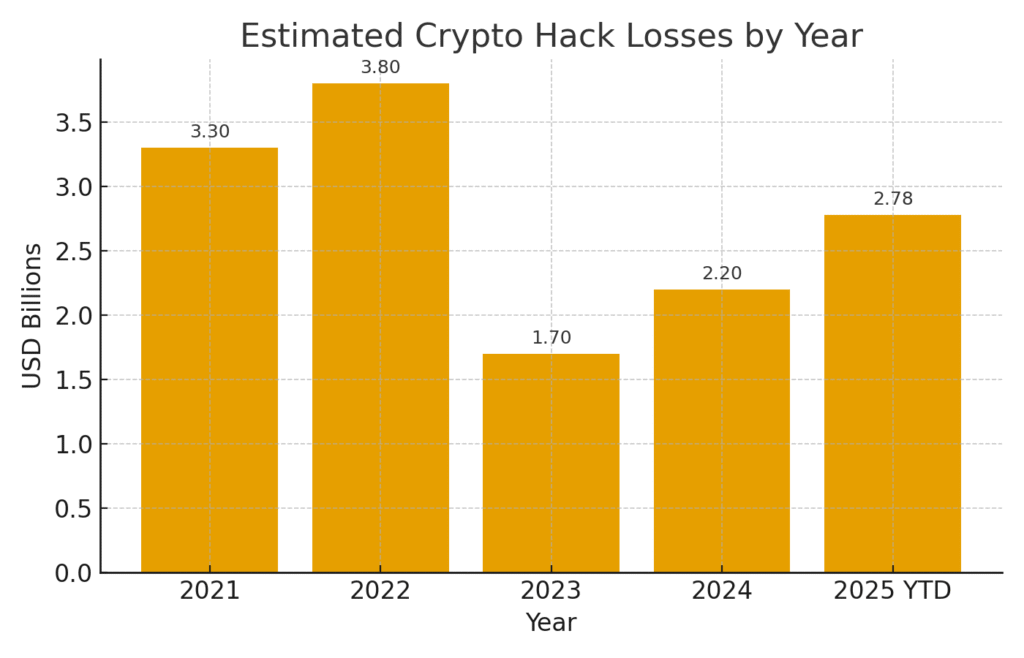
Crypto hacks surged to about $2.2 billion in 2024, with many cases tied to compromised keys and centralized platforms. DeFi losses also remained large.
In 2023, hack losses fell to about $1.7 billion, even as the number of incidents rose. That drop came from fewer and smaller DeFi exploits.
In 2025, losses stayed high. The first half alone saw about $2.47 billion in gross losses across 344 incidents, led by wallet compromise and phishing. Two hits drove much of the total: the Bybit theft and a large DEX exploit. Q3 added about $306.7 million more.
The share of illicit crypto activity looks small next to legal use. TRM Labs estimates illicit volume at about 0.4% of overall crypto volume in 2024, down from 0.9% in 2023. That still equals tens of billions of dollars and real victims.
Policy work marches on. The EU’s MiCA rules started for stablecoins on 30 June 2024 and for other tokens and service providers on 30 December 2024. This pushes risk controls, disclosures, and reserve rules.
The FATF keeps pressing its Travel Rule and due diligence standards. Most major markets have begun to align. Gaps remain in some regions.
State-linked actors stay active. US officials tied a record exchange theft to a North Korean group in early 2025. Attribution and recovery take time, but those cases show why layered defenses matter.
Smart Contract Security
Smart contract security starts in planning, not in audits alone. Good teams design for failure and restrict damage.
Design Rules That Work
- Keep contracts small. Split risky logic.
- Make critical functions pauseable with tight roles.
- Prefer battle-tested libraries and patterns.
- Add circuit breakers and withdraw limits.
- Treat time, price, and randomness with care.
Testing That Catches Real Bugs
- Unit tests for all branches.
- Property tests to guard math and invariants.
- Fuzz tests for weird inputs and edge cases.
- Shadow forks and testnets for full flows.
Reviews And Audits
- Peer review every change.
- Audits before mainnet.
- Audit again after major upgrades.
- Use the OWASP Smart Contract Top 10 as a baseline.
Bug Bounties And AI
Bug bounties help, but they are not a cure-all. AI lowers attacker costs and speeds up exploit search. Programs need clear scopes, fast triage, and real payouts to keep white hats engaged.
Blockchain Privacy Issues
Public chains are transparent by design. That helps audits and forensics. It also exposes patterns. Simple mistakes can link addresses to a user’s identity. Teams must plan for metadata leaks, IP leaks, and wallet fingerprinting.
Mixers once hid flows. Many face sanctions and legal action. Analytics tools keep improving. Strong privacy takes more than one tool. It takes habits, legal review, and user education.
Cybersecurity In Blockchain: People, Process, And Tech
People
Teams work best when security is a habit. Staff train on phishing and wallet hygiene. Access follows least-privilege rules with short-lived admin tokens. Duties rotate on a schedule, and every key action gets logged.
Process
Strong process stops small mistakes from becoming big losses. Changes follow clear change control before any deploy. Moves of funds and upgrades require two people to approve. Playbooks guide incident response and chain fork events so the team acts fast and calm.
Tech
Good tools enforce good habits. Keys sit in hardware security modules. Multi-sig and threshold wallets protect treasuries and admin roles. Systems use rate limits, allow-lists, and anomaly alerts to spot trouble early.
Blockchain Limitations That Shape Security
Immutability: On-chain code is hard to change once live. Teams plan upgrades in advance and include pause switches for emergencies.
Key Management: Users hold value directly. Lost or stolen keys often mean final loss. Strong backup plans and signer controls are vital.
Oracle Dependence: Many apps need off-chain data. Each oracle adds trust edges and more paths to fail. Designs should cross-check sources and set sanity bounds.
Throughput And Fees: High gas can slow fixes and block emergency actions. Teams stage changes and use limits to reduce risk during busy periods.
User Experience: Complex steps invite errors. Clear flows and warnings keep users from signing bad transactions.
Real-World Numbers At A Glance
In 2024, about $2.2 billion was stolen across the ecosystem. In 2023, losses fell to about $1.7 billion as DeFi exploits dropped. The first half of 2025 saw about $2.47 billion in gross losses, led by wallet compromise. The third quarter of 2025 added about $306.7 million more. Illicit activity made up about 0.4% of total crypto volume in 2024. In the EU, MiCA took effect for stablecoins in June 2024 and for a wider scope in December 2024.
Blockchain Security Best Practices: A Simple Toolkit
Keys And Wallets
Protect the crown jewels first. Hold treasury funds in multi-sig or threshold wallets. Keep only small balances in hot wallets for daily needs. Use hardware keys and passkeys. Admin apps should require phishing-resistant MFA.
Code And Deploy
Build with safety from the start. Follow the OWASP Smart Contract Top 10. Add invariant tests and formal checks for core math. Stage deploys with limits, guards, and kill switches. Log every critical action both on-chain and off-chain.
Monitoring
Assume attackers will try new paths. Track TVL, supply shifts, price moves, and abnormal calls. Alert on large transfers, role changes, and failed admin actions. Watch oracle feeds and the mempool for odd patterns that hint at an exploit.
Vendors And Bridges
Third parties extend your attack surface. Vet custody, RPC, and oracle providers. Prefer bridges that use light clients or strong proofs instead of simple multisigs. Cap exposure per chain and per protocol.
Governance
Power must move slowly and safely. Use timelocks and delays for upgrades. Set quorum and vote thresholds that resist flash-loan swings. Publish a security policy and a public incident plan so users know what to expect.
Conclusion
Blockchain Security is not one tool. It is a stack of habits. Criminals probe keys, code, bridges, and people. The trend lines prove it. Losses fell in 2023, then climbed again in 2024 and into 2025. Teams that win ship small, watch fast, and plan for failure. They write clear code. They secure keys. They enforce strict roles. They follow proven guardrails. Strong security keeps users safe and keeps builders focused on growth.
FAQs About Blockchain Security
What Is The Biggest Cause Of Crypto Losses Today?
Wallet compromise and phishing drive many incidents. Large single hits still come from key leaks and centralized platform breaches.
Are Smart Contracts Safer Now Than Two Years Ago?
Yes, in many areas. 2023 saw a sharp drop in DeFi hack value. Reviews, testing, and battle-tested code helped.
What Rules Matter Most In 2025?
In the EU, MiCA sets clear rules for stablecoins and service providers. The FATF Travel Rule also shapes cross-border flows.
Do Bug Bounties Stop All Exploits?
No. They help find issues, but AI tools also help attackers. Programs need tight scope, fast fixes, and real rewards.
How Big Is Illicit Crypto Use?
Recent estimates put illicit volume near 0.4% of total crypto volume in 2024. It still equals large dollar amounts.
Glossary
- Access Control: Rules that decide who can call a function.
- Bridge: Software that moves value between chains.
- Bug Bounty: Reward paid to a researcher for a valid security bug.
- DeFi: Decentralized apps for trading, lending, and more.
- Illicit Volume: On-chain activity linked to crime.
- MEV: Profit from ordering and inserting transactions in blocks.
- Multi-Sig: Wallet that needs several signers to move funds.
- Oracle: A data feed that gives smart contracts outside info.
- Reentrancy: A bug where a call re-enters and drains funds.
- Travel Rule: Policy that requires VASPs to share sender and receiver data.
Summary
Blockchain Security protects value on open networks. The biggest threats are smart contract bugs, compromised keys, oracles, bridges, and centralized platform breaches. Losses fell to about $1.7B in 2023, then rose to about $2.2B in 2024. The first half of 2025 saw about $2.47B more, led by wallet compromise and phishing, with Q3 adding about $306.7M. MiCA took effect across the EU in 2024, while FATF keeps pushing global standards. Strong defenses use multi-sig wallets, hardware keys, strict roles, audits, OWASP Top 10 checks, invariant tests, and live monitoring. Teams should stage deploys, limit blast radius, and plan for incidents. The goal is simple. Keep funds safe, protect users, and build trust over time.