

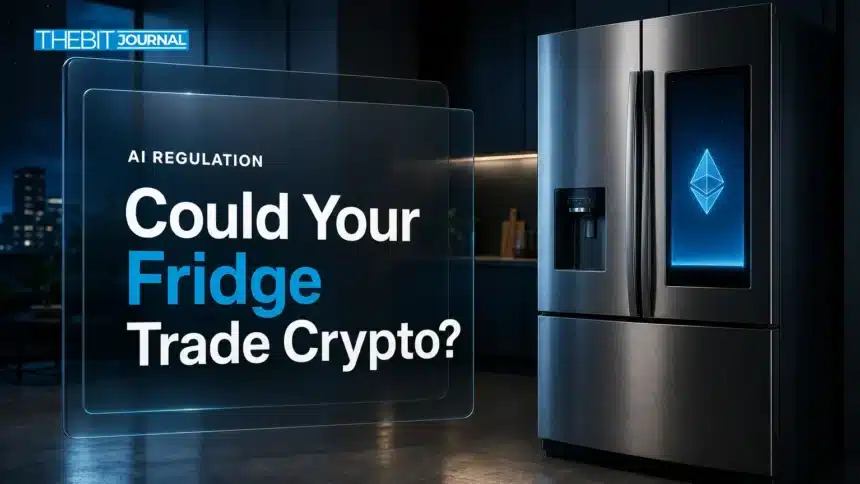

Oversight of CFTC AI agents became a live question on Wednesday. These are autonomous software programs that trade in markets the US derivatives regulator oversees. At the agency’s first Frontier Forum in Washington, DC, Chair Michael Selig said a refrigerator could one day earn money by staking Ether or launching a memecoin. He made the remark on October 28, 2026.
No new rules came out of the event. But the questions Selig raised show where US oversight of trading software may be heading, and how unsettled the basics still are.
- Selig said it’s no longer science fiction to imagine a fridge buying groceries with money it earned from crypto activity, CoinDesk reported.
- He asked whether developers of trading agents must register, who is liable if an agent goes rogue, and whether a “know-your-agent” (KYA) form of identification is needed.
- CFTC staff already use AI extensively to monitor derivatives markets, according to PANews.
- Selig argued AI could give smaller traders and businesses risk-management tools once available only to large institutions.
- No AI rules or guidance were announced at the forum.
Timeline of the CFTC AI agents forum
- Early October 2026: About three weeks before the forum, Selig said regulators were moving ahead with new crypto trading rules even though Congress hadn’t passed the CLARITY Act, according to Benzinga.
- Ahead of the forum: The CFTC’s Innovation Task Force announced a Frontier Forum series. The first event, scheduled for October 28, was devoted to artificial intelligence and agentic finance, per the agency’s press release.
- October 28, 2026 (1:15-2:30 p.m.): A session on super intelligence in derivatives markets, according to the published agenda.
- October 28, 2026 (2:45-4 p.m.): A session on agentic trading. Listed panelists included people from Ornn, Architect and Liquid Compute, based on the agenda The Token Press published.
- October 29, 2026 (04:39 UTC): Cointelegraph published its report on the fridge comment.

Why rules written for humans fit software poorly
The core problem is structural. Selig said the CFTC’s rules were built around “identifiable market participants” carrying out specific financial functions, and that autonomous software raises questions about how those rules apply, Cointelegraph reported. A program that finds and executes trades on its own is harder to slot into categories designed for people and firms.
That’s why his questions focused on registration and liability. If a developer ships an agent that finds and executes trades for a user, does the developer have to register? And if the agent goes rogue, who is responsible? Those gaps sit at the center of any future framework for CFTC AI agents.
Selig also borrowed the administration’s language. Echoing President Trump’s term “super intelligence,” he said the technology is “not artificial” and compared it to the printing press, the steam engine and the internet. Regulators, he said, have to think long and hard about how to regulate intelligently in an age of superintelligence.
Memecoins have come up in Selig’s comments before. About three weeks earlier, per Benzinga, he said regulators classify memecoins as digital collectibles, unlike BTC, ETH and SOL, and warned they carry greater manipulation risk. That backdrop makes his choice of example worth noting, even though the reports from the forum don’t show him linking the two points.
Reactions from the panels and the press
Brett Harrison, a CEO who spoke on one of the panels, took an upbeat view. He said AI is improving trading decisions by analyzing unstructured data and making it easier to enter the market, Bloomingbit reported.
Coverage framed the speech differently. CoinDesk highlighted that Selig posed questions about policing AI while still calling it a road to “autonomous trading.” PANews focused on the KYA idea and on Selig’s suggestion that crypto rulemaking could serve as a template.
How the market reacted
Prices moved only modestly around the forum, and nothing in the available data ties those moves to the speech. Bitcoin, Ether and Solana traded slightly lower over 24 hours, while BNB edged up. The Crypto Fear & Greed Index stood at 51 (Neutral) on October 29, 2026.
| Asset | Price (USD) | 24h change | 30d change |
|---|---|---|---|
| Bitcoin (BTC) | $80,324 | -0.67% | -3.46% |
| Ethereum (ETH) | $2,328.57 | -0.98% | -12.94% |
| Solana (SOL) | $100.48 | -1.36% | -15.06% |
Data from CoinGecko as of October 29, 2026, 05:13 UTC. Ether, the asset in Selig’s staking example, was down about 42% over one year at that time.

Outlook for CFTC AI agents oversight
For now, this is a conversation, not a rulebook. The CFTC described the event as the first in a Frontier Forum series on innovative financial technologies, so more sessions are planned. The open items to watch are whether the agency floats a KYA standard, whether it clarifies registration duties for agent developers, and how it assigns liability when software acts on its own.
Selig’s remark that crypto rulemaking could serve as a template hints at one possible path for any formal step on CFTC AI agents. He announced no proposal and no timeline, so any prediction about the final shape of the rules remains speculation.
The risks in Selig’s own example are real today. Staking rewards vary and come with smart contract and slashing exposure. Memecoins are volatile, carry greater manipulation risk by the regulator’s own description, and can lose all their value. An autonomous agent can amplify losses quickly if it misreads data or is compromised. Nothing in this article is investment advice.
FAQ
Are there new CFTC AI agents rules yet?
No. Reports from the October 28, 2026 forum say no new AI rules or guidance were announced. On regulation, Selig raised questions about registration, liability and identification rather than proposing answers.
What is a know-your-agent rule?
It’s an idea Selig raised as a question: a way to identify AI agents in markets, similar to how know-your-customer checks identify people. No such rule was announced at the forum.
Did Selig say fridges will stake Ether?
He said it’s no longer science fiction to picture a fridge buying groceries with money earned from staking Ether or launching a memecoin. It was an illustration of the regulatory challenge, not a forecast.
Sources
- Your fridge could one day stake Ether, launch memecoins: CFTC chair (Cointelegraph)
- CFTC Chair Says Fridges Could Stake Ether, Launch Memecoins (cointelegraph.com)
- CFTC chief poses questions about policing AI but calls it a road to 'autonomous trading' (www.coindesk.com)
- CFTC Chair Raises AI Agent Regulatory Questions: Is a "Know Your Agent" Rule Needed? (panews.io)
- CFTC Innovation Task Force to Host Frontier Forum Series on Innovative Financial Technologies (www.cftc.gov)
- CFTC Sets AI Forum on Derivatives and Agentic Trading (www.thetokenpress.com)
- CFTC Commissioner Selig Says AI Will Speed Fully Autonomous Trading, Calls for Regulatory Overhaul (en.bloomingbit.io)
- CFTC Chair Mike Selig Pushes New Crypto Platform Rules – Benzinga (www.benzinga.com)
This article is for informational purposes only and does not constitute financial or investment advice. Cryptocurrencies are highly volatile; always do your own research before investing.