


Last updated: November 18, 2026
What is Bitcoin Cash? Bitcoin Cash (BCH) is a cryptocurrency and peer-to-peer network created in 2017 after a dispute about how Bitcoin should scale. Its design emphasizes payments, while miners verify transactions and receive newly issued BCH as block rewards.
Bitcoin Cash shares Bitcoin’s proof-of-work roots and 21 million maximum supply, but it operates on its own blockchain. Understanding that distinction helps explain what BCH can do, and what risks come with using or holding it.
Quick answer: What is Bitcoin Cash?
Bitcoin Cash is a decentralized digital asset that split from Bitcoin on August 1, 2017. It uses proof-of-work mining and a larger block capacity baseline to support transactions, but its price can be volatile and payments depend on the network and the wallet or service involved.
What is Bitcoin Cash and how does it work?
Bitcoin Cash was created as a fork of Bitcoin, meaning developers and users continued with a separate blockchain and asset after a disagreement over scaling. The SEC filing describing BCH says the network is used for payments and to reward miners who verify transactions. BCH is not the same asset as BTC, and sending one to an address or service intended for the other can result in loss.
How Bitcoin Cash works, step by step
- A user creates a transaction. A wallet signs a transfer of BCH and broadcasts it to the network. Wallets and services may differ in features and security practices.
- Nodes check the transaction. Participating computers validate transactions against network rules, including whether the sender can spend the funds.
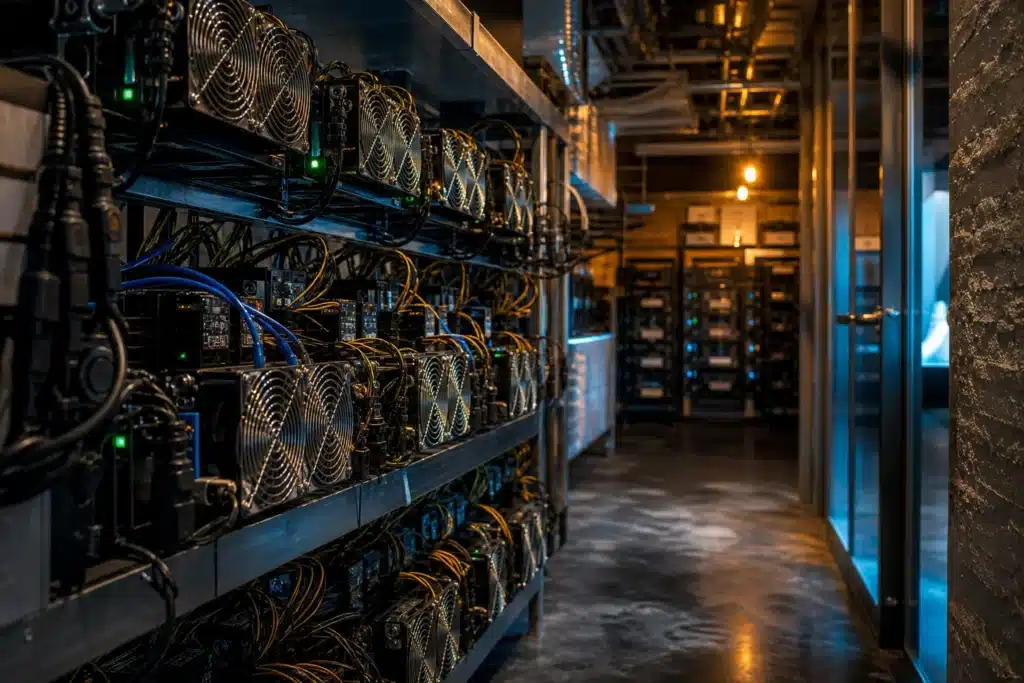
- Miners compete to add a block. Bitcoin Cash uses proof of work. Miners expend computing resources to propose blocks, and successful miners receive a block reward and transaction fees under protocol rules.
- The network builds confirmation. As more blocks are added after a transaction’s block, it gains confirmations. Merchants and services set their own policies for when to treat a payment as settled.
- Supply follows protocol rules. The SEC filing states that BCH has a maximum supply of 21 million. It reported a 3.125 BCH block reward as of June 30, 2026, and said the next halving was expected in 2028. Protocol issuance and timing do not establish future price.
The SEC filing describes an adaptive block-size limit with a 32 MB baseline. A larger capacity can allow more transaction data in blocks, but block capacity alone does not establish confirmation times, fees in every circumstance, or merchant acceptance.
Bitcoin Cash overview and comparison
Bitcoin Cash and Bitcoin share a history and some design features, but their blockchains and markets are separate. The key practical distinction is that a BCH payment must use a BCH-compatible wallet and network. A Bitcoin address or exchange deposit instruction may not accept it.
| Feature | Bitcoin Cash (BCH) | Bitcoin (BTC) |
|---|---|---|
| Origin | Forked from Bitcoin on August 1, 2017, according to an SEC filing | The original network from which BCH forked |
| Primary use described in source material | Peer-to-peer payments and a digital asset | Not detailed in the BCH source material |
| Consensus | Proof of work | Not detailed in the BCH source material |
| Maximum supply | 21 million BCH | Not detailed in the BCH source material |
| Capacity rule | Adaptive block-size limit with a 32 MB baseline, per the SEC filing | Not detailed in the BCH source material |
The table avoids assuming that every technical or market difference can be reduced to a single figure. Bitcoin Cash also changes over time through network upgrades. Its May 15, 2026 upgrade activated changes that included bounded looping operations, reusable function definitions and invocation, re-enabled bitwise operations, and Pay to Script, according to the Bitcoin Cash Node upgrade specification.
Bitcoin Cash Node maintainers said on November 14, 2026, that they planned to implement CHIP-2025-03, Faster Blocks, in a later node release, targeting activation on May 15, 2027. They warned that a different block interval could affect services built around a 10-minute assumption. This was a stated target, not an already activated change.
Market context, mistakes, and risks
Market figures are snapshots, not lasting characteristics of the protocol. CoinGecko listed BCH at $208.52 at 14:30 UTC on November 18, 2026, with a market capitalization of about $4.20 billion and a 24-hour trading volume of about $83.43 million. Those figures can change quickly and do not indicate what BCH will be worth later.
Other developments also need careful wording. CME Group announced BCH futures and micro futures on September 22, 2026, with trading planned to begin October 19 subject to regulatory review. Grayscale’s September 11, 2026 amended filing proposed converting its existing BCH Trust into an ETF, but said the registration would not become effective and no offering would occur until relevant listing standards were approved or approval was otherwise unnecessary.
Common mistakes include confusing BCH with BTC, assuming a payment is final before the recipient’s required confirmations, and treating a past price or planned product as proof of future value. The SEC filing distinguished the existing Grayscale trust, whose shares it described as quoted on OTC Markets, from the proposed ETF conversion.
Bitcoin Cash carries familiar crypto risks: sharp price changes, possible loss of funds from an address or network mistake, wallet or exchange failures, software vulnerabilities, and changes in regulation. Proof of work does not remove these risks.
Frequently asked questions
What is Bitcoin Cash used for?
Bitcoin Cash is used as a peer-to-peer digital asset and for payments, according to the SEC filing. Whether a shop, service, or payment provider accepts BCH depends on that provider; acceptance is not universal.
Is Bitcoin Cash the same as Bitcoin?
No. Bitcoin Cash forked from Bitcoin on August 1, 2017, and now has its own blockchain and BCH currency. Both names and tickers matter when choosing a wallet or sending a transaction.
How is Bitcoin Cash different from Bitcoin?
The BCH network’s stated design includes an adaptive block-size limit with a 32 MB baseline. Bitcoin Cash and Bitcoin are separate networks, and the sources cited here do not provide enough detail to compare every technical or market feature. Check current network and service information before relying on a specific wallet, exchange, or payment route.
Sources
- Bitcoin Cash price and market data (CoinGecko)
- 10-K (www.sec.gov)
- 2026-05-15 Network Upgrade Specification (upgradespecs.bitcoincashnode.org)
This article is for informational purposes only and does not constitute financial or investment advice. Cryptocurrencies are highly volatile; always do your own research before investing.