
This article was first published on The Bit Journal.
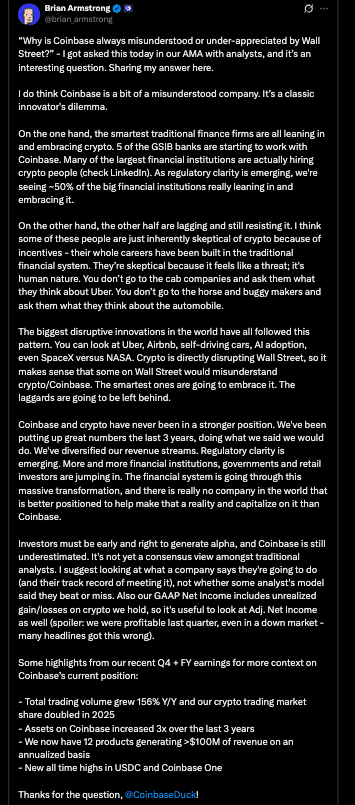
Coinbase CEO Brian Armstrong has been quoted saying there’s an obvious division between Wall Street and crypto. He explained that old financial services companies are split, some of them are rapidly adopting digital assets with the help of Coinbase, others are pushing back on crypto because it threatens their old business models.
According to him, mainstream finance is responding to digital assets in different ways, amid increasing regulatory clarity and institutional flows.
Why Coinbase Says There’s a Wall Street and Crypto Divide
Armstrong answered publicly to a query about why Wall Street tends to get Coinbase wrong or underestimate it. He said the Wall Street and crypto divide is not about the technology or economics, but over how careers and systems in the world of finance are made and how crypto is disrupting them.
According to him, TradFi incumbents approach digital assets like taxi companies used to respond to ride-hailing and hotels responded to short-term rentals.
He argued that resistance from incumbents is not a sign of weakness but a predictable response to change.
“Crypto is directly disrupting Wall Street, so it makes sense that some on Wall Street would misunderstand crypto/Coinbase,” Armstrong said. “The smartest ones are going to embrace it. The laggards are going to be left behind.”
“Coinbase in its strongest position to date”
In his message, Armstrong pointed out that about half of major financial institutions are now actively working with Coinbase around crypto, building out products and talent as regulatory guidance becomes clearer in digital assets.
At the same time, some companies are still reluctant to actively engage in crypto.
Traditional Finance Engagement With Coinbase
Armstrong specifically cited five Global Systemically Important Banks (GSIBs) that have already started interacting with Coinbase, indicating the involvement of major Wall Street players in crypto infrastructure.
He added that the banks and financial institutions running with this are doing so by hiring professionals and creating new business units specifically aimed at crypto.
He noted that better regulatory certainty has enabled such partnerships, and more traditional companies are starting to realize that crypto is here to stay instead of rejecting it outright.
Performance Metrics and Business Growth Cited by Armstrong
In defense of Coinbase’s operations and reputation, Armstrong released data showing strong annual growth in key categories in 2025, including a 156% increase in total transaction volume, a doubling of market share and a threefold expansion of assets under the company’s custodial control over the course of three years.
He also noted that Coinbase now boasts 12 different products making more than $100 million a year, an evidence, in his view, that the company is not just surviving but actually growing even in a rough market.
He emphasized that investors and analysts should look at adjusted results such as adjusted net income because standard accounting figures like GAAP net income included unrealized gains and losses from crypto holdings that could distort the company’s true performance.

Retail and Institutional Momentum in the Face of Market Stress
Armstrong’s recent commentary also reveals overall user interaction with digital assets. He added that Coinbase had seen a surge in retail interest, with individual investors adding to their Bitcoin and Ethereum balances during market downturns recently rather than selling off, which means a trust in the long-term value of crypto as opposed to short-term price movements.
Even as the crypto market experiences volatility, institutional trading on Coinbase has been strong. The platform handled over of $237 billion in institutional trading volume for 2026, according to internal data shared by Armstrong.
These trends further suggest, that while there is a generalized fall in digital asset prices and trading volume, the different sections of the market are reacting in ways that demonstrate ongoing engagement rather than abandonment.
Conclusion
The split between Wall Street and crypto is one of the most obvious divides taking shape in 2026. The remarks of Coinbase CEO Brian Armstrong suggest that traditional finance is becoming increasingly divided.
A few big institutions are actively investing in the development of crypto capabilities and partnerships with Coinbase, while others are more wary or resistant because of their legacy structures and incentives.
The larger message of Armstrong’s thread is that grasping and embracing digital assets, rather than pushing them away, will determine which financial institutions win in the years ahead.
His remarks also hammer on the evolution of Coinbase itself, as its business continues to grow beyond speculative trading and takes in more revenue from new product offerings while grabbing market share with both retails and institutional clients even against a difficult market environment.
Glossary
GSIB (Global Systemically Important Bank): A bank that, if it failed, would threaten the global financial system.
Adjusted Net Income: A measure of profit that does not include certain items such as unrealized gains or losses, applied here to more accurately portray Coinbase’s operating performance.
Retail activity: Trading of crypto assets by individual users as opposed to institutional clients.
Frequently Asked Questions About Wall Street and Crypto Divide
What is the Wall Street and crypto rift?
The Wall Street and crypto divide refers to how some traditional financial firms adopt crypto innovations, while others remain skeptical or resistant.
Do big banks do business with Coinbase?
Five of the world’s biggest banks are cooperating with Coinbase on developing crypto assets, said according to Brian Armstrong, the CEO of Coinbase.
Is Coinbase growing its business?
Armstrong also said transaction volume had grown strongly and market share doubled in 2025, with a range of new products now on offer.
Are retail traders active in times of market decline?
Yes, for retail investors, there is internal data that shows they have been picking up more Bitcoin and Ethereum during the recent price declines.
Does Armstrong believe crypto will change finance?
He argues that cryptocurrency is changing financial services and for institutions to not change with them would be at their peril.
References
reuters
investors
wsj
PANews
Bingx Exchange