






Bitcoin ETF outflows are flashing warning signs across crypto markets, but beneath the surface, institutional money is quietly changing direction rather than disappearing. While billions have flowed out of Bitcoin and Ethereum products, fresh capital continues entering Solana, XRP, and Hyperliquid-linked funds. That growing divergence is fueling a broader altcoin rotation and reshaping how Wall Street approaches digital assets in 2026.
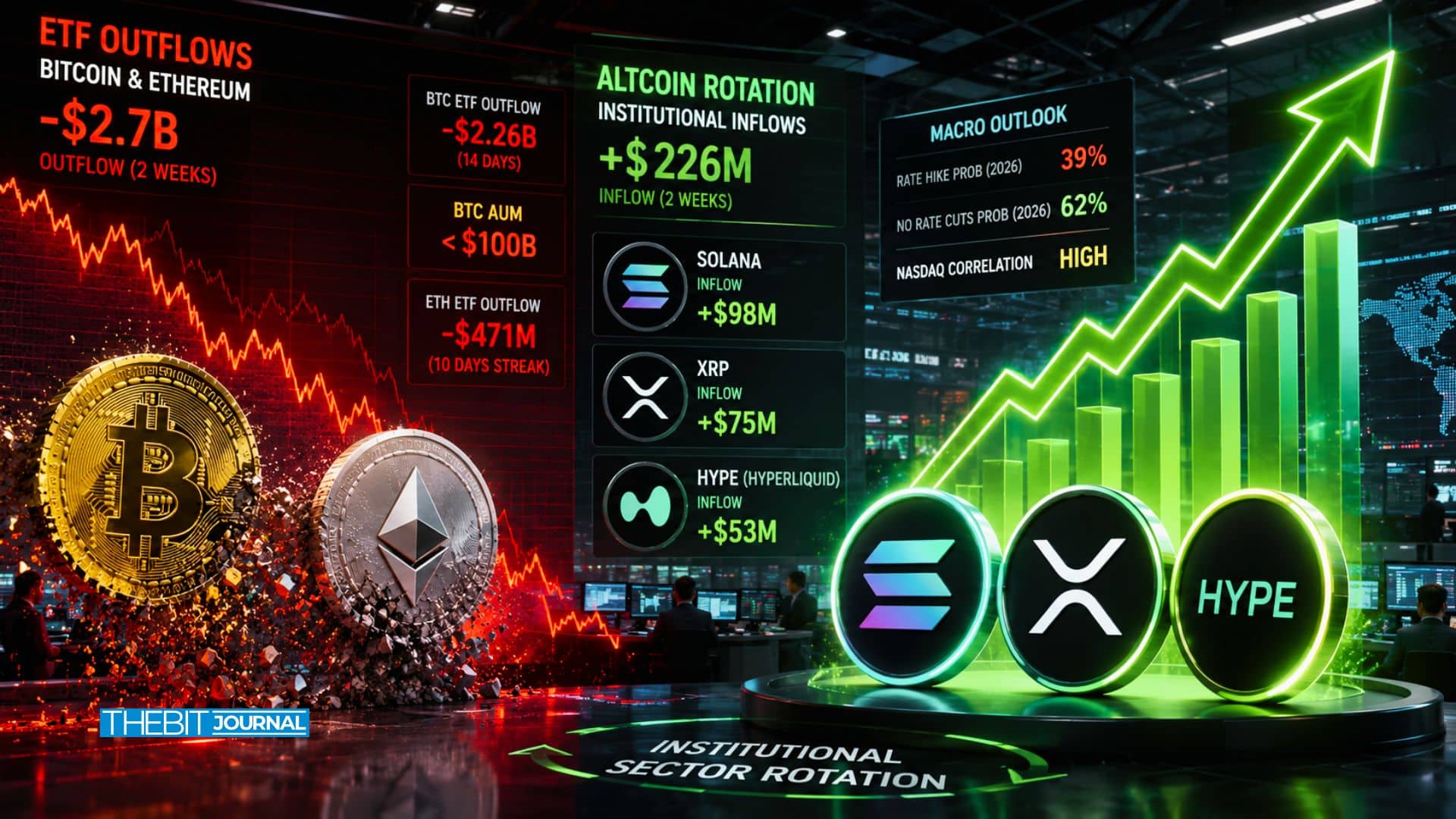
According to the source, Bitcoin and Ethereum ETF outflows reached nearly $2.7 billion over the past two weeks. Yet alternative crypto funds tied to Solana, XRP, and HYPE attracted roughly $226 million during the same period. ETF flow charts show a sharp split between large-cap crypto exposure and emerging blockchain ecosystems. Analysts now believe institutional sector rotation, not market collapse, is driving the latest moves.
Bitcoin and Ethereum ETF Outflows Hit Their Highest Levels in Months
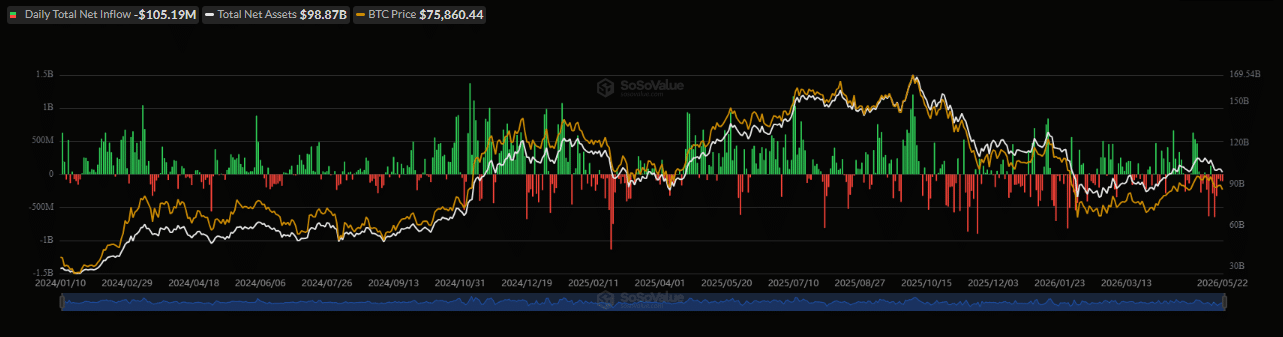
Recent market data revealed that Bitcoin ETF outflows totaled roughly $1.26 billion last week alone, marking the heaviest weekly drain since January. Combined with the previous week, Bitcoin ETF outflows exceeded $2.26 billion in just 14 days, pushing total assets under management below the $100 billion threshold.
Ethereum products also struggled. The nine spot Ethereum funds posted $471 million in outflows and extended their losing streak to 10 straight trading sessions. Market dashboards indicate that Bitcoin and Ethereum ETF outflows accelerated even while Bitcoin traded near $80,000.
That detail changes the narrative completely.
Timothy Misir, head of research at BRN, explained that average daily ETF flows recently dropped to negative $88 million, the weakest level since February. However, unlike earlier selloffs triggered by panic, current Bitcoin ETF outflows appear tied to strategic portfolio repositioning.
Institutional investors are not dumping crypto blindly. Instead, many funds are reducing exposure to macro-sensitive assets while rotating toward utility-driven ecosystems.
Sticky Inflation and Fed Uncertainty Trigger Altcoin Rotation
The latest altcoin rotation reflects growing fears surrounding interest rates and Federal Reserve policy. Earlier this year, crypto ETFs attracted nearly $2.9 billion in inflows after traders expected aggressive rate cuts throughout 2026.
That optimism has faded fast.
Persistent inflation and hawkish economic signals now dominate market sentiment. Futures markets now reflect roughly a 39% chance of future rate hikes, while prediction platforms suggest there is a 62% probability that no rate cuts will happen this year.
Because Bitcoin and Ethereum now behave similarly to technology stocks, Bitcoin ETF outflows increasingly mirror Nasdaq-style reactions to macroeconomic uncertainty. The stronger the rate fears become, the heavier the institutional selling pressure appears.
At the same time, altcoin rotation continues gaining momentum because smaller blockchain ecosystems rely more on network activity, protocol growth, and operational utility than broad macroeconomic conditions.
Why Solana, XRP and HYPE Are Winning Institutional Attention
While Bitcoin ETF outflows dominated headlines, institutional investors quietly expanded exposure to selective blockchain ecosystems. Solana attracted strong demand because of its growing decentralized finance activity and high-speed infrastructure.
XRP also benefited from rising confidence in blockchain-based payment systems. Many institutions now view Ripple’s ecosystem as a practical cross-border settlement network with long-term utility.
Meanwhile, Hyperliquid’s HYPE token emerged as another major winner during the ongoing altcoin rotation. Its derivatives-focused infrastructure continues drawing traders searching for decentralized alternatives to centralized exchanges.
Alvin Kan, chief operating officer at Bitget Wallet, recently stated that the divergence between Bitcoin ETF outflows and alternative crypto inflows reflects internal market rotation rather than collapsing digital asset demand.
Sector-Based Crypto Investing Is Becoming the New Institutional Strategy
Bitcoin and Ethereum ETF outflows also highlight how crypto markets are maturing into a more competitive financial landscape. During previous cycles, institutions mainly relied on Bitcoin and Ethereum for regulated crypto exposure.
Today, ETF wrappers allow portfolio managers to target specialized blockchain sectors without directly managing wallets or exchange risks. That regulated access is transforming crypto into a form of sector-based crypto investing, much like traditional equity markets.
As institutional sector rotation expands, Bitcoin increasingly represents a macro-sensitive digital asset, while ecosystems like Solana, XRP, and Hyperliquid trade on innovation, adoption, and utility-driven growth narratives.
Conclusion
Bitcoin ETF outflows may appear alarming at first glance, yet the broader market reveals a much deeper transformation underway. Institutions are no longer treating crypto as one unified trade. Instead, capital is flowing selectively into blockchain ecosystems with stronger utility, active development, and clearer growth potential.
If altcoin rotation continues at this pace, the next phase of crypto investing could become far more diversified and resilient. The real story may not be about money leaving crypto, but about where smart institutional capital is choosing to go next.
Glossary of Key Terms
Bitcoin ETF outflows: Capital leaving Bitcoin exchange-traded funds.
Altcoin rotation: Movement of funds from Bitcoin into alternative cryptocurrencies.
Spot ETF: An exchange-traded fund backed directly by an underlying asset.
Institutional sector rotation: Investors reallocating capital between different market sectors.
DeFi: Decentralized financial services built on blockchain technology.
FAQs About Bitcoin ETF Outflows
Why are Bitcoin ETF outflows increasing?
Rising interest-rate concerns and macroeconomic uncertainty are pushing institutions to rebalance portfolios.
What is altcoin rotation in crypto?
Altcoin rotation happens when investors move funds from Bitcoin into smaller blockchain ecosystems.
Why are institutions buying Solana and XRP?
Both ecosystems offer strong utility narratives tied to DeFi expansion and payment infrastructure.
Does Bitcoin ETF outflows mean institutions are leaving crypto?
No. Current market data suggests institutions are reallocating capital rather than abandoning digital assets.
Sources/References