






Last updated on July 16, 2026
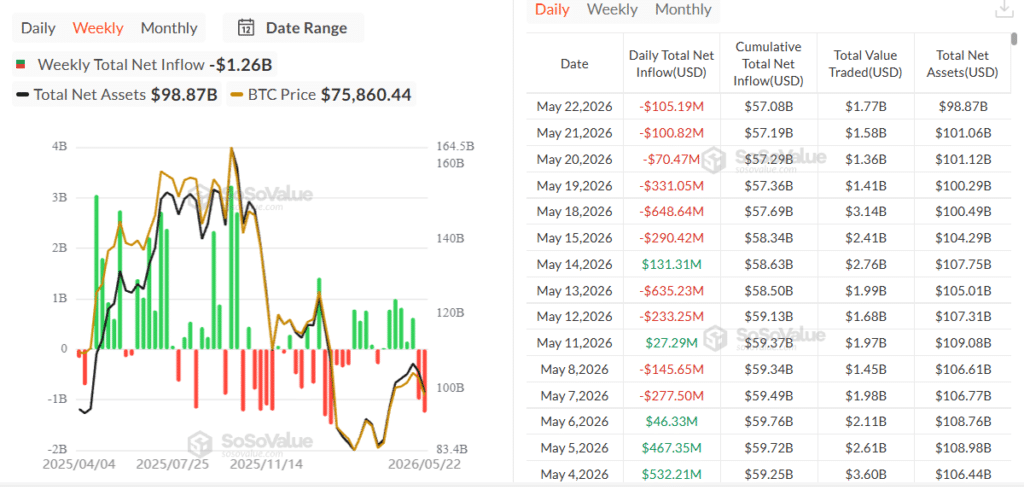
Bitcoin ETF outflows reflected a sharp shift in institutional positioning last week as investors reduced exposure amid softer Bitcoin price action and renewed macroeconomic caution. Market participants closely monitored ETF flows, Federal Reserve commentary, and broader liquidity conditions as risk sentiment weakened across crypto markets. SoSoValue data from the May 22 trading session showed that the 11 U.S. spot Bitcoin ETFs posted approximately $1.256 billion in cumulative net outflows between May 18 and May 22, extending a six-day redemption streak that marked one of the largest weekly reversals of 2026.
The latest Bitcoin ETF outflows followed a strong April and early May period when institutional demand pushed cumulative net inflows above $57 billion. However, the trend reversed as investors reassessed exposure to volatile assets amid inflation concerns, profit-taking activity, portfolio rebalancing, and slowing momentum in Bitcoin’s broader rally.
What Did Bitcoin ETF Outflows Reveal About Institutional Positioning?
Bitcoin ETF outflows highlighted sustained institutional caution rather than isolated withdrawals from a single issuer or trading day. The redemptions continued steadily throughout the week, suggesting investors remained defensive even after the initial wave of selling pressure. The largest single-day withdrawal arrived on Monday, May 18, when investors pulled $648.64 million from spot Bitcoin ETFs.

Outflows continued with another $331 million on Tuesday, followed by $70.5 million on Wednesday, $100.8 million on Thursday, and $105.2 million on Friday, based on SoSoValue flow data published after market close on May 22. By the end of the week, assets under management across the U.S. spot Bitcoin ETF sector had declined to roughly $98.87 billion from levels above $100 billion earlier in the month.
Based on Bitcoin market capitalization levels recorded during the same trading period, ETF holdings represented approximately 6.49% of the total Bitcoin market at week close. The U.S. spot Bitcoin ETF lineup included BlackRock’s IBIT, Fidelity’s FBTC, Grayscale’s GBTC, ARK 21Shares’ ARKB, Bitwise’s BITB, VanEck’s HODL, Franklin Templeton’s EZBC, Valkyrie’s BRRR, Invesco Galaxy’s BTCO, WisdomTree’s BTCW, and Hashdex’s DEFI.
Analysts also noted that billion-dollar weekly ETF flow swings have become increasingly common since spot Bitcoin ETFs launched in 2024, reflecting the growing institutionalization of crypto investment products rather than isolated market stress.
Why Did Institutional Investors Reduce Exposure?
The latest Bitcoin ETF outflows coincided with several overlapping market pressures instead of one isolated catalyst. Federal Reserve Governor Christopher Waller stated during a May 22 speech that inflation was “not headed in the right direction” and supported removing easing biases from monetary policy expectations. His comments likely contributed to weaker risk appetite, while market observers also pointed to profit-taking activity, portfolio rebalancing, and slower institutional accumulation as additional factors behind the redemption streak.
Bitcoin also struggled to sustain momentum after trading near the $83,000 range earlier in May before moving lower during the second half of the month. The cryptocurrency traded around $75,860 by Friday’s close before later recovering toward $77,320. Bitcoin is currently trading around $77,164.68, up 0.49% over the past 24 hours.
Some analysts viewed the latest Bitcoin ETF outflows as an orderly rotation phase following weeks of strong inflows rather than evidence of weakening long-term institutional demand. Others warned that persistent macroeconomic uncertainty and continued hawkish policy signals could extend risk-off positioning across crypto markets. The broader market backdrop also remained cautious due to geopolitical uncertainty and investor sensitivity toward future inflation data releases.
Which ETF Issuers Experienced The Largest Withdrawals?
BlackRock and Fidelity Investments continued dominating institutional Bitcoin ETF activity because of their scale, liquidity depth, and established custody infrastructure. BlackRock’s iShares Bitcoin Trust (IBIT) recorded some of the largest withdrawals during the period. On Friday alone, IBIT posted $68.89 million in net outflows while Fidelity’s Wise Origin Bitcoin Fund (FBTC) recorded another $36.29 million in withdrawals.
Despite the recent Bitcoin ETF outflows, analysts noted that large issuers often help stabilize trading conditions because institutions typically prefer funds with deeper liquidity, operational familiarity, and trusted custody services during volatile market periods. Meanwhile, Grayscale Investments’s GBTC continued its longer-term redemption trend following its ETF conversion in 2024. The fund has now recorded more than $26 billion in cumulative net outflows since conversion.
Much of GBTC’s sustained selling pressure has been largely attributed to investor rotation into lower-fee competitors rather than immediate panic selling. GBTC continues charging a 1.5% management fee while several competing spot Bitcoin ETFs operate below the 0.3% range. Market participants also linked part of GBTC’s redemptions to long-term portfolio restructuring, tax considerations, and fee-sensitive reallocations. Smaller funds including Bitwise’s BITB and ARK’s ARKB experienced relatively modest withdrawals or occasional flat trading sessions compared with larger issuers.
How Did Bitcoin React During The Redemption Streak?
Bitcoin remained volatile during the week but recovered after briefly testing lower support levels. The asset dropped toward monthly lows near $74,200 before later rebounding toward $77,320 during the recovery phase. Bitcoin was currently trading around $77,164.68, up 0.49% over the past 24 hours. Traders closely monitored the $75,000 range because it had previously acted as a resistance zone before Bitcoin moved higher earlier in the month.
Importantly, ETF liquidity conditions remained stable despite continued Bitcoin ETF outflows. Trading volume across spot Bitcoin ETFs exceeded $1.77 billion on Friday, indicating that redemption activity unfolded in an orderly manner instead of through forced liquidations or systemic stress.
Market analysts said ETF outflows do not automatically translate into distressed selling because spot Bitcoin ETFs operate through a creation and redemption mechanism involving authorized participants and secondary market liquidity providers. Healthy trading conditions often indicated that institutions were repositioning portfolios rather than fully exiting the market. Some investors also viewed the recent pullback as a potential accumulation opportunity if macroeconomic conditions stabilize in the coming weeks.
Could Federal Reserve Policy Influence ETF Flows Again?
Future ETF activity will likely remain tied to inflation data, Federal Reserve policy expectations, and Bitcoin’s ability to hold support above the mid-$70,000 range. Some market observers said softer inflation readings or more accommodative monetary signals could revive institutional demand for spot Bitcoin ETFs. Others remained cautious and argued that continued hawkish commentary from Federal Reserve officials may prolong defensive positioning across crypto markets.

Even after the recent Bitcoin ETF outflows, cumulative inflows across spot Bitcoin ETFs remained above $57 billion while the funds collectively held approximately 727,000 BTC. The figures reinforced that institutional participation in Bitcoin remained significantly larger than it was immediately after the ETF launch phase in 2024.
How have Bitcoin ETF flows evolved since then?
Bitcoin ETF outflows continued into July, showing that institutional demand remained uneven despite brief signs of recovery. According to SoSoValue, U.S. spot Bitcoin ETFs recorded $424.66 million in net outflows on July 13, marking the largest single-day withdrawal of the month. The decline followed $197.4 million in net inflows during the previous week, suggesting that investors continued adjusting their positions amid evolving macroeconomic conditions and expectations around Federal Reserve policy.
Despite the continued withdrawals, the broader market remained resilient. Year-to-date, Bitcoin ETF outflows reached approximately $5.8 billion, with June accounting for a record $4.51 billion in net redemptions. Even so, U.S. spot Bitcoin ETFs continued to hold around $74.79 billion in total net assets, indicating that institutional participation remained significant despite the recent period of selling pressure.
Conclusion
Bitcoin ETF outflows remained one of the clearest indicators of institutional sentiment during the trading week ending May 22 as investors adjusted exposure amid shifting macroeconomic expectations and softer Bitcoin price action. The six-day redemption streak erased more than $1.25 billion from U.S. spot Bitcoin ETFs, yet overall liquidity conditions and long-term holdings across the sector remained stable.
Bitcoin’s recovery above $77,000 after briefly falling below $75,000 suggested that some investors still viewed the decline as part of a broader consolidation phase instead of a structural reversal in institutional demand. Market participants were expected to continue monitoring Federal Reserve policy signals, Bitcoin price stability, and institutional accumulation trends to assess whether inflows return in the coming weeks.
Glossary
Spot Bitcoin ETF: A fund that invests directly in Bitcoin.
BTC Selloff: A sharp wave of Bitcoin selling in the market.
Net Outflows: More money leaving a fund than entering it.
Hawkish Fed: A Fed approach supporting higher interest rates.
Portfolio Rebalancing: Changing investments to manage market risk.
Frequently Asked Questions About Bitcoin ETF Outflows
How much did Bitcoin ETFs lose last week?
U.S. spot Bitcoin ETFs saw around $1.256 billion in net outflows last week.
Which Bitcoin ETFs saw the biggest withdrawals?
BlackRock’s IBIT and Fidelity’s FBTC recorded the largest ETF withdrawals.
What did the Federal Reserve say about inflation?
Fed officials said inflation is still too high and may require higher rates for longer.
How much Bitcoin do spot ETFs currently hold?
Spot Bitcoin ETFs currently hold nearly 727,000 BTC combined.
Are Bitcoin ETF outflows a sign of market panic?
Many analysts said the outflows looked like normal investor repositioning, not panic selling.
Sources: