


Last updated: November 6, 2026
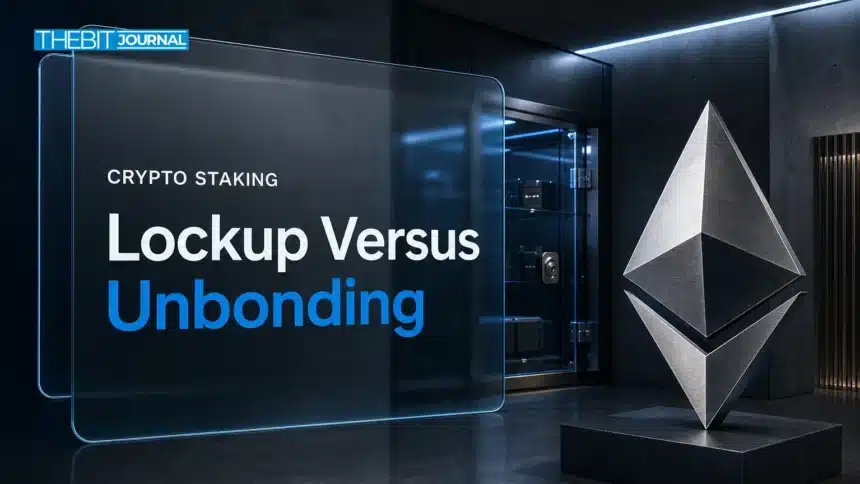
Staking lockup vs unbonding period describes two different limits on access to staked crypto. A lockup blocks withdrawals for a defined time or until a condition is met. Unbonding is the protocol process that begins after a holder asks to stop staking.
“Unstake” doesn’t always mean “available now.” Exit timelines, rewards during the wait, and steps to reclaim tokens depend on the blockchain or staking provider.
TL;DR
- A lockup restricts withdrawals; unbonding is the exit delay after staking ends or is reduced.
- There’s no universal cooldown: examples range from 1 to 2 days on Polkadot to a variable Ethereum exit queue.
- Check when rewards stop, when tokens become transferable, and whether a provider has its own redemption queue.
Staking lockup vs unbonding period: the difference
A lockup restricts withdrawals. It may come from protocol rules, a staking product, or service terms. It can have a fixed end date, but the term alone doesn’t say whether tokens keep earning rewards or whether you can change validators.
Unbonding, sometimes described as an unstaking or cooldown period, is the wait that can follow a request to leave a staking position. A protocol may delay release to manage its validator set or allow time to detect misconduct. Coinbase Prime defines bonding as the wait until an asset becomes staked, and unbonding as the wait after a release request. As of November 6, 2026, it says these periods can last from a few days to a few weeks, and staked assets don’t earn rewards during either period.
How staking lockup vs unbonding period works in practice
Think of lockup as a restriction and unbonding as a process. Tokens might be locked from withdrawal while still delegated, or enter an unbonding queue after an exit begins. Rules can overlap, happen in sequence, or not apply, depending on the network.
Check what starts the clock and when tokens are actually transferable. Stopping rewards or delegation may not release the assets.

Why unbonding timelines vary by network
Proof-of-stake networks set their own exit mechanics. A quoted period might be a protocol minimum, estimate, or provider redemption window. Network activity and queues can affect the wait, so a single figure isn’t a universal promise.
Examples from Cosmos, Polkadot, Solana, and Ethereum
Cosmos documentation gives ATOM an unbonding time of 21 days. The delay gives the network time to detect validator misbehavior and slash bonded tokens. Coinbase Prime also lists 21 days for ATOM and says users can redelegate directly, but can’t redelegate the same tokens again for 21 days.
The Polkadot Wiki lists a 1 to 2 day unbonding period for Polkadot nominators and 7 days for Kusama. Rewards stop during cooldown, and tokens become transferable when it ends. Stopping nominations doesn’t start unbonding on Polkadot: nominators must initiate it, wait 1 to 2 days, then withdraw the unbonded funds to make them transferable.
Solana documentation distinguishes a stake account lockup from staking cooldown. A lockup can block withdrawals until a specified date or epoch while allowing delegation or deactivation. Deactivation takes several epochs, with exact timing depending on network stake activity, according to Solana’s stake account documentation.
Ethereum has no single fixed unbonding duration for validators. Ethereum.org says exits are rate-limited by how many validators are leaving, and eligible withdrawals are processed in a sweep of up to 16 withdrawals per block. Pools or providers may add redemption queues or liquidity constraints: users generally redeem through the provider or sell liquid-staking tokens rather than directly using Ethereum’s validator withdrawal process.

What to check before starting an exit
Read the network and provider terms rather than relying on a generic “unstake” label. Confirm what starts the clock, whether the wait is fixed or variable, and whether tokens remain delegated while locked. You may be waiting for a date, a queue, or both.
Check reward rules and withdrawal steps. Coinbase Prime says rewards don’t accrue during bonding or unbonding, while the Polkadot Wiki says they stop during cooldown. Don’t assume another chain or provider follows the same rule, and check whether a second transaction is required after the wait.
Staking also carries risks beyond access delays. Token prices can move sharply during a lockup, and some networks can slash staked assets for validator misconduct. Provider custody, smart contract bugs, and redemption liquidity create separate risks. Validator slashing is one risk to understand when reviewing a staking setup.
Pros and cons of a staking lockup or cooldown
| Feature | Potential benefit | Trade-off |
|---|---|---|
| Withdrawal lockup | Sets a clear restriction or endpoint when terms specify one. | Tokens may not be available for other uses during the restriction. |
| Unbonding delay | Can give a network time to manage exits and respond to validator misbehavior. | Access is delayed, and rewards may stop while tokens are exiting. |
| Provider redemption | May offer a route to redeem through a pool or service. | Provider liquidity, queues, custody, or smart contract rules may affect access. |

Who a staking delay is and isn’t suited to
A staking arrangement’s timing may be manageable for someone who can tolerate a wait and has checked the exit rules. A lockup, uncertain queue, or provider redemption delay may not fit someone who needs immediate access to funds.
There’s no universal “best” duration. Compare the actual rules, access needs, reward treatment, and validator or provider risks. Liquid staking tokens work differently from direct staking and may have their own redemption and market risks.
Bottom line
Staking lockup vs unbonding period isn’t just a wording difference. A lockup describes a withdrawal restriction; unbonding is typically the delay after an exit begins. Network rules, provider terms, reward cutoffs, and withdrawal steps determine when tokens are available.
As of November 6, 2026, the examples show why the exact chain matters: Cosmos Hub lists 21 days for ATOM, Polkadot lists 1 to 2 days for nominators, and Ethereum exits remain variable. Treat timings as network-specific information, not a promise of instant access.
Sources
- Stake Accounts | Solana (solana.com)
- Staking bonding and unbonding periods on Coinbase Prime (help.coinbase.com)
- governance/params-change/Staking.md at master · cosmos/governance (github.com)
This article is for informational purposes only and does not constitute financial or investment advice. Cryptocurrencies are highly volatile; always do your own research before investing.