


Last updated: November 21, 2026
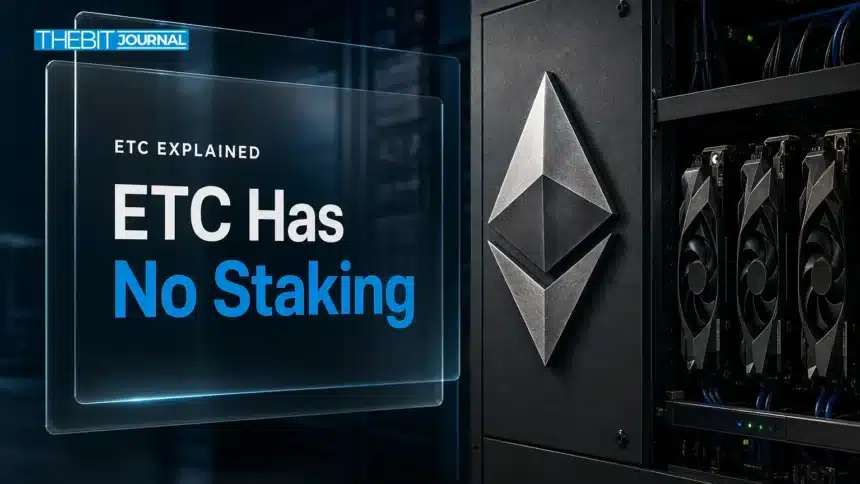
Ethereum Classic staking isn’t available on the network: as of November 21, 2026, Ethereum Classic uses Proof of Work, and miners secure the chain instead of validators receiving deposited ETC. That distinction matters if you’re looking for staking rewards, because a third-party service offering yield is not paying native ETC staking rewards.
Key Takeaways
- Ethereum Classic has no native staking or protocol staking rewards as of November 21, 2026.
- ETC uses ETCHash mining to secure transactions and produce blocks.
- Lending services may offer yield on ETC, but they are outside the protocol and carry counterparty risk.
- Mining rewards depend on network rules and mining activity; they are not a fixed income stream.
Why Ethereum Classic staking isn’t a network feature
Proof of Stake networks rely on validators who lock or delegate tokens to help confirm transactions. Ethereum Classic works differently. Its Proof-of-Work system uses miners, who contribute computing power to compete to add blocks. The ETC user FAQ says the network does not support native staking, so there is no ETC validator deposit that earns a protocol-set staking rate.
That difference is part of how the chain is designed, not a setting that a wallet can turn on. An app, exchange or website might use the word “stake” loosely, but the label alone doesn’t make an offer a network feature. For background on the chain’s design, see our guide to how Ethereum Classic works.
The official Ethereum Classic user FAQ confirms that ETC has no native staking. It also notes that lending protocols may offer yield, but those services operate outside the protocol. That yield should not be described as ETC staking rewards.
Ethereum Classic staking versus mining
Mining is the network’s security mechanism. According to the Ethereum Classic miner FAQ, ETC mining uses ETCHash. Some hardware that previously mined ETH can also mine ETC, though equipment compatibility alone doesn’t establish whether mining will be profitable. Hardware costs, electricity, pool terms and ETC’s market value can all affect a miner’s outcome.
Miners can work alone or contribute hashrate to a pool. The miner FAQ says small solo miners are very unlikely to find a block, so miners without large operations commonly use pools that distribute rewards in proportion to contributed hashrate. Pool payouts are not the same as staking: they come from mining activity and depend on the pool’s operation and rules.
There is no equivalent of depositing ETC into a validator to earn a fixed network reward. If you’re comparing these mechanisms, our explainer on staking and savings account risks covers why a yield label doesn’t tell you how a service works.

What ETC yield services may offer, and what they don’t
A lending platform may let a user deposit ETC and offer interest or another form of yield. In that arrangement, the provider’s terms and ability to meet its obligations matter. The ETC isn’t automatically helping secure the Ethereum Classic chain, and the return isn’t paid by the network as a staking reward.
These services introduce counterparty risk: a provider could fail to return deposited assets or change its terms. Users can also face platform, custody, smart contract, liquidity and regulatory risks, depending on how the service operates. Returns may vary or stop, and a stated rate is not a promise that funds are safe or that the yield will continue.
Before relying on an offer, check who controls the assets, how returns are generated, whether withdrawals can be paused, and what the service’s terms say. Treat claims that describe lending as risk-free staking with caution. Crypto assets can be volatile, and losses can include some or all of the amount deposited.

ETC mining rewards and the emission schedule
Mining rewards are set by Ethereum Classic’s protocol rules and can change at scheduled block heights. At block 25,000,001, mined on July 22, 2026, the ECIP-1017 block reward fell 20%, from 2.048 ETC to 1.6384 ETC, according to the Ethereum Classic Call 57 record.
The Ethereum Classic supply data says the next reward era begins at block 30,000,001, when the reward is scheduled to fall by 20% to 1.31072 ETC. This is a mining emission schedule, not a staking rate or a forecast of a miner’s income. Actual mining results also depend on factors such as competition, hardware and operating costs.
For an overview of ETC’s monetary design and the network itself, read our Ethereum Classic guide. Treat any projected mining returns as uncertain, since network conditions and the value of ETC can change.
How to assess an ETC yield or mining claim
Start by identifying the mechanism. If a service says “Ethereum Classic staking,” ask whether it means lending, a custodial product, mining, or something else. A clear explanation should identify who holds the ETC, where returns come from, and which party is responsible for withdrawals.
For mining, check the equipment and power requirements, pool fees and payout rules, plus the possibility of earning nothing for a period. For a lending service, read its custody and withdrawal terms and consider what could happen if the provider or a connected smart contract fails. Neither route ensures a return.
Ethereum Classic staking searches can lead to offers that blur these distinctions. Verify claims against current network documentation, don’t share a seed phrase with a service, and remember that rules for crypto products differ by country. A qualified professional can explain how local legal or tax rules apply to a particular situation.

Ethereum Classic staking FAQ
Can you stake Ethereum Classic?
No. As of November 21, 2026, Ethereum Classic has no native ETC staking. Its Proof-of-Work network is secured by mining, according to the Ethereum Classic user FAQ.
Does ETC pay staking rewards?
No protocol-level staking rewards are available. A third-party service may offer yield for lending ETC, but that return comes from the service’s arrangement and carries counterparty risk.
How does Ethereum Classic mining work?
ETC miners use ETCHash and computing power to compete to add blocks. Pool mining is common for smaller operations because solo miners are very unlikely to find a block, according to the miner FAQ.
Is an ETC lending rate fixed?
No. A quoted rate may change or stop, and it does not ensure the return of deposited assets. Provider failure, custody problems, smart contract issues and changing terms can put funds at risk.
Sources
- Ethereum Classic price and market data (CoinGecko)
- User FAQs – Ethereum Classic (ethereumclassic.org)
- Miner FAQs – Ethereum Classic (www.ethereumclassic.org)
This article is for informational purposes only and does not constitute financial or investment advice. Cryptocurrencies are highly volatile; always do your own research before investing.