

Ethereum ETF inflows have strengthened this week as Ether continues to outperform Bitcoin and nearly every other major cryptocurrency. The latest improvement in U.S. spot Ether exchange-traded fund demand has coincided with Ether emerging as the only large-cap digital asset posting a notable weekly advance while much of the broader market has remained flat or weaker.
Market and on-chain data indicate that renewed institutional interest and additional network activity have supported the recent momentum, although neither factor alone fully explains the move. The latest figures also show that fresh ETF demand has been concentrated in BlackRock’s products rather than spread across the wider market.
What do Ethereum ETF inflows reveal about the latest market trend?
Ethereum ETF inflows have recovered after a difficult period of sustained withdrawals, signalling renewed institutional participation in spot Ether investment products. As of July 15, SoSoValue reported daily net inflows of $53.83 million into U.S. spot Ether ETFs, bringing cumulative net inflows to $11.07 billion.
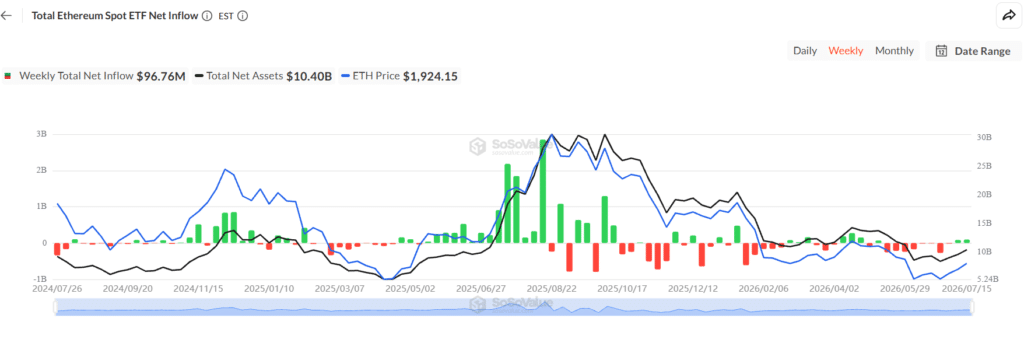
Total value traded reached $538.44 million, while total net assets stood at $10.40 billion. The recovery has gathered pace this week. U.S. spot Ether ETFs attracted $96 million during the first three trading sessions, surpassing the $84 million recorded during the previous week.
That followed heavy outflows in late June, including an $82 million withdrawal on June 25. Coinglass also reported a net inflow of 28,500 ETH into spot Ether ETFs on July 15. As reporting methodologies and cut-off times differ between data providers, small variations in totals are expected, although both datasets point to improving fund flows.
Why is Ether outperforming the broader crypto market?
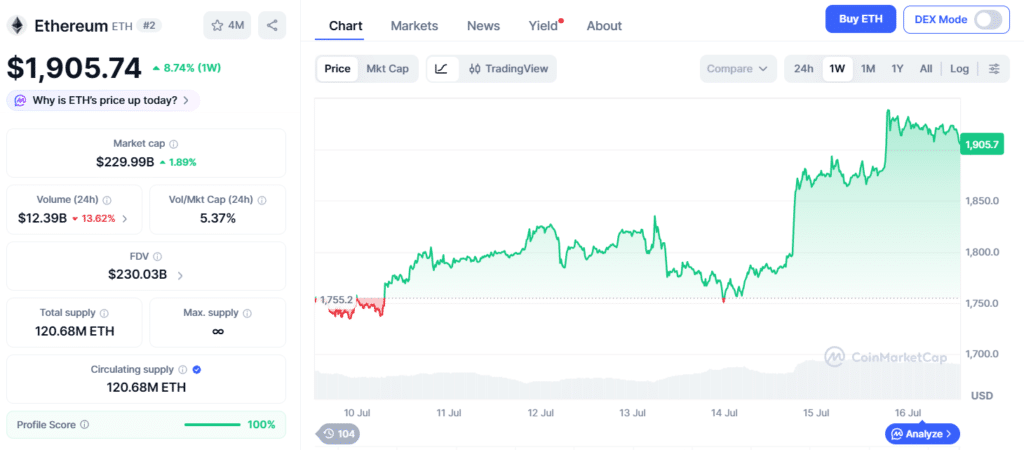
Ether has stood apart from the rest of the large-cap cryptocurrency market this week as most major digital assets have delivered limited gains or moved lower. Ethereum is currently trading around $1,910.88, up 2.25% over the past 24 hours and 9.15% over the past seven days. Its market capitalization stands at approximately $230.55 billion, while 24-hour trading volume is about $12.38 billion.
Bitcoin is currently trading around $64,182.10, down 0.63% over the past 24 hours while remaining 1.99% higher over the past week. Its market capitalization is approximately $1.28 trillion, with daily trading volume of $26.38 billion. Beyond Bitcoin, the broader market has largely weakened. Solana fell 3.04% to $75 and remained lower over the week.
TRON slipped to $0.32 with a weekly decline of 2.38%, while Hyperliquid’s HYPE token dropped to $65.70 and remained 3.53 % weekly down over the same period. XRP, BNB and Dogecoin each posted gains of just over 2% during the week, representing only a small portion of Ether’s advance. While softer U.S. inflation data supported broader markets earlier in the week, available market data suggest it was not the primary factor behind Ether’s relative strength.
Why are BlackRock’s funds receiving most of the fresh allocations?
Ethereum ETF inflows remain concentrated within BlackRock’s products instead of reflecting broad participation across all issuers. Of the $53.8 million that entered U.S. spot Ether ETFs on Wednesday, BlackRock’s ETHA accounted for $45.3 million. BlackRock’s smaller ETHB fund attracted another $4 million, leaving less than $5 million to be shared among the remaining eight spot Ether ETF products.
Grayscale’s original Ether trust continues to face pressure. The fund, which charges a 2.5% management fee compared with BlackRock’s 0.25%, has recorded cumulative outflows of approximately $5.3 billion since launch. The distribution of inflows suggests that recent institutional demand has remained selective, with investors favouring specific ETF products rather than allocating capital broadly across the sector.
What else is supporting Ether’s recent momentum?
Ethereum ETF inflows represent one contributor to Ether’s recent strength, but they are not the only factor supporting demand. Robinhood Chain, the brokerage’s Layer-2 network launched on July 1, settles transactions on Ethereum and uses Ether for gas fees.
The network has processed more than $800 million in daily decentralized exchange volume, with meme coin trading accounting for most of that activity. This growing network activity has become an additional source of demand for Ether alongside improving ETF flows, providing broader support for the asset’s recent outperformance.
Why is Bitcoin presenting a different picture?
Bitcoin continues to hold a substantially larger ETF market despite experiencing more uneven short-term fund movements. As of July 15, SoSoValue reported daily net inflows of $107.80 million into U.S. spot Bitcoin ETFs, bringing cumulative net inflows to $51.14 billion. Total net assets stood at $78.47 billion, while daily trading value reached $1.58 billion.

Coinglass reported daily Bitcoin ETF inflows of $107.70 million, equivalent to approximately 1,660 BTC, with cumulative inflows reaching $51.58 billion as of July 16. However, recent flow patterns have remained volatile. U.S. spot Bitcoin ETFs recorded $424 million in outflows on July 13 before recovering $181 million the following day, suggesting changing short-term positioning rather than sustained accumulation.
Meanwhile, Nansen’s blockchain data showed exchange outflows remaining steady despite tensions in the Middle East, with no meaningful shift into stablecoins. Funding rates also remained close to neutral, indicating that the leveraged long positions that contributed to June’s liquidation events have largely been cleared. Bitcoin dominance currently stands at 58.2%, highlighting its continued leadership in the broader cryptocurrency market despite fluctuating ETF flows.
Conclusion
Ethereum ETF inflows have become an important indicator of renewed institutional interest, but current market conditions suggest they should be viewed as one contributing factor rather than definitive proof of Ether’s recent outperformance. The latest gains have come in a market where most major cryptocurrencies have remained subdued, making Ether’s advance a story of relative strength rather than a broad digital asset rally.
The concentration of inflows into BlackRock’s funds, the emergence of Robinhood Chain as a new source of network demand, and Bitcoin’s comparatively stable on-chain behaviour despite uneven ETF activity together present a more balanced view of the market. Whether institutional demand expands beyond a handful of ETF products and remains consistent in the coming weeks will provide a clearer indication of the sustainability of Ether’s recent momentum.
Glossary
Gas Fees: Fees paid to process transactions on Ethereum.
Robinhood Chain: Robinhood’s Layer-2 blockchain built on Ethereum.
Funding Rate: A fee exchanged between long and short futures traders.
Layer-2 Network: A blockchain that improves Ethereum’s speed and lowers costs.
Spot Ethereum ETF: An ETF that directly invests in Ether.
Frequently Asked Questions About Ethereum ETF Inflows
Why are Ethereum ETF inflows increasing?
Ethereum ETF inflows are increasing because more institutional investors are buying spot Ethereum ETFs.
Why is BlackRock’s ETHA attracting most of the inflows?
BlackRock’s ETHA is attracting most inflows because many investors prefer its lower fees.
How does Robinhood Chain support Ethereum?
Robinhood Chain supports Ethereum by using ETH for gas fees and settling transactions on Ethereum.
Did Bitcoin ETFs also receive new investments?
Yes, Bitcoin ETFs received new investments, but their daily flows remained more volatile.
Can Ethereum ETF inflows affect ETH’s price?
Yes, stronger ETF inflows can increase demand and may support ETH’s price.
Sources