






The U.S. government’s Bitcoin transfer has once again placed federal crypto holdings under the spotlight after wallets linked to the government moved nearly $288 million worth of seized Bitcoin and Ethereum to Coinbase Prime. Large government wallet movements often trigger market speculation because they can hint at changes in digital asset management. This latest activity has drawn even greater attention because it comes despite the U.S. Strategic Bitcoin Reserve policy introduced last year.
According to the source, blockchain data from Arkham Intelligence showed that the transfers took place over roughly half a day on Monday. Although the transactions immediately fueled speculation about a possible sale, blockchain activity alone cannot confirm whether the government intends to sell, transfer, or simply reorganize custody of the assets.
The U.S. Government Bitcoin Transfer Traces Back to Three Criminal Cases
The latest U.S. government Bitcoin transfer involved assets seized in three separate criminal investigations. A wallet tied to Ryan Farace, known for the “xanaxman” darknet case, moved 2,875 BTC worth about $178 million to a newly created wallet. Minutes later, the entire balance was forwarded to a Coinbase Prime deposit address.
A second wallet linked to the defunct BTC-e exchange followed the same routing pattern. It transferred 925.512 BTC worth roughly $57 million to a fresh intermediary wallet before the funds were sent to Coinbase Prime. Both intermediary wallets were emptied shortly after forwarding the Bitcoin, suggesting they served only as temporary relay addresses rather than long-term storage.
Meanwhile, a wallet connected to former Oracle employee Brian Krewson transferred 30,007 ETH worth about $53 million. Unlike the Bitcoin transfers, the Ethereum moved directly to Coinbase Prime without passing through a temporary wallet.
The transfers attracted attention because President Donald Trump’s March 2025 executive order designated seized Bitcoin for the Strategic Bitcoin Reserve, with the policy stating that those holdings should not be sold. Although this U.S. government Bitcoin transfer does not prove that any assets have been sold, moving the funds to Coinbase Prime has raised fresh questions about whether the government’s handling of seized digital assets is changing.

Why the Wallet Routes Matter
Blockchain analysts closely examine wallet movements because every transaction is recorded on a public ledger. Platforms such as Arkham Intelligence allow researchers and traders to monitor large transfers in real time, often revealing institutional activity before any official statement is released.
The different routing patterns also provide useful clues. Fresh intermediary wallets are commonly used to separate original seizure wallets from institutional deposit addresses. This approach improves operational privacy and simplifies custody tracking, but it does not necessarily indicate that the government is preparing to sell its holdings.
Coinbase Prime Does Not Automatically Mean a Sale
Many traders viewed the U.S. government Bitcoin transfer as a possible sign of selling pressure. However, Coinbase Prime offers much more than trading. It provides institutional custody, financing, asset staging, and execution services for governments, exchange-traded funds, corporations, and large asset managers.
Governments usually keep seized cryptocurrency in secure cold wallets rather than on exchanges. Because exchanges are frequently used before assets are sold or converted into other digital assets, including stablecoins, transfers to Coinbase Prime naturally attract market attention. Even so, routing funds to the platform does not confirm a sale.
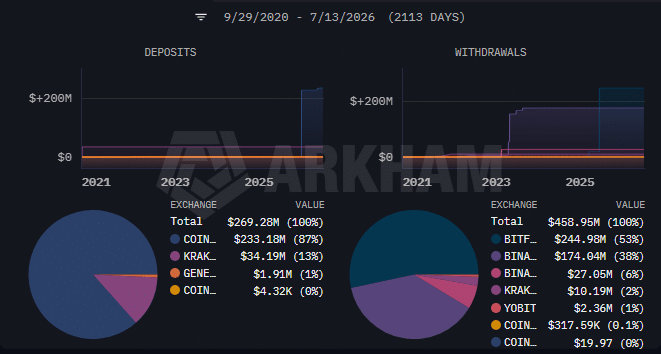
Blockchain data also showed a separate movement of 140.214 BTC between government-controlled Coinbase Prime addresses and a Coinbase cold wallet. Because the transaction appeared on both the inflow and outflow records, analysts viewed it as an internal custody movement rather than new selling activity.
Conclusion
Even after the latest U.S. government Bitcoin transfer, federal wallets still hold about $20.65 billion in digital assets, including roughly 324,552 BTC, 28,394 ETH, and more than 145 million USDT. Although the latest movement attracted widespread attention, it represents only a small fraction of the government’s overall crypto holdings.
Even when governments do not sell, large wallet movements can make traders nervous because additional supply could eventually reach the market. That concern alone can increase volatility before any official confirmation appears. While the latest U.S. government Bitcoin transfer has fueled speculation, blockchain data reveals only where assets move, not why they move. Until federal authorities provide further clarification, government wallet activity will remain one of the crypto market’s most closely watched indicators.
Glossary of Key Terms
Strategic Bitcoin Reserve: U.S. reserve for seized Bitcoin.
Coinbase Prime: Institutional crypto custody and trading platform.
Cold Wallet: Offline storage for cryptocurrencies.
Intermediary Wallet: Temporary wallet used during transfers.
FAQs About U.S. Government Bitcoin Transfer
Why were the assets moved to Coinbase Prime?
The transfer supported institutional custody and does not confirm a sale.
Did the government sell the Bitcoin?
No. The transfers alone do not prove any assets were sold.
Why did Bitcoin and Ethereum follow different routes?
Bitcoin used intermediary wallets, while Ethereum moved directly.
How much crypto does the U.S. government still hold?
About $20.65 billion, including 324,552 BTC, 28,394 ETH, and 145.549 million USDT.
Sources / References