




The Federal Reserve has opened consultation on two proposals for payment stablecoin issuers under its supervision, moving implementation of the GENIUS Act into the details that determine how an issuer would operate. The September 24 package covers both the financial safeguards around stablecoins and the process through which supervised banks would seek permission to issue them through subsidiaries.
According to the Board’s announcement, the proposals address eligible reserve assets, capital, risk management, safeguarding arrangements and applications. They are proposals, not rules already in force. Comments are due 60 days after publication in the Federal Register, so the deadline should be calculated from that publication rather than assumed from the announcement date.
Backing and capital serve different purposes
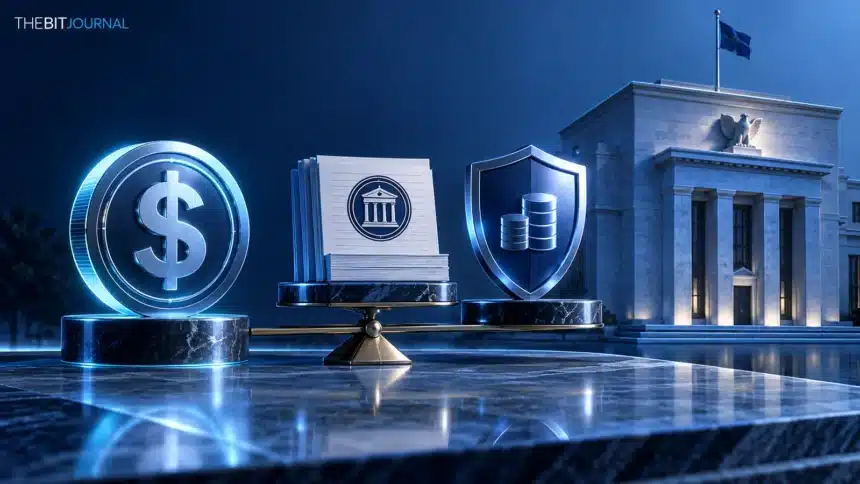
The first proposal would require full backing with permitted assets, including short-term Treasury bills and other specified liquid instruments. It would also establish standardized capital requirements for certain credit and operational risks. These safeguards address related but distinct problems.
Reserves support the value that holders expect to redeem. Capital helps absorb losses arising from the issuer’s business and operations. An issuer can report adequate reserve assets while still facing expenses, legal liabilities or a technology incident. Conversely, a well-capitalized company does not automatically give token holders prompt access to the assets backing their claims.
That distinction becomes most visible during stress. A balance sheet is a snapshot, while redemption is a process that has to work as requests arrive. The quality of assets, the ability to sell or mobilize them and the procedures for paying holders all matter. Calling an instrument fully backed leaves those operational questions unanswered unless the rules and disclosures explain them.

Barr focuses on access to redemption
Governor Michael Barr supported the proposal while identifying issues for further examination in a separate statement. He emphasized reliable redemption at par under different conditions and called for clarity on universal redemption rights. He also highlighted interest-rate and foreign-currency risks as areas where public feedback would be useful.
Those concerns go beyond the ordinary experience of a token trading close to one dollar. A holder buying through an intermediary may face a different practical route to cash from an institution dealing directly with an issuer. The resilience of the overall system depends on how those routes behave when demand for redemption rises, not only when trading is calm.
Barr also raised concerns about a proposed threshold concerning supervisory or enforcement action on anti-money-laundering deficiencies. His statement illustrates that support for the rulemaking process does not mean every element of the eventual framework is settled. The consultation remains a venue for resolving those details.

Banks would face a separate application process
The second proposal concerns the route for Board-supervised banks applying to issue payment stablecoins. The Fed says applicants would submit business plans and financial information, with procedures for appeals, hearings and final decisions. Approval would therefore involve more than demonstrating that a token contract can be deployed.
A business plan has to connect the proposed service to its funding, customers, controls and ability to operate over time. For a stablecoin issuer, that includes how tokens enter circulation, how redemptions are handled and how responsibilities are divided among service providers. Outsourcing a technical component does not eliminate the need to explain who remains accountable for the service.
TBJ’s reporting on OpenReserve’s conditional banking approval shows why the stage of an approval process matters. An application, a conditional authorization and a fully operating service are different milestones. The same discipline is useful when interpreting the Fed’s proposed framework.

The market implications will depend on the final text
Clearer requirements could help institutions estimate the cost of entering stablecoin issuance. They could also affect the economics of reserve management and the operational resources needed to run a program. But neither outcome can be quantified from the announcement alone, and the proposal does not establish which banks will choose to participate.
The next developments to watch are publication in the Federal Register, substantive comments and changes in any final rule. Readers should also separate the Fed’s supervised population from other issuers that may fall under different authorities. One regulator’s proposal is not a universal approval of every dollar token.
For now, the consultation moves the discussion toward the mechanics of a credible payment instrument: the assets behind it, the capital supporting its operator and the holder’s route back to money. Those details will determine whether a stablecoin remains dependable when conditions are difficult, rather than simply convenient when everything is working.