





For over a decade, traders clung to the four-year halving cycle as crypto’s compass. Bull markets bloomed ahead of Bitcoin halvings, then gave way to brutal winters. Yet 2025 marks a historic turning point.
The arrival of spot ETFs, the rise of real-world asset tokenization, and the dominance of stablecoins are disrupting that rhythm. Observers now call this seismic shift ‘The Great Crypto Rotation’.
ETFs Usher in a New Era of Capital
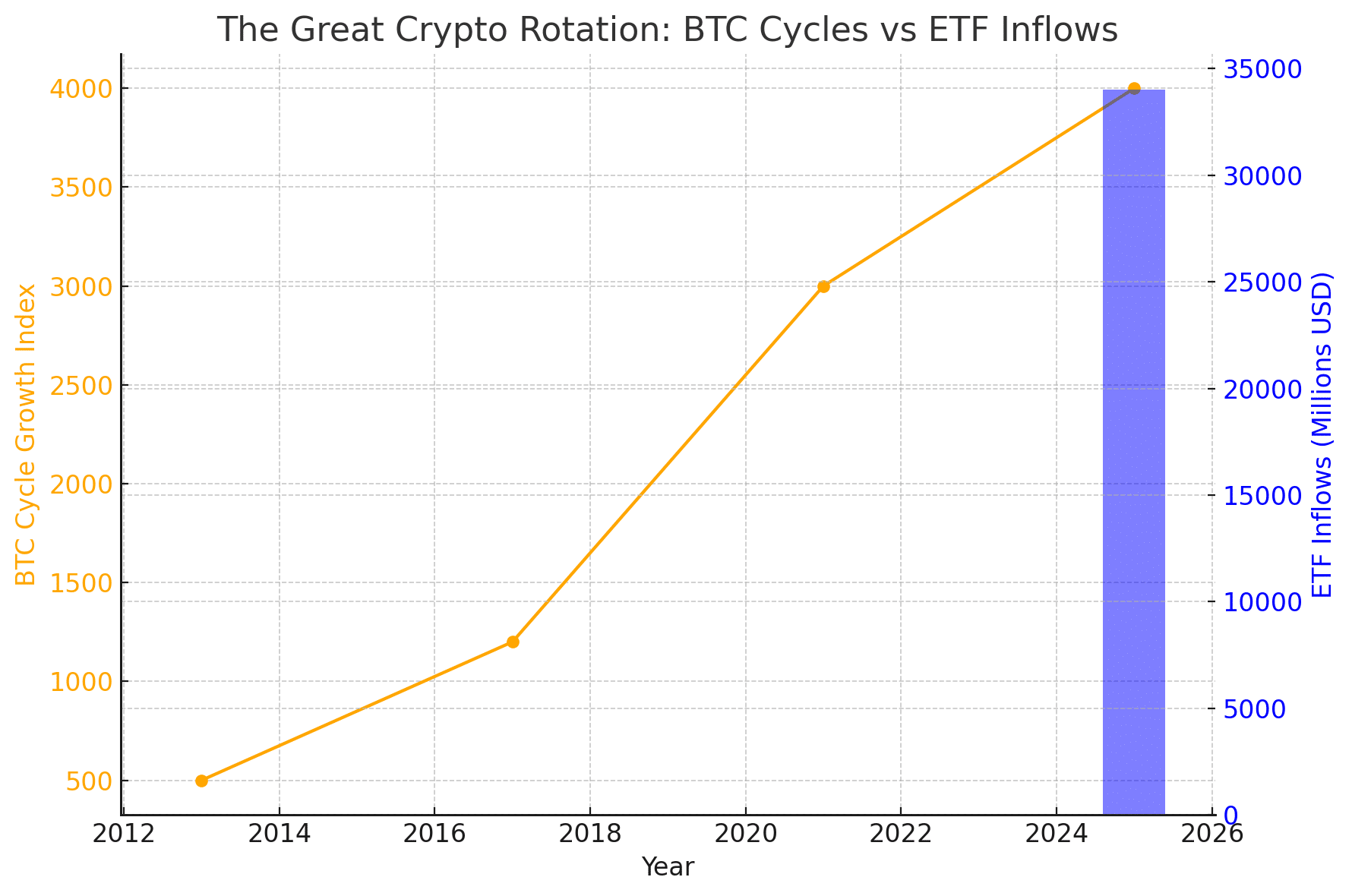
Since spring 2024, billions have flowed into regulated Bitcoin and Ethereum ETFs, reshaping how capital enters the market. These funds attracted not only retail investors but also pensions, asset managers, and sovereign wealth funds.
Analysts estimate that more than $34 billion has been absorbed, a volume that dwarfs previous halving-led inflows.
ETF products have brought a new kind of stability, encouraging institutions to treat crypto as a long-term allocation rather than a speculative trade. This is central to ‘The Great Crypto Rotation’, where cyclical speculation gives way to steady capital absorption.
As ETF analyst James Seyffart remarked on X, “The approval of generic listing standards has changed the game. Altcoin ETFs will follow, and the cycle narrative is done.”
RWAs Become Anchors in Digital Markets
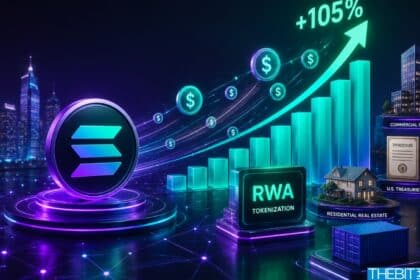
Real-world assets (RWAs) are quickly moving from buzzword to backbone. Governments and corporations are experimenting with tokenized bonds, equities, and commodities. By 2025, global RWA tokenization surpassed $9 billion in active projects, with forecasts of exponential growth.
This shift means crypto is no longer floating on speculative narratives alone. Instead, it is anchored by yield-generating assets and institutional trust. Cardano recently pledged $50 million to boost liquidity for RWAs and stablecoins, showing how networks are repositioning for this reality.
Within ‘The Great Crypto Rotation’, RWAs serve as the ballast keeping digital finance tethered to real economies.
Stablecoins Cement Their Dominance
Stablecoins have become the quiet giants of the crypto world, with a market capitalization surpassing $150 billion and daily volumes rivaling those of Bitcoin. They are no longer just on-ramps. They are settlement tools, remittance bridges, and DeFi lifelines.
Central banks have taken notice. Some warn that stablecoins “perform poorly as money,” yet private adoption continues to rise. Circle even explored “reversible transactions,” signaling how flexible innovation may address regulatory pressure.
These moves highlight the dual reality of ‘The Great Crypto Rotation’: stablecoins are both disruptors and bridges, reshaping monetary networks as traditional finance struggles to keep pace.
Altseason Narratives Give Way to Selectivity
Perhaps the most striking consequence of ‘The Great Crypto Rotation’ is the fading of blanket “altseasons.” In earlier cycles, when Bitcoin rose, altcoins followed. Now, performance is fragmented.
Projects with strong fundamentals — such as Ethereum with its staking yields or Solana with high throughput — attract capital. Others fade into obscurity.
As Bloomberg strategist Mike McGlone noted, “Institutions will not blindly buy altcoins. They will look for utility, liquidity, and regulatory clarity.” This underscores the new era: selective accumulation, not speculative mania, defines which assets thrive.
Conclusion
The four-year cycle may not vanish entirely, but its predictive power is diminished. ETFs deliver regulated exposure, RWAs inject real-world stability, and stablecoins dominate daily usage.
Together, they form the pillars of ‘The Great Crypto Rotation’. For traders, this means adapting to a market shaped less by halving hype and more by institutional flows, tokenized assets, and utility-driven demand.
Crypto’s future is no longer bound by rigid cycles. It is being rebuilt in real time, as ‘The Great Crypto Rotation’ sets the stage for a financial system where digital and traditional capital finally converge.
FAQs about ‘The Great Crypto Rotation’
Q1: What is ‘The Great Crypto Rotation’?
It is the shift from four-year halving cycles to a new era driven by ETFs, RWAs, and stablecoins.
Q2: Why do ETFs matter so much?
They channel regulated, long-term institutional capital into crypto markets, reducing reliance on retail speculation.
Q3: How do RWAs fit into crypto markets?
They tokenize real assets like bonds or equities, bringing yield, stability, and trust to digital ecosystems.
Q4: Are altseasons over?
Yes, broad altcoin rallies are fading. Selective, utility-driven assets now capture most institutional attention.
Glossary
ETF (Exchange-Traded Fund): A regulated fund traded on stock exchanges that holds assets like Bitcoin or Ethereum.
RWA (Real-World Asset): A physical or financial asset represented digitally on a blockchain.
Stablecoin: A cryptocurrency pegged to stable assets, often the U.S. dollar, used for settlement and payments.
Altseason: A period when altcoins collectively outperform Bitcoin.
Liquidity: The ease with which an asset can be traded without impacting its price.
Tokenization: Converting real-world assets into digital tokens for blockchain trading.