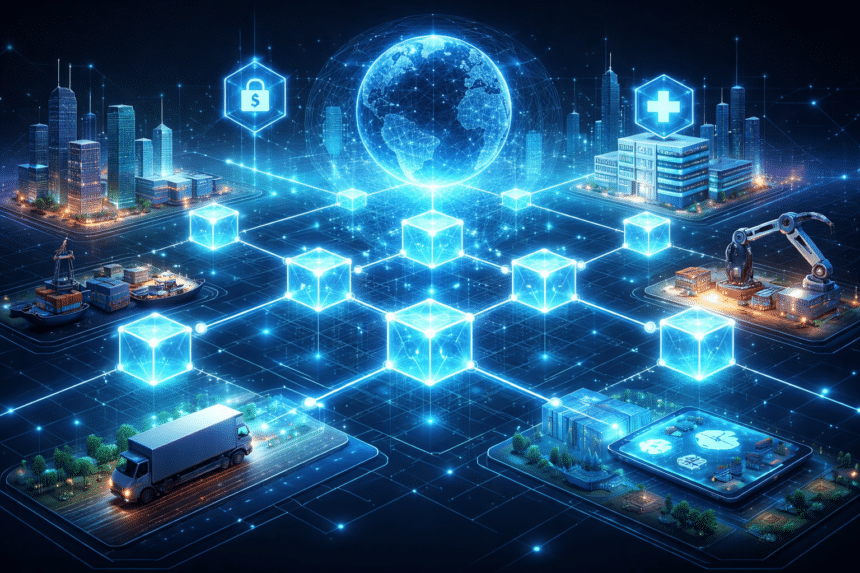

Blockchain technology is no longer just a concept linked to cryptocurrency. It has grown into a powerful system that is changing how data is stored shared and trusted across industries. Governments, businesses, hospitals, and global companies are now using blockchain to solve problems that traditional systems could not fix. This shift is happening because industries need more transparency stronger security and faster operations.
In the last ten years digital systems have gotten very interconnected. Every second, there is a movement of data across different countries. The online systems are channels through which money, medical records, and identities are transferred. Normally, these systems operate under the control of a central authority. If that authority fails, data could be lost, stolen, or even altered. Blockchain provides a fresh approach to handling data that does not require a single central owner.
According to studies, the worldwide investment in blockchain solutions amounted to more than 17 billion dollars in 2023. Experts predict that this figure will rise to more than 94 billion dollars by the year 2027. Such a drastic increase indicates that both the government and private sectors have very strong confidence in the technology. Companies do not just test out the technology but have already moved on to creating large-scale applications with it.
This article explains how blockchain is revolutionizing every industry. It covers finance healthcare supply chains, manufacturing, real estate, media, government, and sustainability. Each section explains the changes in clear and simple language so that anyone can understand how blockchain is reshaping the modern world.
What Is Blockchain Technology and Why It Matters Today
Blockchain is a digital system that records information in a shared and secure way. Instead of storing data in one central database blockchain stores data across many computers called nodes. Each record is grouped into a block. These blocks are linked together in order which creates a chain. Once data is added it cannot be changed easily.
The very structure of blockchain is what provides it with such high levels of security. For instance, a modification of the record by one party would require doing so simultaneously on the majority of the computers in that network. Moreover, this whole process would be very challenging and thus time-consuming. That’s why blockchain is generally considered the most reliable in terms of the accuracy and integrity of data.
Today, blockchain is one of the main players in the field of digital trust, which is an issue. The whole problem starts with over 8 trillion dollars worth of cybercrime being reported as a loss to the global economy each year. Data leaks occur in areas like banking, health care, and government. The good side of the story is that the blockchain brings down this risk by being transparent and non-manipulative with the records.
Moreover, another reason why blockchain is important is its efficiency. Conventional systems rely on human verification, the involvement of intermediaries, and lengthy approvals. The blockchain technology, on the other hand, takes over most of these steps. The time needed for a transaction that used to take days is now reduced to minutes or even seconds. This remarkable speed is one of the main factors why different sectors are adopting blockchain solutions.
Why Industries Are Moving Away From Traditional Systems
The old-fashioned systems were designed for a slower-paced world. Various fields continue to depend on centralized data storage, paperwork, and manual authorization. The operations of such systems are slow, costly, and at the same time, they put sensitive data in danger of being leaked. When the size of operations increases, the drawbacks of these systems become more pronounced.
Centralized systems have also been a source of trust issues. If one organization has control over the data, then the others must have faith in the accuracy of that data. Trust in many sectors has been broken due to fraud, mistakes, or unethical practices. Blockchain technology eliminates the need to rely on one authority for trust. Instead, trust is distributed among the nodes in the network.
Another problem is inefficiency. Cross border payments supply chain tracking and medical record sharing often involve multiple middlemen. Each step adds time and cost. Blockchain reduces these layers by allowing direct verified transactions between parties.
The table below shows how traditional systems compare with blockchain based systems.
| Factor | Traditional Systems | Blockchain Systems |
| Data control | Central authority | Shared network |
| Transparency | Limited | High |
| Security | Vulnerable to breaches | Tamper resistant |
| Speed | Slow processing | Near real time |
| Trust | Requires intermediaries | Built into system |
How Blockchain Is Transforming the Financial Industry
The financial industry was one of the first to adopt blockchain technology. Banks payment providers and investment firms face constant pressure to reduce costs increase speed and improve security. Blockchain directly addresses these needs.
Blockchain in Payments and Money Transfers
The traditional systems of international money transfer are not only slow but also very expensive. It is the World Bank that confirms the fact that, on average, global remittance fees are more than 6 percent per transaction. Payment networks based on blockchain technology cut these costs down by eliminating the intermediaries.
With the help of blockchain, the peer-to-peer transactions can be settled instantly. The funds can be transferred from one country to another in just a few minutes instead of several days. This feature is especially vital for the underdeveloped regions where banking services are not very easily available. By giving access through mobile, blockchain is the technology that is boosting financial inclusion.
Blockchain in Banking and Lending
Blockchains are leveraged in banking to enhance the process of record management and meet the standards of regulatory compliance. The automated processes include the approvals of loans, verifications of identity, and audits of transactions conducted through the use of smart contracts. Smart contracts are defined as automatically executed programs that apply rules as soon as the necessary conditions are met.
The said automation gives rise to fewer mistakes and an increased rate of service delivery. Furthermore, it results in a decrease in costs associated with operations. A significant number of banks claim that they have been able to cut down their expenses in the back office by 30 to 50 percent after they started using blockchain technology.
Blockchain in Digital Assets and Tokenization
Blockchain allows real world assets to be represented digitally. Stocks bonds real estate and commodities can be tokenized on blockchain platforms. Tokenization increases liquidity and makes assets easier to trade.
The table below compares traditional finance with blockchain based finance.
| Area | Traditional Finance | Blockchain Finance |
| Settlement time | 2 to 5 days | Minutes |
| Transaction cost | High | Low |
| Market access | Limited | Global |
| Transparency | Restricted | Public records |
How Blockchain Is Revolutionizing Healthcare Systems
Healthcare systems manage sensitive data and complex supply chains. Errors and fraud in healthcare cost billions each year. Blockchain offers solutions that improve security transparency and patient trust.
Secure Patient Data and Medical Records
Medical records are commonly kept in various hospitals, clinics, and insurance companies. Such splitting of records causes mistakes and slow processing. With the introduction of blockchain technology, a single record that only trusted providers can view will be created and it’s also safe to share with them.
The financial impact of data theft in the medical field is estimated to be $10 million per incident. Blockchain offers lower breach danger since it encrypts data and data access is determined by permissions. Moreover, patients become the ones who decide who will have their information viewed.
Drug Supply Chain Transparency
One of the greatest issues currently faced by the world is the presence of counterfeit drugs. The World Health Organization reports that counterfeits are found among one out of every ten medicines in the poorest areas of the world. The application of blockchain technology enables the tracing of drugs right from the manufacturer to the pharmacy, with each step being recorded and verified.
The tracing of drug movements through the supply chain not only minimizes the chances of fake drugs getting into the market but also allows for quicker and more effective recalls in the case of safety issues.
Clinical Trials and Research Integrity
Research experiments or clinical trials demand precise data gathering and reporting. Blockchain technology is the one that guarantees that after the data is recorded, it cannot be modified. This makes the trial results and subsequently the regulatory approvals more trustworthy.
How Blockchain Is Changing Supply Chains and Global Trade
Supply chains consist of a multitude of firms operating in various nations. The absence of clarity results in slower processes, dishonest dealings, and uselessness. Blockchain technology eliminates these issues and finally makes these complicated networks visible and trustworthy.
Product Tracking and Traceability
The blockchain technology maintains a record of every single movement of the product from its source to its final delivery. The monitoring helps better control over the stock and also leads to fewer losses. In the case of food contamination, companies resort to blockchain for tracing the source in a matter of seconds rather than weeks.
Reducing Fraud and Counterfeit Goods
Global brands are losing more than 500 billion dollars yearly due to fake merchandise. Authenticity is ensured by Blockchain through digital certificates that are interlinked with the physical goods. The origin can be verified by the customers and partners at once.
Improving Logistics and Trade Documentation
Trade documents like bills of lading are often paper based. Errors and delays slow shipments. Blockchain digitizes these documents and automates approvals. This reduces shipping times and administrative costs significantly.
How Blockchain Is Transforming Manufacturing and Industrial Operations
Manufacturing relies on precision coordination and quality control. Blockchain improves transparency across production lines and supplier networks.
Smart Contracts in Manufacturing
Smart contracts automate agreements between manufacturers and suppliers. Payments trigger automatically when goods meet quality standards. This reduces disputes and speeds up operations.
Quality Control and Audit Trails
Blockchain creates permanent records of inspections and certifications. Auditors can verify compliance easily. This improves product quality and regulatory reporting.
Machine Data and Automation
Industrial machines generate large volumes of data. Blockchain secures this data and ensures accuracy. Combined with automation this leads to more efficient predictive maintenance.
| Manufacturing Area | Before Blockchain | After Blockchain |
| Supplier trust | Manual verification | Automated records |
| Quality audits | Time consuming | Instant verification |
| Payment cycles | Delayed | Automated |
How Blockchain Is Disrupting Real Estate and Property Management
Real estate transactions are slow and paperwork heavy. Blockchain simplifies property management and ownership transfers.
Property Records and Land Registries
In many regions land records are incomplete or corrupt. Blockchain stores property titles securely and transparently. This reduces fraud and legal disputes.
Tokenization of Real Estate Assets
Properties can be divided into digital tokens. Investors can buy small shares instead of entire properties. This opens real estate investment to more people and increases liquidity.
Faster and More Secure Property Transactions
Smart contracts automate escrow and ownership transfer. Deals close faster and with fewer intermediaries.
Challenges Slowing Blockchain Adoption Across Industries
Blockchain adoption has been benefited with the challenges nonetheless. Scalability is still an issue even as networks expand. Uncertainty in regulations also prevents some areas from quick adoption or deployment.
Energy consumption has been a problem too, mainly for the traditional blockchain models. The new ones are much more efficient in energy use and continuously get better in this regard.
There is also a skills gap. Blockchain expertise is limited. Education and training are needed to support growth.
The Future of Blockchain Adoption Across Industries
Blockchain adoption will continue to grow as systems mature. Integration with artificial intelligence and internet of things will create smarter automated networks.
The analysts’ forecasts point out that for the year 2030, blockchain would already be the technology supporting more than 10 percent of the world’s GDP. The early-bird-picking-the-best-spot industries will get the first-out-of-the-trust and efficiency advantage.
Blockchain is no wizard that vanishes all the systems but will rather be an excellent co-worker of the present technologies. The future scenario is that of hybrid models ruling the market for the time being.
Final Thoughts: How Blockchain Is Revolutionizing Every Industry
Blockchain is changing how industries operate share data and build trust. Its impact extends far beyond digital currency. Finance, healthcare, manufacturing, government, and sustainability all benefit from its structure.
As adoption increases blockchain will become a standard part of digital infrastructure. The shift is already happening across the global economy.
Understanding blockchain is no longer optional. It is a foundational technology shaping the future of every industry.
Frequently Asked Questions About Blockchain Technology
What is blockchain in simple words
Blockchain is a digital system that records information in a shared and secure way. Data is stored in blocks and linked together in order. Once data is added it is very hard to change. This makes blockchain trusted and reliable for many industries.
Why is blockchain considered more secure than traditional systems
Blockchain does not store data in one central place. Instead data is shared across many computers. To change a record most computers must agree. This makes hacking and data tampering very difficult compared to traditional databases.
Which industries are using blockchain the most today
Finance, healthcare supply chains, manufacturing real estate, media and government services are leading blockchain adoption. These industries use blockchain to improve transparency, reduce costs and increase trust in their systems.
Is blockchain only used for cryptocurrency
No blockchain is used far beyond cryptocurrency. It supports payments, medical records supply chain tracking digital identity, voting systems, and environmental reporting. Cryptocurrency was only the first major use case.
Summary: How Blockchain Is Revolutionizing Every Industry
Blockchain technology is revolutionizing the way industries deal with data trust and value. It does so by paving the way for fast, unmovable, secured networks and highlighting the slow centralized systems. Amongst others, the shift results in better service, less fraud, and lower costs for both the customers and the companies throughout the sectors.
The finance industry is using blockchain as a means of making payments quicker and also providing wider access. The healthcare sector is the one where blockchain is the most trusted in securing patient data and drug supply chains. The supply chains are employing blockchain to already know the whereabouts of their products and, more importantly, to prevent the entry of counterfeit goods into the market. The manufacturing industry is getting the most out of blockchain through automatic processes and verified audit trails.
Real estate media government and sustainability efforts also gain from blockchain adoption. Property records become safer digital content ownership becomes clearer and public services become more transparent.
While challenges remain blockchain adoption continues to grow. As systems improve and skills expand blockchain will become a core part of global digital infrastructure. Its impact goes far beyond technology and reshapes how industries operate and collaborate.