
This article was first published on The Bit Journal.
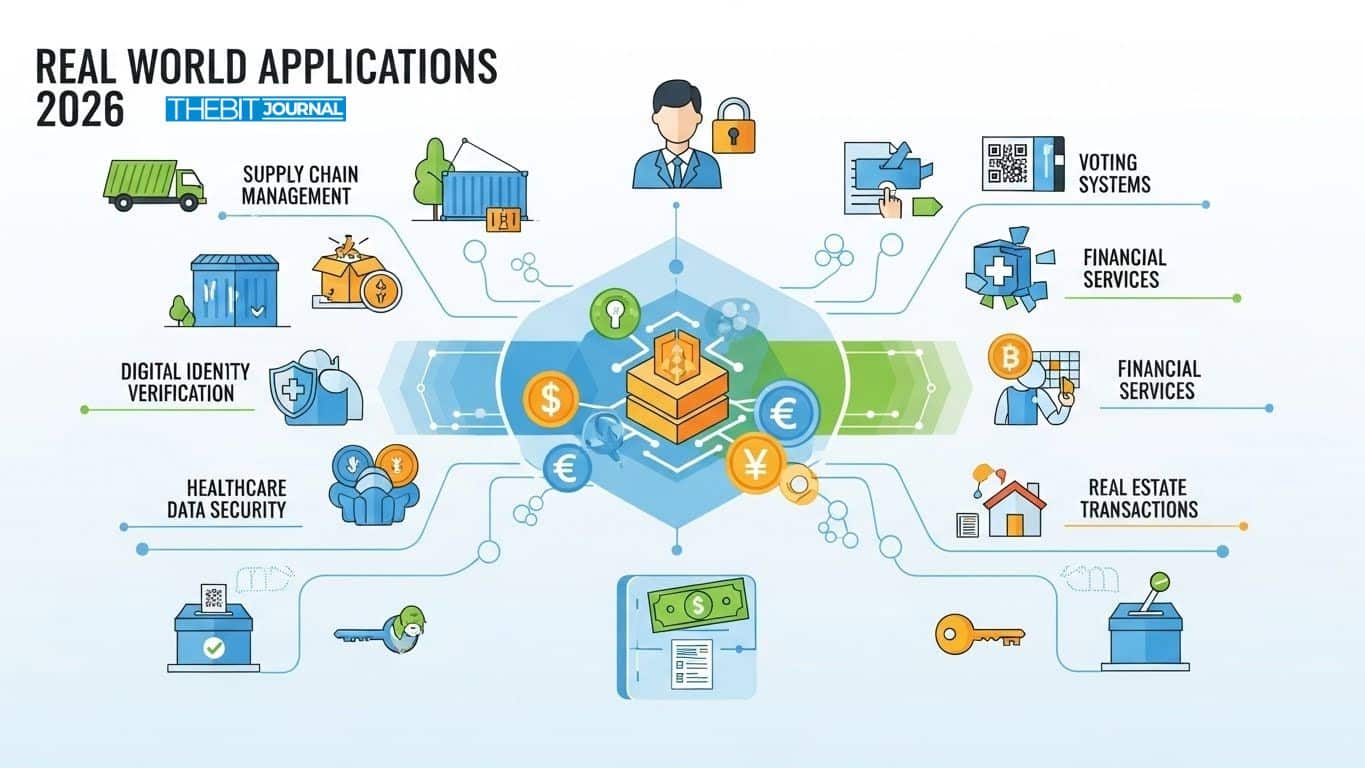
It’s 2026, and blockchain applications have become an essential part of business operations, way beyond the initial hype of cryptocurrencies.
Whether it’s to accelerate the process of bank transfers or design new ways to protect records in a doctor’s office, blockchain provides a shared, immutable ledger that increases trust, security, and transparency among stakeholders.
Organizations and enterprises are beginning to use blockchain technology in tangible ways throughout all industries. In finance, for instance, the world’s biggest banks have turned to blockchain to slash paperwork and record-keeping by automatically confirming what needs to be approved in order to settle transactions.
Governments test blockchain IDs and land registries. This top 10 blockchain use cases showcases the creativity behind today’s blockchain applications.
Finance and Banking
Blockchain’s roots are in finance, and in 2026, it powers a good deal of banking. Banks and upstart fintech companies are using blockchain applications to shorten the time it takes to send or receive money.
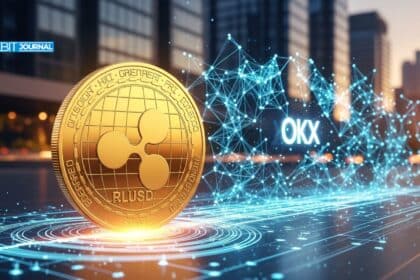
For instance, financial institutions use Ripple’s blockchain network to send international transfers nearly instantaneously, without slow intermediaries.
Blockchain provides cost savings from increased speed of transaction, elimination of manual intervention and the intermediaries (who often extract fees). In the real world, smart contracts can automatically execute loan contracts and trade clearing.
Institutional adoption is ramping up and leading asset managers now have tokenized funds on-chain. Firms like JPMorgan have moved collateral onto blockchain rails. Visa and PayPal have already plugged stablecoin payment rails. This is why finance remains one of 2026’s most popular blockchain use case, resulting in quick transactions at low costs.
Supply Chain and Logistics
In supply chains, traceability is one of the standout gains from blockchain. An append-only ledger on a blockchain provides “clear and verifiable proof” of an item’s origin.
Using blockchain establishes an audit trail that documents the history of an asset and gives participants confidence it is authentic.
Industry examples are abundant: DeBeers used blockchain to track 100 high-value diamonds from mine to retail outlet, and Maersk’s TradeLens tracks global shipping containers. Walmart’s Food Trust tracks produce. In one test, it tracked a package of mangoes to the farm in 2.2 seconds, compared with days before blockchain.
These systems largely enhance the speed of retrieval and lower counterfeits. The logistics blockchain allows the participants to see the same data at the same time and helps prevent disputes and delays.
For example, both FedEx and other shipping companies have been using blockchain applications to track cargo and monitor customer service. Overall, blockchain applications in the supply chain provide companies with real-time visibility and trust for even the most complex multi-party network.
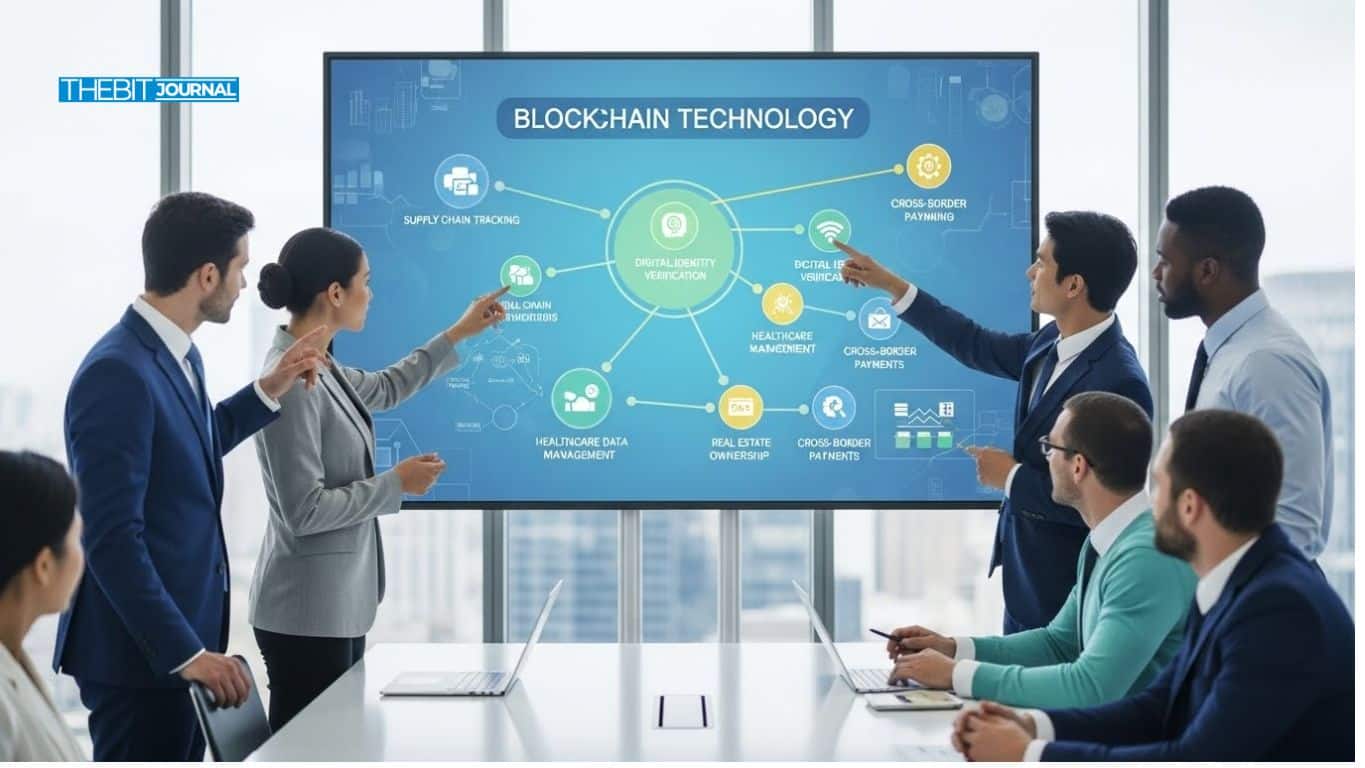
Healthcare and Pharmaceuticals
In health care, it is used to protect sensitive data and manage medical supplies. Records can be kept and shared on permissioned ledgers so only authorized providers have access.
An important feature is that blockchain offers better protection for patient data and makes it easier to share records. Every-health-transaction (e.g. lab result, prescription) is time-stampable on-chain without impeding the latter’s privacy and data accuracy.
In the pharmaceutical supply chain, blockchain tracks drugs from manufacturer to pharmacy. As products make their way along the supply chain, every time an action takes place on a product, it’s recorded on the blockchain in an unchangeable history.
This allows immediate validation of a drug’s authenticity, aiding in the fight against counterfeiting. Real-world pilots back this up; pharmaceutical consortia use blockchain (like MediLedger) to compliantly serialize drugs. On the whole, blockchain in healthcare makes medical data and drugs tamper-evident and traceable.
Government and Public Sector
Blockchain is being quickly adopted for public sector use. A tool like a blockchain can improve transparency, trust and the sovereignty of citizens.
Blockchain in government is no longer a hypothetical; it’s a reality, as national initiatives demonstrate that ledgers can enhance public service delivery and record integrity.
One of the big application areas is digital identity: Estonia’s e-Residency is a blockchain-based identity system for non-citizens that allows them to register companies and sign documents securely.
Other countries are issuing verifiable credentials (diplomas, health records) on blockchains to facilitate instant cross-border verification.
Blockchain voting is also explored. Pilot programs have been testing secure digital ballots through blockchain’s audit trail. Even though widespread adoption remains tentative, these tests prove blockchain can improve election security in a controlled environment.
Blockchain offers governments an immutable audit trail for identity management and compliance. Blockchain applications in government, from citizen IDs and titles to voting, are going mainstream in 2026.
Energy and Utilities
Blockchain appears to have a place in energy markets, especially with respect to renewables and the decentralized grid. P2P energy trading platforms are becoming popular, allowing both homes and businesses to purchase or sell electricity directly.
Blockchain provides a secure, transparent ledger of these microtransactions. For example, projects such as Power Ledger or LO3 Energy give households the ability to trade solar power between each other on trading platforms that use blockchain. Automatic settlements occur via smart contracts upon delivery of power.
Another common use case is the monitoring of renewable energy certificates (RECs). These tradable certificates (representing 1MWh of green energy) could be tracked on blockchain, guaranteeing one-to-one ownership and no double-counting.
The timestamping on blockchain ensures that regulators, and buyers can validate each REC as a unique and traceable record.
The market foresees that the blockchain-in-energy will escalate quickly from $3.7billion in 2025 to $833.8billion in 2035 as such applications thrive. In a nutshell, blockchain in energy is blockchain’s role in energy is as a ledger for transactions and certificates, enabling efficient, decentralized power markets.
Insurance
The insurance industry applies blockchains to automate policies and cut fraud. If a smart contract is connected to a blockchain, it can automatically execute payouts when predefined conditions are met. For example, flight delay or crop insurance could potentially pay out customers immediately when an oracle confirms an insured event happened.
Insurers are already leveraging blockchain and smart contracts to automate manual processes and accelerate claims, in turn cutting costs as well as the potential for fraud.
Blockchain also delivers a shared history view of claims across companies, avoiding duplication of work. Various consortia (such as B3i and Insurwave) are running pilots with blockchain platforms for marine insurance, reinsurance, and supply chain cover.
These open doors for all participants to validate data such as shipment details and resolve claims directly on the chain.
In 2026 blockchain technology applications for insurance would keep helping insurers work faster and more transparently, resulting in faster claim resolution and less conflict.
Real Estate and Property
Land or real estate transactions are enhanced through blockchain’s immutable record keeping. Smart contracts could facilitate faster real estate deals by transferring it automatically when payments are made.
Outside of that, full-on land registries are going on-chain. As an example, Bergen County, New Jersey, is logging 370,000 property deed transfers on a blockchain. It is the largest American deed-tokenization project to date.
Similarly, Georgia’s government added 1.5million national land records to blockchain. These systems allow immediate title history verification and help to minimize fraud by fabricated documents.
Because records are immutable on a blockchain, once a deed is placed on record, it cannot change without detection. Blockchain in real estate extend beyond title registries to include fractional ownership tokens and real-estate investment platforms.
In any of these cases, blockchain provides transparency and efficiency to property markets.
IoT and Industry 4.0
On the industrial and IoT (Internet of Things) side, sensors on machines are secured by blockchain while machine-to-machine processes are all automated.
Internet-connected plants log machine events on a ledger, thus preserving the data integrity throughout the production process. A shared blockchain ledger means there’s a vast trove of data to compare suspicious activity with, and the hashing processes render tampering virtually impossible.
In the real world, IoT sensors can keep track of temperature or check quality on a blockchain to ensure that data is authentic for feathering in quality control.
In addition to tracking, beyond tracking, blockchain enables automated billing between devices. For instance, an electric car could pay a charging station, without needing to stop to enter credit card information, using a blockchain token.
Industrial IoT pilots, such as in supply networks, are using blockchain technology to coordinate robots and machines autonomously.
Media and Entertainment
Applications of blockchain in media focus on Digital rights and payments. Artists can ensure they get paid their deserved amount and on the spot by putting ownership rules and payment terms into a smart contract. One example is music royalties, which used to be processed in months and are now moving toa chain.
Record Financial (on Avalanche blockchain) pays artists in real time. Their platform aggregates and normalizes royalty data, then uses the blockchain to distribute payments instantly. This provides a “single, verifiable source of truth for music payments,” says Avalanche CEO. Now, artists no longer have to deal with long delays and opaque accounting.
NFT art and collectibles are another example of blockchain use cases. Smart contracts can automatically distribute and route revenue from an NFT sale to contributors.
Blockchain-powered platforms for streaming, gaming and digital art platforms allow artists/creators to maintain control over their rights and get clear and timely payments.
Retail and Luxury Goods
Finally, retail and luxury brands are using blockchain to combat counterfeits and interact with consumers.
Luxury brands such as LVMH and Prada did this by associating themselves with the Aura Blockchain Consortium. Aura’s remedy provides every item with a rare token kept on blockchain that serves as a digital passport for authenticity.
Scan a code on a handbag or watch, and an item’s authentic source is quickly located. Citing Aura’s own documentation, these luxury houses came together to define the technological standard for the luxury industry via blockchain.
In the mainstream retail market, companies are testing blockchain-based loyalty programs and methods for tracking how merchandise moves through a supply chain. For example, retailers can reward consumers with points that are tokenized and administered on-chain.
Some businesses log high-value goods (wine, art) on blockchains to reassure buyers about their provenance. These blockchain applications serve as proxies for building trust with customers as shoppers can confirm that a product is authentic in a matter of seconds.
Blockchain is further proving its worth in retail, ensuring product authenticity while pioneering new digital engagement models at large.
| Application / Industry | Use Case (2026) | Impact |
| Finance and Banking | Faster payments, DeFi platforms | Banks use blockchain (e.g. RippleNet) for instant cross-border transfers; smart contracts automate lending |
| Supply Chain and Logistics | Product traceability and provenance | Walmart/IBM Food Trust traces produce in 2.2 seconds; Maersk/IBM TradeLens tracks global shipping |
| Healthcare and Pharma | Secure patient records, drug supply chain | Blockchain secures patient data sharing; pharma pilots trace drugs to prevent counterfeits |
| Government and Public Services | Digital IDs, voting, land and vehicle titles | Estonia’s blockchain e-Residency for IDs; Bergen County (NJ) tokenizes 370k deeds; WV blockchain voting pilots |
| Energy and Utilities | Renewable energy trading, smart grids | P2P energy trading platforms and renewable credit tracking on blockchain |
| Insurance | Automated claims, fraud prevention | Smart contracts automate insurance payouts; pilots streamline underwriting and claims |
| Real Estate and Property | Deeds, titles, property transactions | New Jersey tokenized 370k land records; Georgia’s land registry on blockchain |
| IoT and Industry | Secure device data, automated workflows | Blockchain provides an immutable audit trail for IoT data |
| Media and Entertainment | Digital rights, NFTs, royalty tracking | NFT music platforms and blockchain royalty systems (e.g. Avalanche) |
| Retail and Luxury Goods | Anti-counterfeit tracking, loyalty programs | Luxury brands (LVMH, Prada via Aura consortium) use blockchain to authenticate products; NFT loyalty rewards |
Conclusion
Blockchain applications in 2026 are reaching practical deployment across a variety of sectors. Finance and payments, logistics, healthcare, government services, or energy markets are all witnessing real-life blockchain projects improving efficiency and trust.
Pilot stages are graduating to full-scale systems, blockchain-secured land registries and on-chain medical records demonstrate how the tech is solving real business problems.
The examples above demonstrate how blockchain applications yield transparent, tamper-resistant records and automated operations applicable to everyday industries.
Glossary
Blockchain: A secure, distributed database in which information is stored as a series of “blocks” that are spread throughout the network.
Smart Contract: Code on a blockchain that automatically runs itself when predetermined conditions are met.
Immutable Ledger: A record-keeping mechanism where entries cannot be edited after being created.
Tokenization: Generating a digital token on the blockchain to represent either a real or digital asset.
Distributed Ledger Technology (DLT): A general phrase for a database shared and synchronized across multiple sites or institutions.
FAQs About Applications of Blockchain Technology in 2026
What is blockchain technology?
A blockchain is a shared form of encrypted ledger in which transactions are recorded in blocks linked together. Every block is time-stamped and cryptographically linked to the previous one, making it immutable or very difficult/very expensive to change. The shared ledger is maintained by multiple parties, which creates a secure and transparent system of record that does not require a central authority.
Why is blockchain applicable to supply chains?
In a blockchain ledger, every step of a product’s journey is recorded and can be verified. If there’s a food recall or a problem with quality, companies can trace the source immediately. Blockchain applications ensure that tampering with records is almost impossible, so consumers and companies can rely on a history of goods.
What does blockchain do that makes the security for data like medical records better?
Blockchain is a tool that makes sure data, like electronic patient records, can only be altered with the agreement of authorized nodes. Every entry is timestamped and encrypted. Patients have control over who can access their data, and there’s a clear on-chain log of who has accessed or changed the record. So, blockchain technology adds a layer of privacy and security to make it less vulnerable to unauthorized access.
What are smart contracts and what is their purpose?
Smart contracts are small pieces of self-executing code on a blockchain that automatically handle a transaction and begin action when conditions are met.
Is blockchain just for cryptocurrencies?
No. Though it undergirds the Bitcoin system, blockchain has many applications beyond digital currencies. Blockchain applications in 2026 have several use cases for a broad variety of purposes from validating academic records to handling energy transactions.
References