







This article was first published on The Bit Journal.
Ethereum has shown stable resilience amid a rough few weeks in crypto. As Bitcoin experienced volatility, Ethereum has overall shown strength in terms of price action and technicals.
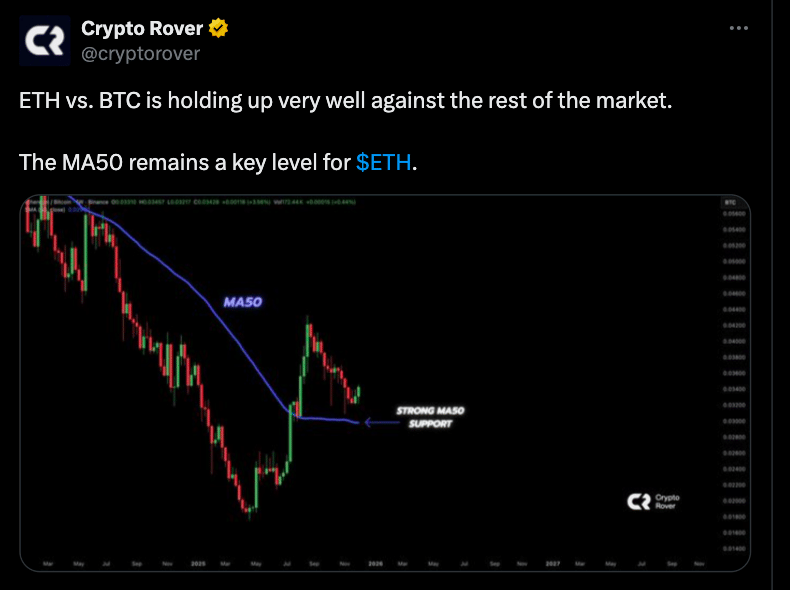
The ETH/BTC ratio also appears to be stable, with fresh data such as ETF inflows and holdings above its 50-day moving average suggesting that Ether may be poised to take another run at besting Bitcoin.
This has put the “Ethereum vs Bitcoin strength” story back on the radars of traders and investors.
Recent Market Moves: What the Charts Suggest
$ETH has seen some renewed interest over the past week. According to reports, Ethereum gained roughly $140 million from spot-ETF inflows, with large institutional investors leading the way.
This institutional interest comes as Ethereum has bounced and reclaimed MA50 on its chart, a short-term moving average that many traders view as an important support level.
Going off recent market data, 2025, $ETH has been between $3,100 and $3,200 in addition to the wider crypto market cap and not to mention BTC price stabilization after an episode of volatility.
Ethereum performance against altcoins sets high hopes, resuscitating fervor regarding its comparative performance.
These are signs that despite macro jitters and a widespread of liquidation pressure, $ETH is holding key structural support, strengthening the “Ethereum vs Bitcoin strength” case.
Why MA50 is Important – Technical Support and Market Psychology
To many traders and chart watchers, the 50-day moving average (MA50) is a battle line; it shows the medium-term trend, and often has acted as support during pullbacks. Ethereum holding above the MA50 in December makes the bullish bias credible.
Indeed, technical-analysis reports have highlighted a bullish price/MACD divergence and oversold conditions, meaning that $ETH may be shaping up to establish a recovery base.
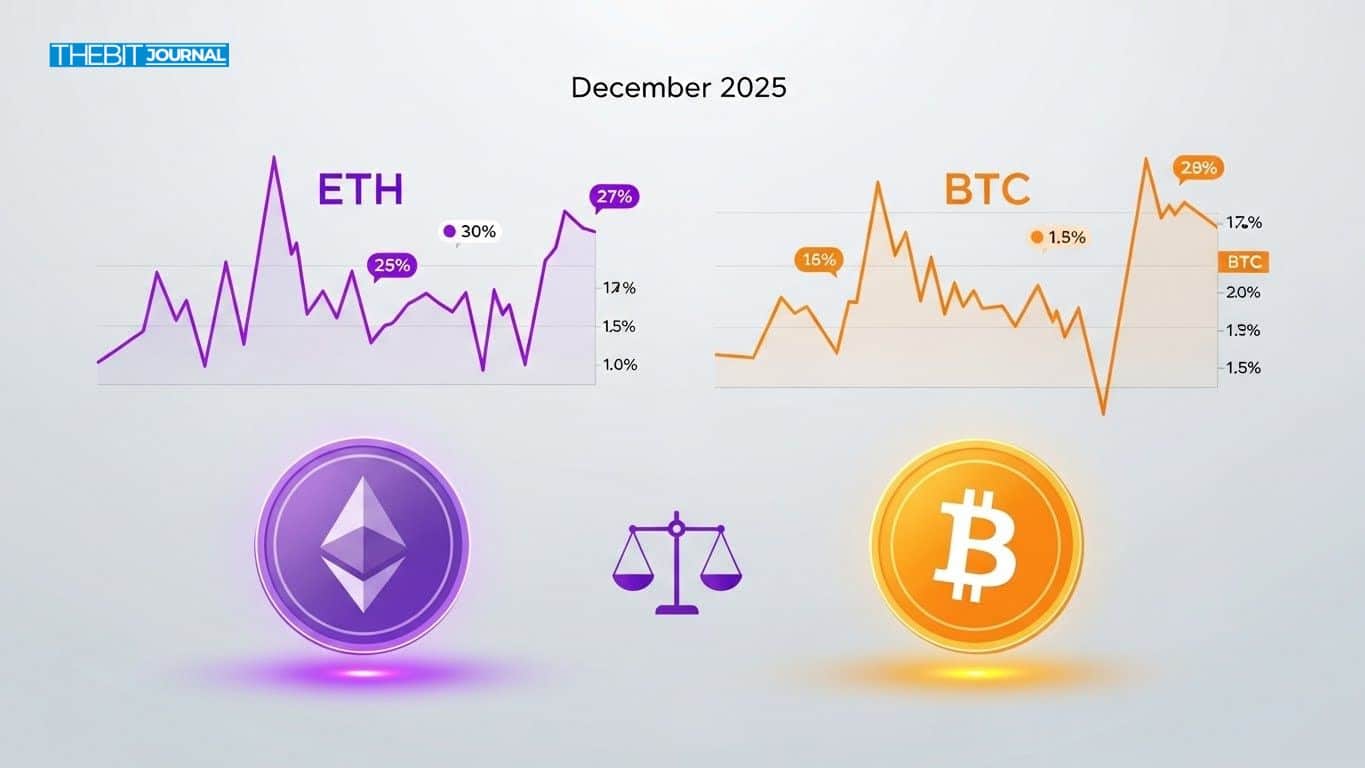
A short-term $ETH target of $3,300-$3,500 is being touted by some analysts if the momentum persists.
As the moving-average support is a popular metric among traders, holding on to MA50 can keep investor confidence high, also maintaining the counter-narrative theory that Ethereum may potentially outgain Bitcoin in the near future.
Institutional Flows and On Chain Fundamentals – Increased Confidence in ETH
Looking beyond technicals, Ethereum’s fundamentals are seemingly becoming favored by institutional and large investors. And as previously mentioned, some $140 million swept into Ethereum ETFs recently, evidence that institutions are not done with the space yet, despite lingering macro risks.
On-chain metrics and overall ecosystem growth are also helping to fuel ETH’s appeal. Though Ethereum has scaled and upgraded its network in series over the last number of years, it hasn’t stopped short of powering a wide range of DeFi, smart-contract and Layer-2 usage, attributes that set ETH apart from BTC and bolster its long-term strength.
Combining technical support, institutional demand and ecosystem fundamentals, this builds a more solid “Ethereum vs Bitcoin strength” story going into 2026.
What It Means for Traders and Investors – Positioning in Volatile Markets
For current ETH holders, this recent rebound and influx of institutions proves the point; holding onto $ETH while it experiences tumultuous ups and downs might not be as volatile a bet as some believe. The MA50 support can be used as a risk-management reference.
For those investors comparing ETH vs BTC, the developments suggest that Ethereum is not playing catch-up; it is finding its way. However, DYOR!
Conclusion
It is important to watch over the next few weeks, in order to see whether Ethereum does indeed have an edge over Bitcoin. Key indicators to monitor include:
Whether ETH maintains/surpasses/loses below its MA50 and what price does relative to this level.
Further inflows into ETH ETFs; may reopen institutional demand. On-chain metrics, network activity, smart-contract usage and Layer-2 transaction volume are signs of real rather than speculative demand.
If ETH leads an alt rally, then there could be an increase in the ETH/BTC pair. Macro events, interest-rate decisions, inflation figures, risk sentiment in global markets all have an impact on crypto flows overall.
So long as these indicators align, the “Ethereum vs Bitcoin strength” could continue to gain traction.
Glossary
MA50 – The 50-day moving average, which is a well-used technical indicator representing the average price of the last 50 days. It frequently serves as support or resistance in the market’s trend.
ETF inflows – Capital entering exchange-traded funds, which reflects investor demand for the underlying asset .
ETH/BTC ratio – A measurement of how Ethereum is doing as compared to Bitcoin; helps to determine which asset is performing the best over time.
MACD divergence – A technical signal that occurs when momentum indicators begin to diverge from a security’s price action, and is typically considered a reversal indicator.
On-chain activity – Transactions, smart-contract usage and network flow recorded on a blockchain, a signal of the real use rather than speculative trading.
Frequently Asked Questions About Ethereum vs Bitcoin Strength.
Why does MA50 matter for Ethereum today?
As MA50 represents the medium term trend, remaining above it suggests that ETH’s uptrend perhaps remain intact despite its recent volatility.
Does Ethereum actually look more powerful than Bitcoin currently?
The signals at the present, ETH/BTC stability, ETF inflows and ecosystem fundamentals, may favor ETH, albeit crypto is a volatile space by nature and results are never assured.
Is it safe to treat ETF inflows as indicative of long-term confidence?
Institutional pours tend to signal longer term interest since ETFs are popular with more conservative or strategic players, a potentially positive sign for $ETH’s future stability and mainstreaming.
What could derail ETH’s strength?
An abrupt drop below the MA50, renewed macro and regulatory stress, could release another bout of crypto-market-wide panic, which could challenge ETH’s relative momentum vs Bitcoin.
References
Coinpaper
TechStock²
CoinCodex
Blockchain News
MarketPulse
The Economic Times