

This article was first published on The Bit Journal.
The Sui blockchain has achieved a big feat as its Sui stablecoin total market cap exceeded $500 million. Also, as treasuries allocate capital in Sui’s DeFi ecosystem, they help to power deeper liquidity and economic activity without saturating spot markets, making stablecoins an activity driver on the network.
Treasury Evolution: From Passive to Active Protocol Roles
For much of history, many large crypto holders treated it as just an easy-to-use reserve asset, with occasional buying and selling.
A different model, however, is taking shape on Sui. On-chain analytics suggest that foundation-owned wallets remain the largest holders of SUI, while treasury-owned wallets tracked on explorers account for concentrated positions, including roughly 108 million SUI (about 3% of total supply).
This is important because these treasuries are taking governance actions and distributing liquidity through the ecosystem. The result of this treasury action affects both price and protocol trajectory. These entities define the growth of Sui’s ecosystem by voting on governance proposals and contributing to project incentives.
This transition from passive custody to active control is something new in how blockchain treasuries contribute to the long-term health of networks.
Stablecoins Drive Sui Growth
One important reason behind the recent growth has been the rapid rise of usage of stablecoins on the network, specifically USD-pegged tokens like USDC, which make up over 70% of all stablecoin liquidity on Sui.
This stablecoin liquidity recently reached about $500 million in market cap from on-chain data. Stablecoins are used as the base layer of lending, trading and DeFi yield generation, allowing investors to engage with financial products without being subjected into volatile price movements.
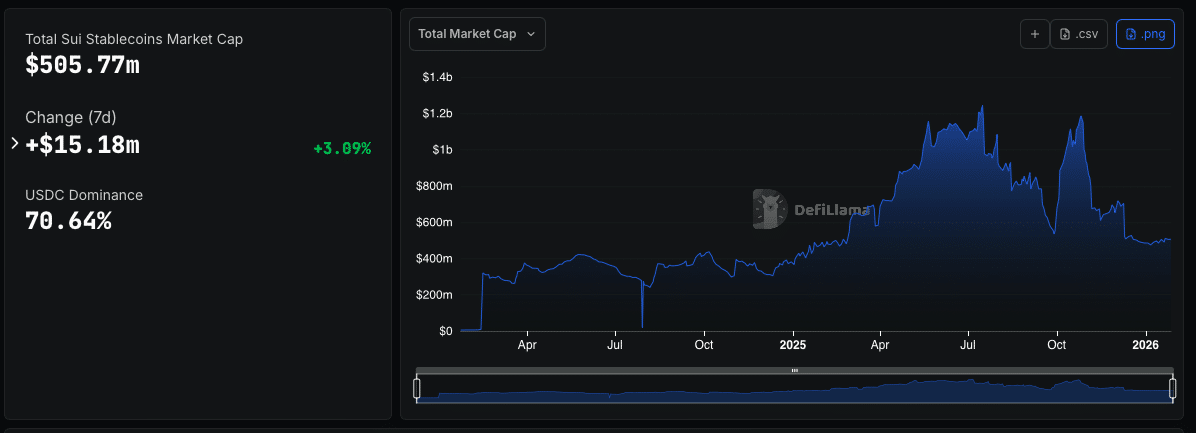
Stablecoins also enhance investor confidence because they provide a predictable unit of account and liquidity anchor. Unlike other volatile tokens, stablecoins let both retail and institutional users have a higher level of confidence when entering/exiting positions or partaking on yield strategies from protocol to protocol without the feeling that a larger price swing could happen again.
This main function of stablecoins has helped transform the Sui economy, where using stablecoins for lending and liquidity pools deepens market activity without creating excessive sell pressure on native tokens like SUI.
Treasuries have also played a role in driving this trend by deploying stablecoin capital to certain functions that support network usage such as liquidity mining, governance incentives and embedded DeFi protocol yield farms.
Yield Ground and Liquidity Expansion
The Sui stablecoin growth is also connected to increasing yields and a growing total value locked (TVL) in DeFi protocols on the network.
As of late January 2026, rates in Sui’s DeFi ecosystem ran from the low single digits on low-risk lending ones all the way to aggressively high double-digit rewards for incentive pools.
For instance, lending protocols like NAVI Protocol and Suilend offered 5-7% APYs on USDC deposits while DEX such as Cetus published yields over 70% from trading fees and liquidity mining incentives to showcase efficiency and liquidity depth.
This has attracted capital into Sui’s ecosystem. By locking up stablecoin liquidity into productive uses such as lending and trading pools, treasuries help reinforce on-chain liquidity and thus make it easier for users to perform transactions without having to worry about high slippage.
Ecosystem Growth and Protocol Activity
Sui’s expansion goes beyond the adoption of stablecoins. More general indicators including TVL and DEX activity show a thriving DeFi ecosystem.
TVL has been exploding into the billions of dollars in the Sui ecosystem, where top projects such as Suilend, Navi and Momentum are racking up volumes of assets. For example, Suilend alone managed to achieve hundreds of millions in TVL, while other protocols also experienced strong month-over-month gains in liquidity.
These DeFi primitives help in multiplying the effects of stablecoin liquidity by offering multiple channels for capital utility including lending, derivatives, automated market makers and yield farming.
Healthy protocol activity turns into network usage, which leads to new capital coming in that makes the system stronger via a feedback loop over time.
Meanwhile, Sui’s architecture which prioritizes speed and low fees has also enticed developers and projects in search of responsive settlement and composability for advanced DeFi products.
This technical foundation, as well as the actively participating treasury, will continue to grow Sui’s presence in the DeFi ecosystem.
Conclusion
Sui’s growth in 2026 is more than reaching a half-billion-dollar market cap. It embodies a structural transition in the way treasuries interact with blockchains, progressing from passive custodian of assets to active participants in governance, protocol execution and liquidity provision.
This transition has been brought about by stablecoin liquidity, which has provided the essentials needed for deeper DeFi engagement, strong yield opportunities and sustained ecosystem momentum.
Glossary
Sui stablecoin growth: the increase in the aggregate amount of stablecoins such as USDC transacting and leveraged on the Sui blockchain, supporting liquidity and DeFi applications.
Treasury wallets: blockchain addresses controlled by institutions or foundations which hold and distribute tokens such as SUI and stablecoins to give them use in the protocols.
Stablecoins: cryptocurrencies pegged to stable assets (often fiat currencies) that offer consistent value, enabling financial activities such as lending and trading.
Total Value Locked: the value of assets deposited in decentralized finance protocols, which signals its ecosystem utilization.
Yield: the reward or income produced from holding or contributing assets to DeFi activities, such as lending or liquidity pools.
Frequently Asked Questions About Sui Stablecoin Growth
What sent Sui stablecoin surging to $500 million?
The drivers were deep stablecoin liquidity (over 70 percent of which is USDC), an active treasury deploying into DeFi, and rising yields encouraging capital to remain on the network rather than moving back off to spot markets.
How does treasury activity differ now compared to before?
In contrast to past era, when treasuries were passively invested in assets, Sui treasuries are actively governing, providing liquidity, earning fees and using protocols.
What are the yields on Sui DeFi?
Yields vary by strategy, but a low-risk lender can expect 3% to 10% return yields on stablecoins, and higher (50%+) returns in incentivized pools which show protocol incentives and usage.
Why does Sui care about stablecoin liquidity?
Stablecoin liquidity increases market depth, lowers trading friction and allows for a variety of financial activities, including lending and trading without subjecting users to volatile token price movements.
References