






Last updated on, 19th July, 2026
The crypto market moves fast, and that speed can blur the line between real momentum and pure manipulation. For newer traders especially, a token that suddenly jumps 40% in a few hours can look like a golden chance. In reality, it can be a trap set by insiders who buy early, create artificial hype, and then unload on late buyers once the price spikes.
That pattern is not new, but in digital assets it spreads faster, hits harder, and often leaves almost no time for second thoughts. That is why learning how to identify a crypto pump and dump matters as much as learning technical analysis or market cycles.
In simple terms, a pump and dump scheme happens when a group artificially pushes up the price of a coin through hype, misleading claims, or coordinated buying, then sells into the rally while retail traders rush in. The result is usually ugly. Price collapses, liquidity vanishes, and the people who arrived last are left holding losses. A proper safety guide starts there, with the understanding that not every sharp rally is real demand and not every trending token deserves trust.
What a Crypto Pump and Dump Really Looks Like
A crypto pump and dump usually begins quietly as a small-cap token with thin liquidity starts getting attention in chat groups, influencer circles, or sudden social chatter. The message often sounds familiar. It is framed as a hidden gem, an early opportunity, or the next breakout before the wider market notices. Then the story picks up speed. Volume rises, the chart turns vertical, and fear of missing out does the rest.
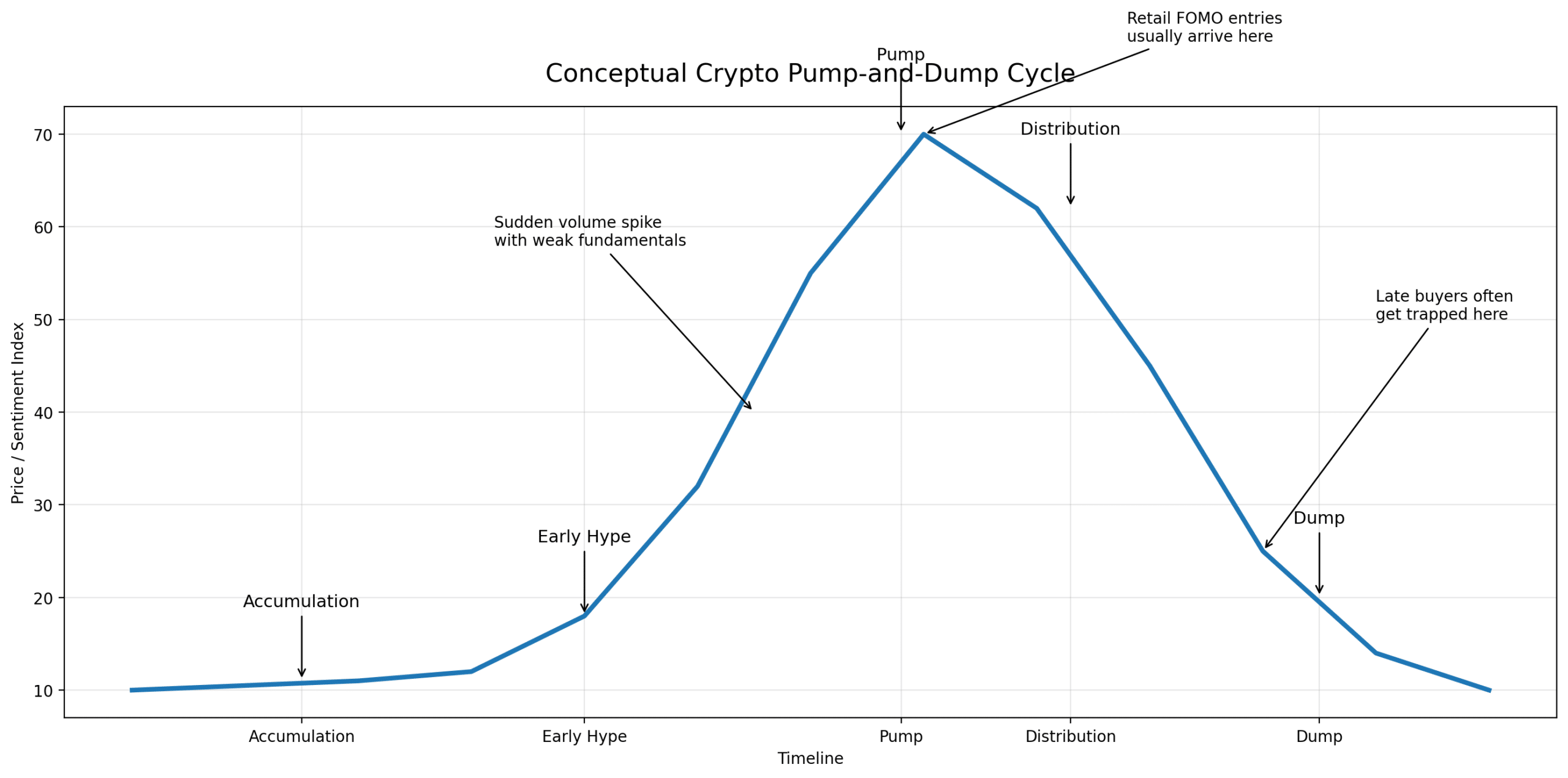
The problem is that the move often has no solid foundation behind it. There may be no product update, no credible team announcement, no major partnership, and no meaningful on-chain activity to support the surge. Price rises anyway because excitement becomes the product. That is the core of crypto pump and dump manipulation. It feeds on urgency, shallow research, and human emotion more than real value.
How a Crypto Pump and Dump Distorts Normal Market Signals
A crypto pump and dump is designed to make artificial demand look like genuine market interest. Organizers may accumulate a low-liquidity token before promoting it through private groups, social media accounts, paid influencers, or misleading announcements. Once new buyers push the price higher, early holders sell into the rising volume and leave late entrants exposed to the collapse.
Regulators including the U.S. Commodity Futures Trading Commission and FINRA have warned that sudden price tips, guaranteed-return language, coordinated online promotion, and pressure to buy immediately are common features of pump-and-dump activity. Traders should also remember that rising volume alone does not prove healthy demand.
In a crypto pump and dump, repeated trading between connected wallets, concentrated ownership, and shallow order books can create a false appearance of market strength. The safest approach is to verify the catalyst, examine who controls the supply, and check whether liquidity remains available when sellers begin exiting.
Educational Guide to Crypto Pump and Dump Warning Signs
| Warning sign | What it means | How it appears during a crypto pump and dump | What a careful trader should check |
|---|---|---|---|
| Sudden price acceleration | Price rises much faster than its normal trading pattern | Large green candles appear without a verified product update, listing, partnership, or adoption milestone | Compare the move with official announcements, broader market conditions, and the token’s previous volatility |
| Thin liquidity | Few buy and sell orders are available near the current price | A relatively small purchase moves the token sharply, while selling causes an immediate drop | Review order-book depth, liquidity-pool size, slippage, and the value that can be sold without moving price heavily |
| Concentrated token supply | A small number of wallets control much of the circulating supply | Early holders can coordinate sales and overwhelm retail demand near the top | Check top-holder percentages, team allocations, vesting schedules, exchange wallets, and linked addresses |
| Unusual volume spike | Trading activity jumps far above its normal level | The crypto pump and dump appears popular even though the increase may come from short-term churn or coordinated wallets | Compare volume across several exchanges and check whether activity continues after the first promotional wave |
| Aggressive social promotion | Marketing focuses on urgency rather than evidence | Anonymous accounts repeat price targets, guaranteed gains, or “buy before it is too late” messages | Look for disclosed sponsorships, credible sources, official documentation, and independent coverage |
| Weak project fundamentals | The token lacks a working product, active development, or transparent leadership | Promotion replaces measurable progress, and price becomes the project’s main selling point | Review the white paper, developer activity, audit history, roadmap progress, and team background |
| Insider exchange deposits | Large holders move tokens toward trading platforms | Organizers may be preparing to sell while public promotion remains bullish | Monitor large wallet transfers, exchange inflows, and whether deposits rise during the price surge |
| Rapid liquidity withdrawal | Funds supporting the trading pool are removed | Buyers may be unable to exit after the crypto pump and dump begins collapsing | Check whether liquidity is locked, who controls the pool, and whether the contract allows sudden withdrawal |
| Restrictive contract functions | Developers retain unusual control over token trading | The contract may allow minting, transfer blocking, high sell taxes, or wallet blacklisting | Use a contract scanner and review ownership, minting authority, fees, blacklist functions, and upgrade permissions |
| Price collapse after promotion | Early buyers sell once retail demand peaks | The token falls sharply as liquidity disappears and stop-loss orders accelerate the decline | Avoid chasing the first rebound and reassess volume, liquidity, wallet activity, and the original catalyst |
A single warning sign does not always confirm a crypto pump and dump. The risk becomes more serious when several signals appear together, particularly concentrated ownership, unexplained volume, aggressive promotion, insider transfers, and weak liquidity.
The First Red Flag Is an Unnatural Price Spike
One of the clearest warning signs is a coin that shoots up too far, too quickly, without a believable reason. Healthy rallies often build in stages. They may pull back, consolidate, and continue as buyers and sellers test conviction. A manipulated move is different. It can feel almost theatrical. A token with low daily volume suddenly doubles, triples, or posts massive candles in a short window.
That does not automatically prove a crypto pump and dump, but it should trigger caution. When price action looks detached from actual news, traders need to ask a simple question: who benefits from this move, and who is being left behind? That question saves money more often than any fancy indicator.
Watch the Volume, Liquidity, and Holder Structure
Volume matters, but so does the quality of that volume if a token shows a sharp jump in trading activity while liquidity remains shallow, the price can be moved with relatively little capital. That creates the perfect setup for manipulation.
Holder concentration is another clue as when a few wallets control a large share of supply, the market becomes fragile. A token can look strong on the chart while actually sitting on a powder keg. Once those large holders sell, the drop can be brutal. In many suspected crypto pump and dump cases, concentration risk hides beneath the excitement. Traders who skip that check are often trading the story, not the market.
Hype Without Substance Is a Classic Trap
The language around these schemes tends to repeat itself: promoters promise guaranteed upside, claim the coin is about to explode, or insist that it is still early even after a huge move. The tone is breathless, not analytical. Real projects usually speak through product progress, development, adoption, and measurable milestones. Scam-driven promotion leans on emotion, repetition, and pressure.

That is why Spotting Crypto Pump and Dump Scams: A Safety Guide is really about learning to separate noise from evidence. If the loudest claims revolve around price targets instead of utility, token design, security, or governance, something is off. Markets can be irrational for a while, but empty hype rarely holds together for long.
Social Pressure Is Often Part of the Scheme
Many victims do not get pulled in by charts alone as they get pulled in by community momentum. A room full of excited traders can make reckless behavior seem normal. The rush feels like a crowd sprinting toward an open door. Nobody wants to be the person still standing outside, thinking.
That emotional pressure is exactly why a crypto pump and dump works so well. It turns hesitation into weakness and caution into regret. The most effective defense is distance. If a trader feels pushed to buy immediately, avoid questions or trust anonymous calls; the setup already looks unhealthy.
How Traders Can Protect Themselves
A trader should check whether price growth matches real catalysts. They should review market cap, liquidity depth, token distribution, and recent wallet behavior. They should also examine whether the project has a credible use case, visible leadership, active development, and transparent communication.
Another useful habit is avoiding coins that move on rumors alone. In a genuine market breakout, evidence usually exists somewhere beneath the noise. In a crypto pump and dump, the noise is often the entire engine. Traders who slow down and demand proof usually avoid the worst damage.
Conclusion
Crypto offers real opportunity, but it also attracts manipulation because excitement travels faster than verification. Pump and dump schemes thrive where traders stop asking basic questions. A sharp rally, loud promotion, and a trending chart can look convincing in the moment, yet markets built on pressure and illusion usually crack the same way they rise. The safest approach is not cynicism, it is discipline. When traders learn to identify a crypto pump and dump, they protect more than capital. They protect judgment, which is what keeps them in the market long enough to find real opportunities.
FAQs
What is a pump and dump scheme in crypto?
It is a coordinated effort to push a token’s price up artificially and then sell into the rally, leaving late buyers with losses.
Are all fast-rising tokens scams?
No. Some rally on real news or adoption, but sudden price spikes without substance deserve careful scrutiny.
Why are small-cap tokens easier to manipulate?
They often have lower liquidity and fewer active buyers, which makes price easier to move with limited capital.
Can on-chain data help spot manipulation?
Yes. Wallet concentration, unusual transfer patterns, and weak liquidity can reveal hidden risk.
What is the safest response to hype-driven buying pressure?
Pause, verify the catalyst, review the token structure, and avoid emotional entries.
Glossary of Key Terms
Crypto pump and dump: A manipulation scheme where price is inflated artificially before insiders sell.
Liquidity: The ease with which a token can be bought or sold without causing a major price swing.
Market cap: The total value of a token’s circulating supply at the current price.
Holder concentration: The percentage of supply controlled by a small number of wallets.
FOMO: Fear of missing out, a common emotional driver behind poor trading decisions.
Volatility: The speed and size of price movement over a given period.
Sources
Disclaimer: This content is for educational and informational purposes only and does not constitute financial or investment advice. Cryptocurrency markets carry significant risk, and traders should conduct independent research before making any decision.