






Margin calls are the kind of plumbing issue that turns into a headline overnight. When leverage piles up across markets, the selloff starts where risk is highest and liquidity is thinnest, then spreads because traders need cash quickly. That is the backdrop for the latest market crash, where crypto and precious metals slid together and correlations stopped behaving.
Bitcoin fell about 24% in roughly a week, sliding from around $90,076 to as low as $65,700. Silver dropped around 34% in a similar window, gold fell more than 6%, and the dollar index rose while risk assets weakened. This market crash is pushing investors to focus on mechanics, not slogans.
Why this market crash looks like forced selling, not a simple sentiment wobble
Declines can come from choice or compulsion as choice is when investors change their view. Compulsion is when a broker, a clearinghouse, or a risk desk decides the position is too large for the collateral behind it. This market crash has carried the fingerprints of compulsion, especially in metals.
After extreme volatility, margin requirements on silver futures were raised, increasing collateral per contract and squeezing leveraged longs. When margin rises, effective leverage falls, and traders are pushed into the same tight hallway: add cash, cut size, or close.
In a stressed tape, many do not have spare cash ready, so they sell, and the selling starts to snowball. During a market crash, liquidity becomes one pool, and crypto is often the quickest way to raise it.
Bitcoin’s breakdown: key levels and what the tape is signaling
Bitcoin’s decline has looked like step-downs with brief pauses, then another flush. Traders have fixated on $73,600 as a psychological marker because losing prominent prior levels can flip the market’s posture from buying dips to selling rallies. Below that, $56,100 is being watched as the next major shelf, largely because it acted as a repeat test zone in prior trading. If the current market crash remains driven by deleveraging, those historical shelves tend to attract bids, even if only temporarily.
Order-book liquidity has mattered as much as any chart. When bids thin out, the same sell order moves price further, and the bounce that follows can look real until the next wave of risk reduction hits. In a market crash, that stop-and-go behavior is common because traders keep checking whether forced selling is finished, then step back when it is not.
ETF flows and the demand signal that stopped cushioning dips
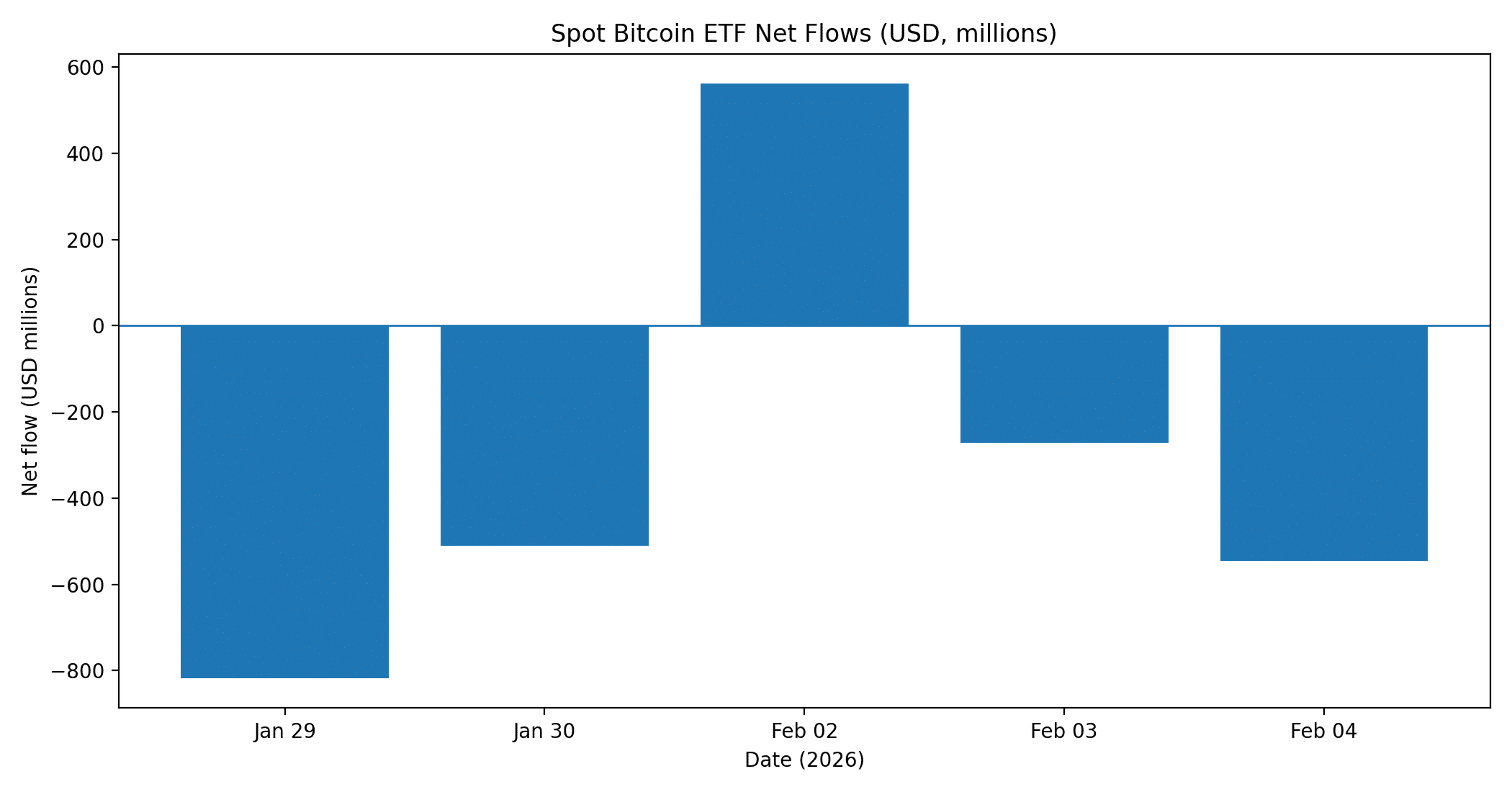
Spot Bitcoin ETFs have become a daily read on incremental demand as when flows are persistently negative, rebounds often struggle because there is less structural buying to absorb sell pressure, and that dynamic has deepened this market crash.

Around the latest leg down, the flow tape swung hard: roughly -$817.8M on Jan. 29, -$509.7M on Jan. 30, a brief +$561.8M on Feb. 2, then -$272.0M on Feb. 3 and -$544.9M on Feb. 4. One green day did not change the trend, and choppy, heavy flows can make positioning fragile.
Inflation risk and policy gravity
The Federal Reserve’s January 28 implementation note kept the federal funds target range at 3.5% to 3.75%, reinforcing that policy is still sensitive to inflation.
A January 2026 analysis from a policy research institute argued that inflation could surprise higher in 2026, potentially above 4% by year-end, citing tariff pass-through, fiscal dynamics, labor supply pressures, and expectations. Federal Reserve research has also described how higher trade costs and disruptions can lift CPI inflation. When that conversation heats up, risk assets tend to behave like they are on a leash, which can prolong a market crash.
An IMF analysis described resilience after tariff shocks while warning about risks that build over time, and another policy analysis highlighted how tariff threats can keep uncertainty elevated. Uncertainty feeds volatility, and volatility makes leverage more expensive.
Conclusion
Fast rebounds arrive when selling pressure is exhausted and fresh buyers show up with real market cash. Slower rebounds happen when selling is structural, tied to deleveraging, margin mechanics, and persistent outflows. Right now, the evidence looks closer to structural, which is why the market crash has stayed stubborn.
A healthier recovery will likely need sustained positive ETF inflows, calmer inflation expectations, or a clear easing in cross-asset stress that reduces the need to raise cash. Until then, traders may keep treating rallies as tests, and the market crash narrative will remain the lens for price action.
Frequently Asked Questions (FAQs)
Why did Bitcoin fall alongside silver and gold?
Because leverage links markets through collateral. When margin requirements rise and volatility spikes, traders sell liquid assets to raise cash, and crypto often becomes a source of quick liquidity.
Do ETF outflows “cause” a market crash in Bitcoin?
They are not the only driver, but persistent outflows can remove a steady source of demand. In a stressed tape, that can make declines sharper and rebounds weaker during a market crash.
What is the clearest sign that the worst is passing?
Stabilizing volatility plus a run of consistent inflows is a strong combination. It signals that forced selling is fading and buyers are willing to add exposure deliberately.
Glossary of key terms
Margin requirement
The collateral required to hold a leveraged futures position, often raised during volatile periods.
Margin call
A demand for additional collateral when losses or volatility increase, forcing a trader to add cash or reduce exposure.
Spot Bitcoin ETF flows
Daily net creations or redemptions in spot Bitcoin ETFs, used as a proxy for incremental demand.
DXY
A measure of the U.S. dollar against a basket of major currencies, often used as a liquidity and risk-sentiment proxy.
Trade disruption inflation
Inflation pressure that arises when tariffs, supply shocks, or higher trade costs raise prices through supply chains.
Sources